The 6 Reasons Hayes Rental Properties Could Inflation-Proof Your Savings

  • Inflation (and recessions) can be nerve racking for people and their hard-earned savings and wealth.
  • Yet there are six reasons which make investing in private rental properties a potentially wise investment in these changeable times.
  • This article looks at how investing in Hayes property could help you ‘hedge’ against inflation and protect your savings and wealth against the possible recession.

The cost-of-living predicament is threatening the budgets of many Hayes households.

Inflation is running at 7.8%, yet the best savings rates in the market are only 2.75% (because of low Bank of England interest rates). This means that the value of people’s savings is falling fast.

To add insult to injury, the possibility of a recession on the horizon could add another nail in the coffin of people’s wealth and savings.

Looking back at the last recession (ignoring the 2020 Covid recession), the Stock Market (FTSE index) dropped 40.1% during the Credit Crunch (2008/9) — scarcely a soothing thought if you worry about a recession looming in the next couple of years.

A recession can have a catastrophic impact on household budgets, as a weaker economy characteristically means that salaries drop, and people get made redundant.

So, why do I suggest Hayes rental properties will help to protect your wealth and hedge against inflation?

Hayes rentals aren’t perfect, yet in many ways, they go a long way to help – let me tell you why.

  1. One of the most significant benefits of investing in residential property is to hedge against inflation. An ‘inflation hedge’ is an investment that defends against the decreased purchasing power of your money that results from the loss of its worth/value due to inflation.

The last time the UK suffered high and persistent inflation was the 1970s.

In 1973, the average British house was worth £9,942. In 1980, that same house was worth £23,287. If the same £9,942 had been invested instead in the stock market in 1973, it would have been worth £19,384 in 1980.

So how did that compare to inflation?

Neither property nor the stock market beat inflation in those seven years (as the goods and services of that £9,942 in 1973 had risen to £25,897 by 1980).

But investing in the stock market between 1973 and 1980, that stock market investor would have lost 25.2% of their investment in ‘real terms’, compared with only 10.1% for property investors.

However, there was the bonus of seven years’ worth of rent!

To give you some idea of what that would be worth in today’s figures (even if the rent didn’t go up during that time frame) …

The average Hayes landlord will earn £120,204 in rent over seven years.

  • Rental properties have repetitive, regular monthly income, whilst dividends from the stock market are dependent on there being profits which, in a recession, can be hit and miss.
  • Existing Hayes landlords know that the rents their rental properties achieve don’t historically decline during recessions in the medium term.

In 2008, Hayes rents dipped by 5.2%, yet they soon bounced back a year later.

And even if average rents do go down, every rent is fixed at the start of the tenancy. Also, it is infrequent for a tenant to negotiate a reduction in rent mid-tenancy even if average rents did drop.

  • Property prices sometimes fall during recessions.

In the 2008 Credit Crunch recession, property values in the borough of Hillingdon dropped 18.04%.

Dropping from £266,873 at the peak in January 2008 to £218,722 in April 2009 (before they started to rise again).

Yet as I stated above, the Stock Market dropped 40.1% with the Credit Crunch. Also previously, the Stock Market dropped 36% on Black Monday before the early 1990’s recession and 55.3% in 1974.

Which sort of drop would you prefer?

  • (Almost) guaranteed rental payments. Insurance can be taken out for rental payments (you can’t get that on stocks and shares). Also, the government will cover most (or all) of the rent when someone is made redundant and needs to apply for social security.
  • For those Hayes landlords who take a mortgage, inflation can be a benefit. The first is the effect of inflation on mortgage debt. As Hayes house prices rise over time, it reduces the loan to value percentage of your mortgage debt and increases your equity. You will receive a lower interest rate when you re-mortgage in the future because of the lower loan to value percentage.

Also, as the equity in your Hayes rental property increases, assuming you fix your mortgage, your payments stay the same.

Finally, inflation also helps Hayes buy-to-let landlords because rents tend to increase with inflation. So as rents go up, your fixed-rate buy-to-let mortgage payments stay the same, creating the prospect of more significant profit from your buy-to-let investment.

Yet, there are downsides to renting.

Rent arrears can be a worry though. However, during 2021, landlords who used a letting agent were, according to an investigation from Denton House Research, 272.5% less likely to be in arrears of two months or more.

One of the biggest reasons is the more stringent tenant referencing that letting agents tend to do compared to landlords who do it themselves. At our agency, we like to reference tenants carefully for job security, stability, and any history of non-payment on rents, always liaising with previous landlords/agents to see they were a good tenant.

That is why many tenants with a poor tenancy record are attracted to properties that are not through agents, as they know most (not all) DIY landlords don’t reference their tenants as thoroughly as letting agents do. Solid referencing is not a 100% guarantee you won’t get rent arrears or have your rental property trashed, yet it will go a long way to mitigate it.

One of the things about investing in Hayes rental properties is that buy-to-let investors have more control over their returns than stock market investors do. Buy-to-let provides long-term stability and constant income to counterweight the massive swings seen in the FTSE stock market.

There is something reassuring about touching and feeling your investment – the ‘bricks and mortar’.

You must make your own decision when investing in the private rental market in Hayes. If you’d like to chat over the phone for five or ten minutes to discuss where I would be investing in the Hayes property market, don’t hesitate to send me a message or pick up the phone.

How are you planning for the spectre of a potential recession?

Has the Hayes Property Market Peaked?

Should you buy now or wait for the bargains?

  • Many commentators believe we have seen the peak of the Hayes property market.
  • So, should savvy bargain hunters wait for Hayes house prices to fall?
  • Or could postponing your house buying for any anticipated Hayes house price drop be a costly mistake?

Over the last two years, the Hayes property market has been a rollercoaster ride of hyperactive demand together with the new sport of getting your offer accepted when you compete with 30 other bidders.

Yet there are clouds on the horizon that the

Hayes property market could be at its peak.

Bank of England interest rates have increased four times in the last few months to try and combat inflation.  Meanwhile, many Hayes households are finding it tough to counter the most significant drop in real incomes in a single year since records began in the mid-1950s, all at the same time as gas, heating oil and electricity prices are predicted to rise again in the autumn.

Hence why some economists are predicting house price drops in the coming 18 to 24 months of 3% to 5%.

So, surely this is not the best time to buy a Hayes property – and surely savvy buyers should wait for Hayes house values to fall?

Is it realistic to see double-digit national house price growth? Certainly not.

The question is how far the Hayes property market will slow and whether the slowing will drop into modest falls.

Let me look at household income first.

At best, the outlook is gloomy as real household disposable income is set to drop by 2.4% in 2022/23, the largest drop since records began in 1956 this is despite the £17.6 billion of financial support for British households revealed in Rishi Sunak’s Spring 2022 Statement with the National Insurance thresholds, energy bill support package and duty cut on petrol. Without these changes announced by the Chancellor, real household disposable income would have fallen by an additional 1% in 2022/23.

Secondly, as interest rates increase, mortgage rates will increase in line, increasing mortgage costs, so surely that will curtail demand, meaning Hayes house prices will drop, and buyers should wait to catch a bargain?

Finally, with inflation on the rise, the real value of people’s savings will decrease quicker, and the value of their deposits will diminish meaning Hayes prices will surely drop, and people should wait to buy?

Surely the Hayes property market has peaked and

buyers should wait for the bargains?

Well, I don’t think so, and these are the reasons why I say that.

I believe, subject to no significant shocks in the world economy, Hayes house price growth will be very slow in the next 18/24 months and go into low single digits (even the odd month dipping ever so slightly into the red), but not the 16% to 19% annual drop we saw in 2008/9.

Let me look at real household income. Every economist predicts growth in real household income in 2023/24 by around 1%.

If the two years are combined, the predicted effect on real household income in the next two years (2022/23/24) is a net loss of 1.4%, whilst in the credit crunch years 2010/11/12, the net loss was 2.7%.

I was looking at the increase in mortgage rates. 79% of owner-occupiers have fixed their mortgage costs and had their affordability stress-tested to Bank of England interest rates of 3% to 4% under the Mortgage Market Review rule changes in 2014. I believe the most significant impact of increasing interest rates will be at the point of taking on a new mortgage by first-time buyers (as opposed to servicing or the porting of an existing mortgage from one house to the next house).

The four successive Bank of England base rate rises, inflation and the rising cost of living are likely to bring more cautiousness over summer and autumn when it comes to people buying a property. Yet, there is still a massive imbalance of demand for property over the number of properties for sale to quench that demand.

The potency of the job market and the ongoing mismatch between the supply of properties (mentioned in last week’s article on the Hayes property market) on the market and demand for those properties will support property values.

Finally, the by-product of increasing inflation is that it makes buy-to-let more attractive. If there is a reduction in first-time buyers, this will be counterweighted by more landlords buying again, supporting the current level of Hayes properties.

But what if Hayes house prices do drop significantly?

So let’s assume that Hayes house prices do fall, irrespective of the reasons above, it will not inevitably help Hayes buyers.

If we have a house price crash, people tend to find their careers are at risk, and their salaries don’t rise as much. The younger generation (i.e. first-time buyers age range) often gets hit the toughest by recessions.

If first-time buyers wait until 2024 to buy and Hayes property values drop by 10%, that will prove more expensive.

In the last 2008/09 crash, lenders weren’t offering 5% deposit mortgages. The lowest deposit mortgage that first-time buyers could get was with a 10% deposit and even then, they were hard to come by.

When writing this article, first-time buyers can obtain a 5% deposit mortgage for a fixed rate of 2.66% for five years.

The typical first-time buyer apartment in

Hayes sells for £268,200.

So, if they were to buy now, on this mortgage deal, the first-time buyer would have to stump up a £13,410 deposit and their mortgage payments would be £932.86 per month.

Yet, let’s say property values in Hayes do drop by 10% in the next 18 months, the apartment would now be worth £241,380, so a significant saving. Or is it?

Everyone believes interest rates will rise further, so let’s assume they go to 3% by the autumn of 2023. That means the mortgage rate for a 10% deposit mortgage will be in the early 5%’s, so let me assume 5.29% (because the banks tend to increase the gap between the base rate and the mortgage rate in recessions to allow for the extra risk).

The monthly mortgage payment on the 5.29% mortgage would be £1,136.90 per month, and you would need to nearly double your deposit to £24,138.

So even if Hayes’s house prices did drop by 10%, the first-time buyer would be £2,450 worse off a year in mortgage payments and would have to find double the deposit.

… and then there is the other cost of waiting.

You have two years’ worth of rent to pay. The average rent for a Hayes property is £1,468 per month.

If you waited a couple of years for Hayes house prices

to drop by 10%, you would spend £35,232 in rent.

Choosing to buy a Hayes property makes even more economic sense if it is a long-term choice, as homeowners can ride out any house price drops.

Homeowners who plan to stay in a property can generally rely on getting their money back within six to ten years whilst not paying any rent.

Will Hayes prices go up, or will they go down?

Remember, George Osbourne said house prices would drop by 18% in May 2016 if we voted to leave the EU, whilst many economists said they would drop by 5% to 10% when Covid hit in March 2020.

And we all know what happened.

If you think you will be better off owning your own Hayes home rather than renting one, don’t bother to wait for the suggested house price drop that may never happen.

These are my thoughts, what are yours? Let me know in the comments.

Hayes Property Market to Crash in 2022?

  • According to some newspapers and pundits, the property market boom could soon be over with the increasing interest rates and inflation.
  • In this article, I share the 3 fundamental economic reasons why things are different to the last property market crash.
  • The insider’s way to find out if there will be a property crash.
  • …and 4 reasons why buy-to-let landlords are coming back into the Hayes rental market to protect their wealth and hedge against inflation.

With inflation and the cost-of-living crisis, some say this could cause property values to drop, by between 10% and 20% in the next 12 to 18 months.

There can be no doubt that the current Hayes property market is very interesting. 

At the time of writing, there are only 297 properties for sale in Hayes (the long-term 15-year average is between 310 and 330), meaning house prices have gone up considerably.

According to the Land Registry…

Hayes property prices have increased by 5.4%

(or £23,000) in the last 12 months.

So, as Robert Kiyosaki says, ‘the best way to predict the future is to look to the past’. I need to look at what caused the last property crash in 2008 and how that compares to today.

  1. Increase in Interest Rates

One reason mentioned as a possible cause of a crash is the rise in the Bank of England interest rates affecting homeowners’ mortgages.

Higher mortgage rates mean homeowners will have to pay a lot more on their mortgage payments, leaving less for other household essentials. In 2007 (and the 1989 property crash), many Hayes people put their houses up for sale to downsize to try and reduce their mortgage payments.

Yet the newspapers fail to mention that 79% of British people with a mortgage have it on a fixed interest rate

(at an average mortgage rate of 2.03%).

Also, just under 19 out of 20 (93.2%) of all UK house purchases in 2021 fixed their mortgage rate. 

So, in the short to medium-term (two to five years), most homeowners won’t see a rise in mortgage payments for many years. Also, 27.8% of all UK house purchases were 100% cash (i.e. no mortgage).

Of the 932,577 house purchases registered since February 2021 in the UK, 259,205 were bought without a mortgage.

Yet some people say this will be a problem when all these homeowners come off their fixed rate. The mortgage lending rules changed in 2014, and every person taking out a mortgage would have been assessed at application as to whether they could afford their mortgage payments at mortgage rates of 5% to 6% rates, not the 2% to 3% they may well be paying now.

No pundit says the Bank of England interest rates will go above 2% with a worst-case scenario of 3%. If the Bank of England did raise interest rates to 3%, homeowners would only be paying 4.5% to 5.5% on their mortgages and thus well within the stress test range made at the time of their mortgage application.

This means the probability of a mass sell-off of Hayes properties or Hayes repossessions because of interest rate rises (both of which cause house prices to drop) is much lower.

  • House Price / Salary Ratio

Another reason being bandied about by some people for another house price crash is the ratio of average house prices compared to average wages.

The higher the ratio, the less affordable property is. In 2000, the UK average house price to average salary ratio was 5.30 (i.e. the average UK house was 5.3 times more than the average UK salary). At its peak just before the last property crash in 2008, the ratio reached 8.64.

The ratio now is 8.85, so some commentators are beginning to think we’re in line for another house price crash. However, I must disagree with them because mortgage rates are much lower today than in 2007. For example…

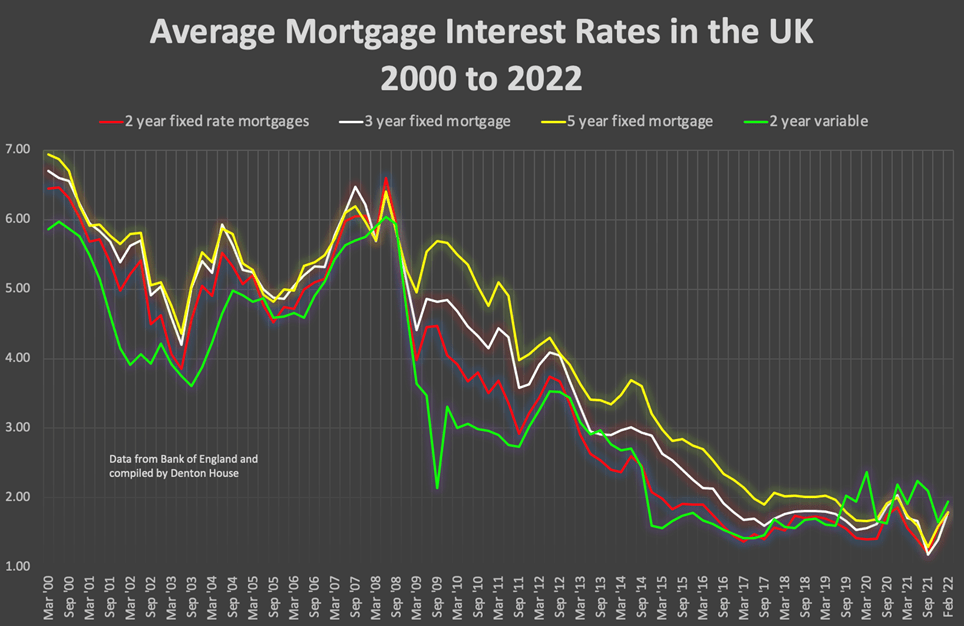
The average 5-year fixed-rate mortgage in 2007 was 6.19% (just before the property crash), yet today it’s only 1.79%.

So, whilst the house price/salary ratio is the same as the last property crash in 2008, mortgages today are proportionally 71.1% cheaper.

  • Banks Reckless Lending

Another reason for a property crash in 2008 was the reckless lending practices in the run-up to that crash.

The first example of reckless lending was self-certified mortgages. A self-certified mortgage is when the lender doesn’t require proof of income.

In 2007, 24.6% of new mortgages were self-certified mortgages.

So, when the economy got a little sticky in 2008, the people that didn’t have the income they said they had to pay for their mortgages (because they were self-certified) promptly put their properties on the market.

The banks’ second aspect of reckless lending was how much they lent buyers to buy their homes. Today, banks want first-time buyers to have at least a 10% deposit and ideally more. There are 95% mortgages available now (meaning the first-time buyer only requires a 5% deposit), yet they are pretty challenging to obtain.

Back in 2005/6/7, Northern Rock was allowing first-time buyers to borrow 125% of the value of their home. Yes, first-time buyers got 25% cashback on their mortgage!

In 2007, 9.5% of all mortgages were 95%, and 6.1% of mortgages were 100% to 125%.

Meaning that nearly 1 in 6 mortgages (15.6%) taken out in 2007 had a 95% to 125% mortgage.

When the value of a property goes below what is owed on the mortgage, this is called negative equity. A lot of Hayes homeowners with negative equity (or who were getting close to negative equity) in 2008 panicked because of the Credit Crunch and put their houses up for sale.

To give you an idea of what happened last year (2021) regarding mortgage lending, only 2.4% of mortgages were 95%, and 0.2% of mortgages were 100%. This is because the mortgage lending rules were tightened in 2014.

So why did Hayes house prices drop in 2008?

Well, in a nutshell, a lot more Hayes properties came onto the market at the same time in 2008, flooding the Hayes property market with properties to sell.

Meanwhile, mortgages became a lot harder to obtain (because it was the Credit Crunch), so we had reduced demand for Hayes property.

Prices will drop when we have an oversupply and reduced demand for something. Hayes property prices fell by between 16% and 19% (depending on the property type) between January 2008 and May 2008.

So, what were the numbers of properties for sale in Hayes during the last housing market crash?

There were 330 properties for sale on the market in Hayes in the summer of 2007 (just before the crash), whilst a year later, when the Credit Crunch hit, that had jumped to 558.

This vast jump in supply and the reduction in demand caused Hayes house prices to drop in 2008.

Compared with today, there are only 297 properties for sale in Hayes, whilst the long term 15-year average is between 310 and 330 properties for sale.

So, what is going to happen to the Hayes property market?

The Hayes house price explosion since we came out of Lockdown 1 has been caused by a shortage of Hayes homes for sale (as mentioned above) and increased demand from buyers (the opposite of 2008).

However, there are early signs the discrepancy of supply and demand for Hayes properties is starting to ease, yet this takes a while before it has any effect on the property market, so it will be some time before it takes effect.

This will mean buyer demand will ease off whilst the number of properties to buy (i.e. supply) increases. This should gradually bring the Hayes property market back in line with long-term levels, rather than the housing market crash.

My advice is to keep an eye on the number of properties for sale in Hayes at any one time and only start to worry if it goes above and beyond the long-term average mentioned.

But before I go, I need to chat about what inflation and the cost of living will do to the Hayes property market.

How will inflation and cost of living affect the Hayes property market?

There is no doubt that cost-of-living increases will have a dampening effect on buyer demand. If people have less money, they won’t be able to afford such high mortgages. This will slow Hayes house price growth, especially with Hayes first-time buyers.

Yet, the reduction in first-time buyers is being balanced out by an increase in landlord’s buying, especially at the lower end of the market.

This, in turn, will stabilise the middle to upper Hayes property market. This means the values of such properties (mainly Hayes owner-occupiers) will see greater stability and a buyer for their home, should they wish to take the next step on the property ladder.

So why are more Hayes landlords looking to extend their buy-to-let portfolios, even in these economic circumstances?

I see new and existing buy-to-let Hayes landlords come back into the market to add rental properties to their portfolios. As the competition with first-time buyers is not so great, they’re not being outbid as much.

Yet, more importantly, residential property is a good hedge against inflation.

Firstly, in the medium term, property values tend to keep up with inflation.

Secondly, inflation benefits both landlords and existing homeowners, with the effect of inflation on mortgage debt. As Hayes house prices rise over time, it reduces the loan to value percentage of your mortgage debt and increases your equity. When the landlord/homeowner comes to re-mortgage in the future, they will receive a lower interest rate.

Thirdly, as the equity in your Hayes property increases, your fixed-rate mortgage payments stay the same.

Finally, inflation also helps Hayes buy-to-let landlords. This is because rents tend to increase with inflation. So as rents go up, your fixed-rate buy-to-let mortgage payments stay the same, creating the prospect of more significant profit from your buy-to-let investment.

Hayes Rental Homes Nightmare

  • Hayes needs 146 additional private rented properties per year to keep up with current and future demand from Hayes tenants.
  • Yet over the last 5 years, Hayes has lost 250 private rented homes.
  • What are the 5 reasons the supply of private rental properties in Hayes are falling? What does this mean for tenants and landlords in Hayes?

There has been a rise in demand for rental properties and an 8.9% fall in the number of Hayes private rented properties, which has caused Hayes rents to rise by 11.2% in the last year, a new all-time high. 

The National Residential Landlords Association asked the respected economics think tank, Capital Economics, to carry out research on the UK rental market. It found that if the current trends in the property market in terms of growth of the population, Brits living longer, the lack of new homes building and the reduction in social housing (aka council housing) then demand for homes in the private rented sector needs to increase by 227,000 homes per year. 

So, based on those numbers, Hayes needs to have an additional 146 private rented properties per year.

The problem is the number of private rented properties in Hayes has reduced from 4,682 in 2017 to 4,432 in 2021, a net loss of 250.

So, why has supply of private rented homes in Hayes reduced?

  1. Section 24 Income Tax

Section 24 was introduced in 2017 to level the playing field on the taxation of property between homeowners and landlords. Section 24 stops landlords from offsetting their buy-to-let mortgage costs against the profits from their rental property. Interestingly, no other kind of UK business is affected by the Section 24 taxation. In other words, whatever other form of business you might be in, be it butcher, baker or candlestick maker, every other business can offset their finance costs against their profits, except buy-to-let.

The issue caused by Section 24 Tax is that some landlords ended up paying more income tax than they really made in profit after paying their buy-to-let mortgages. Meaning on the back of rising Hayes house prices in the last five years, some Hayes landlords have sold their buy-to-let investments.

2. 3% More Stamp Duty for Landlords

When someone buys a property, they normally must pay a tax to the Government for the privilege. This tax is called Stamp Duty. Yet landlords must pay an additional 3% stamp duty supplement on top of that when they purchase a Hayes buy-to-let property. Evidence suggests some Hayes landlords have decided to hold off or scale back buying additional buy-to-let properties for their portfolio because of the thousands of extra pounds that landlords have to pay to buy the rental property.

3. Holiday and AirBnb Lets

Some Hayes landlords are converting their long-term rental properties into short-term furnished holiday and AirBnB properties. Whilst the hassle, stress and service levels are much higher, these types of properties do tend to make more money and aren’t as heavily taxed as normal lets. When properties convert to short-term lets, it removes another Hayes property out of the general supply chain of long-term rental properties.

4. Greater Legislation for Rental Properties

With more than 150 pieces of legalisation, and new laws being added each year, the burden on landlords is huge. On the horizon is the Renters Reform Bill which will remove the no fault evictions. Also, all rental properties with an Energy Performance Certificate (EPC) rating of below a ‘C’ will have to be improved (i.e. money spent on them) by the landlord. This could be more than £10,000 per property. Hence, why some Hayes landlords have been selling their rental properties with low EPC ratings in the last 18 months.

5. Accidental Landlords Selling Up

There are some Hayes landlords who are classed as ‘Accidental Landlords’. In 2008/9, with a slowing property market and house price values dropping in the order of 16% to 19%, (depending on the type of property) some Hayes homeowners decided to let their home out as opposed to selling it at a loss. Yet, with the price booms of the last 18 months, many decided to cash in on the higher property prices and sell – again taking another private rental property out of the system.

So, why is demand of private rented homes in Hayes increasing, even though more people own their home in Hayes than 5 years ago?

Even with better provision of affordable social housing and higher rates of owner occupation in Hayes (rising from 48.71% of homes in Hayes being owner occupied in 2017 to 50.50% in 2021), demand for private rental property continues to outstrip supply.

There are many reasons behind this including …

  1. People are living longer, meaning not so many properties are coming back into the mix to be recycled for the younger generation.
  • Net migration to the UK has continued at just over a quarter of a million people a year since 2017, meaning we need an additional 115,000 households to house them alone.
  • For the last two years, one in six of the owners of properties that have been sold have moved in to rented accommodation instead of buying on because of the lack of properties to buy.

So, what is the outcome of the imbalance between supply and demand on Hayes rental properties?

Quite simply – Hayes rents have rocketed. They are 11.2% higher today than the spring of 2020.

The severe shortage of housing in the private rented sector is pushing up rents in Hayes as demand continues to grow. Many Hayes people are finding it hard work to find appropriate accommodation at a reasonable rent, and with mounting numbers of tenants predicted to continue, this situation will only get worse unless more houses are built.

My heart goes out to those Hayes tenants struggling with the cost-of-living crisis only to then be hit by higher rents.

Yet, these higher rents are now enticing new landlords back into the Hayes buy-to-let market because of the higher returns.

With higher inflation, property investment has been seen in the past a safe harbour to invest one’s money in. With the bonus of rising yields (because of the increase in rents) together with the nervousness of the Bank of England to increase interest rates too much because of the issues in Eastern Europe, this could be the start of a second renaissance in the Hayes buy-to-let market.

If you have concerns about the issues in legislation and taxation, then the advantage of employing a letting agent, with the choice of property, what you pay for it and how it’s managed, will go a long way to mitigate them.

If you are considering getting into the Hayes buy-to-let market for the first time or expanding your property portfolio (whether you are a client of mine or not) please do not hesitate to give me a call and we can discuss these matters further.

Hayes Homeownership Rockets by 616 Homes in the Last 5 Years

  • The Hayes housing market over the last five years has behaved oddly.
  • Hayes house prices are 18.3% higher than in 2017, even though during those five years, the British economy had the uncertainty of Brexit and the massive fall in GDP during the pandemic.
  • Yet, a less observed trend is that the net number of homeowners in Hayes has risen by 616 households, a jump of 3.7%.
  • Why has growth in homeownership happened, and what does it mean for Hayes’s existing homeowners (and landlords)?

With the newspapers full of news about the death of homeownership and the growth in Generation Rent, it must surprise many (as it did with me) that the number of homeowners in Hayes has grown.

To give some context…

the number of homeowners in Hayes dropped between 2011 and 2017 by 63 households, yet between 2017 and 2021, that grew by 616 households.

So, what is behind this growth in homeownership and is it a good thing?

Politicians love it when homeownership rises, as they believe owning a house turns individuals into model upright citizens. It was one of the critical reasons for the council house sell-off in the 1980s.

Yet the hard data to back this up is unexpectedly slim, whilst other studies hint that homeownership has some harmful costs to the economy, such as reduced entrepreneurial spirit and the disinclination to move home to find work.

However, increasing homeownership may be a good foundation for Britain’s economic recovery after the last few years. Homeowners have a greater propensity to live in single-family unit homes like townhouses and semi-detached houses.

A greater demand for more single-use homes supports the construction of such dwellings (instead of other types such as small apartment blocks or Homes of Multiple Occupation). This is important because single-family unit homes tend to be better build quality, have more extensive gardens, and have more local amenities.

So, what are the sort of numbers I am talking about in Hayes?

In 2017, there were 8,027 Hayes owner-occupied homes.

By 2021, this had grown to 8,644 Hayes homes.

This means homeownership in Hayes has risen from 48.7% of the households in Hayes in 2017 to 50.5% in 2021, a proportional

 increase of 3.7%.

So, what is behind this growth in homeownership?

  1. 95% mortgages have been readily available at low-interest rates now for over a decade. In 2017, first-time buyers also got an exemption from stamp duty. This created a perfect storm of demand, which caused the number of Hayes first-time buyers to rise.
  • Whilst the rise in homeownership in Hayes precedes the pandemic by a couple of years, another factor to the growth relates to the last property market recession of 2008/9 (the Credit Crunch). Between 2009 and 2012, many Hayes homeowners found themselves unemployed and still had to pay mortgages at 6% to 8%. Some homes were repossessed or some had to sell their home at a low price to unshackle themselves from their high mortgage costs. This development, nevertheless, took many agonising years to play out, reducing the homeownership until the middle of the last decade.
  • People’s views on the way they live have altered during the lockdowns. In a sphere of stay-at-home instructions and social distancing, the peace of mind of homeownership gives Hayes homeowners the security of tenure.
  • Finally, there has been a long-term change in the demographics of the UK. Millennials (currently aged between 26 and 41) are less likely to be homeowners than their Baby Boomer parents were at the same age. Yet, the British millennial generation is now entering its prime home-buying period as they have saved their deposit and are more likely to inherit money from their grandparents. (The average age of a first-time home-buyer in the UK is 33 compared to 26 in the mid-1990s).

So, the final question has to be…

how much further could homeownership go in Hayes?

The biggest hurdle could prove to be the supply of available homes.

Many ‘accidental landlords’ have been selling their properties recently, which first-time buyers have bought. Accidental landlords put their own homes up for rent in the early to mid-2010’s because they could not sell. Now they have been motivated to cash in on the higher Hayes house prices in the last couple of years, which increased the supply of properties to buy for owner-occupation.

Also, the number of houses on the market in the UK available to buy has increased from existing owner-occupiers. In December 2021, there were 355,700 properties for sale yet by March 2022, that had risen to 431,000. This is giving greater confidence to other Hayes homeowners too scared to put their homes up for sale because they are concerned they would to not be able to find anything else. Things are starting to change in that regard. 

Also, there are signs of a recovery in British new home building as the number of new housing starts in 2021 hit the highest level since the financial crisis of 2007. Yet with a steady increase in Hayes landlords returning to the market in the last few months, this tide will turn.

Hayes’s homeownership could continue to swell for a while yet!

P.S. What does this mean to the private rented sector in Hayes? Come back next week as I give some fantastic insights every Hayes landlord will want to read to ensure they remain profitable in the Hayes buy-to-let market.