Hayes Property Prices Have Risen by 520% Since 1995

“Tell me what is happening to the Hayes property market”, asked the friend of a friend at a recent do I went to in Hayes (after finding out I was an agent in Hayes).

I always reply, “It depends if you are buying, selling or both”.

The Hayes property market is like a seesaw. For the last two years, it has been quite firmly in the realms of a 90% seller’s/10% buyer’s market.

However, unless you are a Hayes buy-to-let landlord, Hayes first-time buyer, or executors selling a deceased person’s estate, most home movers are both (i.e. they are both sellers and buyers).

So, what determines where we are on the seesaw of a seller’s market or a buyer’s market?

It comes down to simple supply and demand economics. i.e. the number of properties on the market versus the number of buyers in the market.

Like when someone sells goods or services, it’s the same with property. So, when we have a low supply of properties on the market and high demand for properties to move into (like we have had for the last two years since the end of lockdown one), house prices go up.

Hayes house prices are 7.8% higher than a year ago.

The other side of the coin was seen in the Credit Crunch years of 2008/9. Many people wanted to sell their houses in Hayes, yet the banks weren’t lending, so people couldn’t buy. This meant the supply of property on the market exceeded demand; hence Hayes house prices dropped by 16% to 19% in 18 months (depending on what type of property you were selling) as we had a 20% seller’s market / 80% buyer’s market.

Whilst demand and supply are the key driving force on the balance of the buyer/seller’s market seesaw, it is not the only influencer of the property market. The price band is also an essential determiner of house prices, albeit over the longer term.

To show this, initially, I will go back to 1995 to ascertain what has happened to average house prices over the long term in Hayes.

The average Hayes house price has risen from £81,424 in 1995 to £505,539 in 2021, a growth of 520.9%.

Interesting, when you compare that against the national figure of 407.2%. Also, looking at where our local authority stands against other areas, we are 42nd out of 331 local authorities in England & Wales for house price growth.

It’s called the property ladder for an excellent reason, and the health of the whole Hayes property market is very dependent on those bottom rungs of that ladder.

Therefore, looking at the data for our local authority, paying particular attention to the lower end (in terms of price), some intriguing data comes to light. It is crucial as the lower end of the property market (in terms of price) is a good bellwether for the whole Hayes property market.

So, I looked at the following …

  1. Lower 10th Percentile of the Hayes housing market – i.e., the bottom 10% in terms of the value of properties sold – e.g., small apartments and ex-local authority properties in the less popular areas, which mainly attract buy-to-let landlords.
  • Lower Quartile of the Hayes housing market – i.e., the bottom 25% of Hayes property in terms of their value, e.g., first-time buyer homes and mid-market buy-to-let property.

… and if one looks at our figures for Hayes and the whole local authority, you can see the three parts (lowest 10% / lowest 25% and overall average) have performed quite differently.

  • The average value of a Hayes property sold in 1995 in the lower 10th percentile (i.e., the bottom 10% of the Hayes property market) was £44,000, and in 2021, it was £275,000, a growth of 525% (compared to the national average of 428.4%).
  • The average value of a Hayes property sold in 1995 in the lower quartile (i.e., the bottom 25% of the Hayes property market) was £56,500, and in 2021, it was £365,000, a growth of 546% (compared to the national average of 417.7%).

Some of you might be asking yourself, what do all these different figures mean to Hayes homeowners, first-time buyers and landlords? 

As the overall average is slightly below the lower 10th percentile and lower quartile growth figures, the middle to upper market in Hayes has performed worse than the lower end in terms of house price growth since 1995.

The thought I am trying to get across to every Hayes homeowner/buy-to-let landlord is that there isn’t just ‘one’ Hayes property market.

There are markets within markets – almost like a fly’s eye. It is essential not to look at just the headlines but delve deeper when considering what is really happening and not to just look at the overall averages.

As we enter the height of the summer, the Hayes property market seesaw has started to change ever so slightly, changing from the 90% seller’s/10% buyer’s market we have had in the last two years to more of a 70% seller’s/30% buyer’s market.

With that in mind, if you can spot trends before anyone else is aware of them you could find yourself some potential Hayes property bargains.

Hayes Starter Homes are 32.9% Cheaper Today Than in 1989

Even though the average value of a Hayes first-time buyer property has risen by 454.9% since 1989 to £284,840, the monthly payments Hayes first-time buyers must make on their mortgages as a proportion of their take-home pay is 32.9% less today compared to 1989.


Today, according to the Nationwide Building Society …


the average Hayes first-time buyer only needs to pay out 53.2% of their household take-home pay on their mortgage payments, compared to 79.2% in 1989 (i.e. a third less).


You might say 1989 was 33 years ago, a long time ago and not relevant to today. I would agree.
So next, I looked a little closer to home, and in 2007 …

the average Hayes first-time buyer had to spend 61.9% of their household income on mortgage payments (i.e. 14.1% proportionally cheaper than today).

So why do I say all these things?


Last month, the Bank of England revealed that its Financial Policy Committee would be removing their mortgage market affordability test on people taking out mortgages in August.
The test was introduced in 2014 to ensure the UK didn’t have a repeat of the 2008 Credit Crunch and particularly hit first-time buyers with what they could afford to buy.


This rule change means Hayes property buyers could soon be able to borrow thousands of pounds more and purchase larger homes.

The decision to withdraw the affordability test certainly raised eyebrows in the press, primarily as the Bank of England has raised interest rates five times in the last six months to try and reduce rising inflation.

Yet, as stated in the first part of this article, Hayes first-time buyers are comfortably paying their mortgages compared to previous years therefore – everything should be ok with this rule change.

The old rules tested home buyers on mortgage repayments if interest rates rose to 6%/7%, yet the Bank thought that rule was too harsh.

Not all rules have been changed, as the important Bank of England ‘loan to income ratio’ stays put.
The Bank were keen to stress that the mortgage market was not going to turn into a free-for-all as it did in the mid-2000s when the likes of Northern Rock were offering 125% mortgages, and a sixth of all UK mortgages were given without proof of income.

I believe it will have a progressive effect on the Hayes property market.

Many Hayes tenants who have been paying rents far more than actual mortgage payments for the same Hayes home, but have failed affordability assessments regardless, will now be able to get on the property ladder.

The rule change should open the Hayes property market up a little more and allow house prices to grow in Hayes.


I advise anyone who has been refused a mortgage on affordability in the past to speak to a mortgage arranger. If you don’t know of one, drop a message to me, and I will give you details of mortgage arrangers you could talk to.

81.5% of Hayes Properties Were Bought With a Mortgage in the Last Ten Years

Could the high levels of mortgages that Hayes people take out cause another property crash?

Many Hayes homeowners and landlords have been contacting me recently and asking what will happen to the Hayes (and the UK) property market? More specifically, will we have a repeat of the 2008/9 Credit Crunch property crash?

High mortgage payments were one of the critical catalysts to Hayes house prices dropping by between 16% and 19% (depending on the type of property) in just over one year in Hayes.

To answer that question, let me look at the mortgage numbers locally to see where we stand in the Hayes area.

26,431 of the 32,441 property sales in the last decade in Hillingdon were made with a mortgage

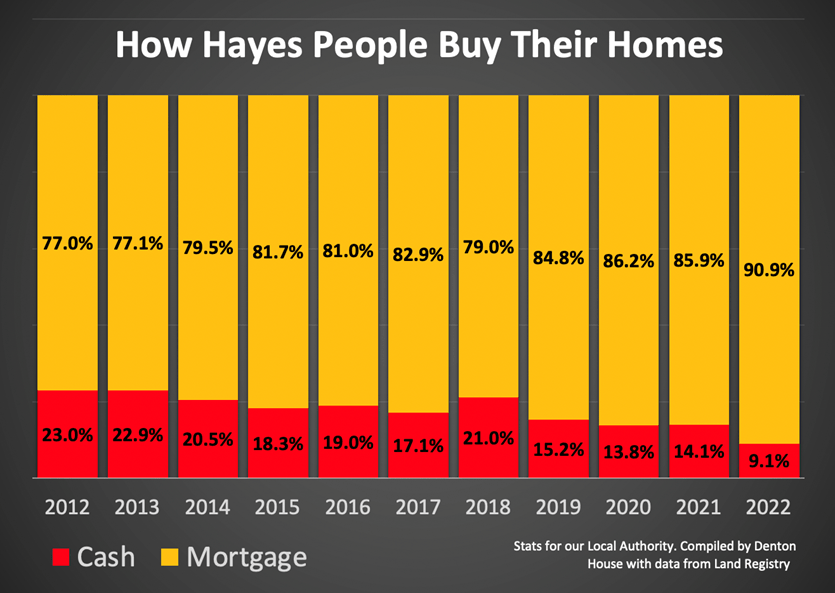
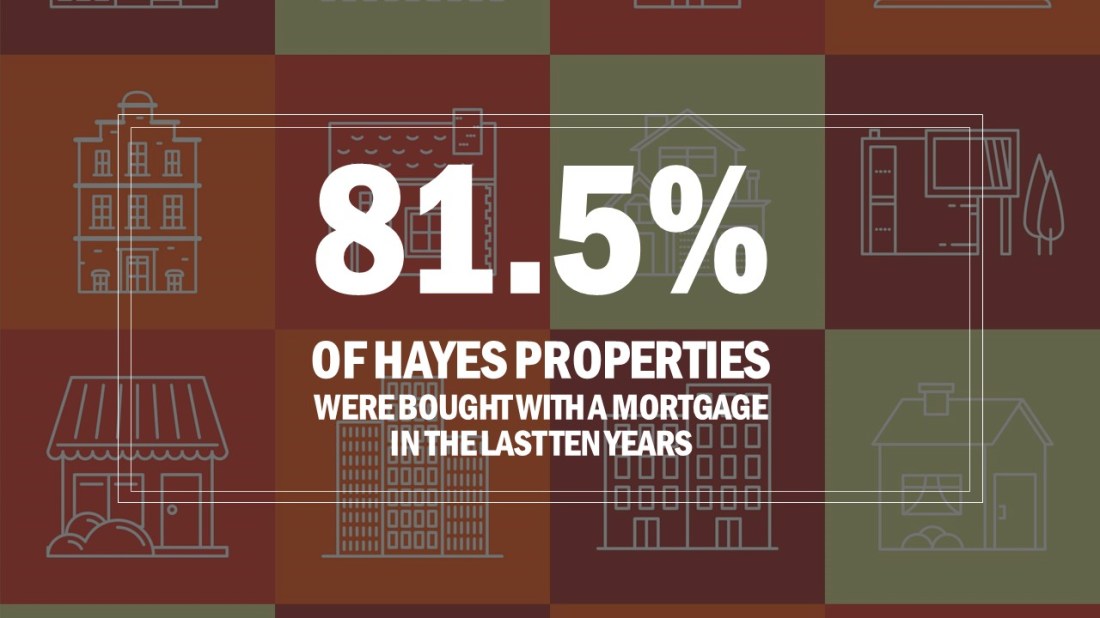
81.5% of our local authority area house purchases have been made with a mortgage (meaning 18.5% are made with 100% cash).

Interesting, when compared with the national average of 67.4% of house purchases with a mortgage over the last decade.

However, what is thought-provoking is the number of house purchasers buying with a mortgage has steadily been increasing over the last decade.

Between 2012 and 2017, the percentage of people buying with a mortgage was 79.9%, yet over the last five years in Hillingdon, that has risen to 85.4%

Initially, this doesn’t sound good. Yet, as always with my articles on the Hayes property market, the devil is in the detail.

The issue is that most people need a mortgage to buy their home.

However, it’s not the amount of mortgage that is the issue, more the level of monthly payments. So, if you fix your mortgage rate, then your payments are fixed (a good idea especially as interest rates are on the rise).

In the last quarter, just under nineteen out of twenty (94.35%) of new borrowers that took out a mortgage had a fixed-rate mortgage at an average interest rate of 1.84%

That’s good news for recent buyers as most of their payments won’t rise even though Bank of England interest rates have risen over the last few months. Yet it’s essential to see what existing homeowners with mortgages have done with their mortgage rates (i.e. fixed or not) as they form the bulk of the property market.

This is because in 2008/9 (the last crash), many people were unable to afford their high monthly mortgage payments when they were made redundant because interest rates were much higher. This meant many Hayes homeowners ‘dumped’ their houses onto the market, all in one go in 2008, because they couldn’t afford their high mortgage payments.

Also, the banks could not lend money for mortgages as easily because of the Credit Crunch, meaning fewer people could get a mortgage, so the demand for Hayes houses dropped as well.

In a nutshell, the number of Hayes properties on the market almost doubled overnight in 2008, yet demand plummeted as mortgages were hard to come by. High supply and low demand meant Hayes house prices nosedived in 2008/9

Going into the Credit Crunch, one in six (60.4%) homeowners with a mortgage had a fixed rate at an average rate of 5.76%. By 2013, this had dropped to one in three people (33.29%) having a fixed-rate mortgage at an average of 3.34%.

Yet today, just under 17 out of 20 homeowners with a mortgage have a fixed rate at an average of 1.97%

Whilst the country might owe collectively £1,630.5 billion in mortgages, irrespective of increasing rates, most homeowners have protected themselves with a low fixed interest rate.

Also, the overall ratio of mortgage debt in the UK, compared to the value of the homes the mortgages are lent on, is also low compared to the year before the last property crash. This ratio is called the Loan to Value ratio (LTV). The higher the LTV, the less equity the homeowner has in the property.

In 2007 (the year before the crash), only 49.4% of people had a mortgage less than 75% of the house’s value (i.e. they had an LTV of less than 75%). Today that stands at 60.9%, which means more people have more equity in their property.

Another thought on why the country is in a better position is only 4.22% of mortgages have a 90% or higher LTV (compared to 16.28% just before the crash in 2007).

1 in 6 people were vulnerable to negative equity in the last property crash, whilst today that would only be 1 in 25.

This means if we do have another property market correction for any other reason … the number of people in negative equity will be much smaller, so it won’t affect the property market as much.

So, in conclusion, as we have fewer people with high LTV mortgages and fixed rates that are a third of what they were in the Credit Crunch, we are, as a country, in a better position to weather any storm.

If you would like any advice or opinion on the Hayes property market, be it buying or selling or anything to do with investing in the Hayes buy-to-let property market, don’t hesitate to drop me a line.

23.7% of Hayes Property Sellers Reduce Their Asking Prices as the Property Market Starts to Return to Equilibrium

  • 79 of the 334 properties on the market in the Hayes area have had a price reduction in the last 3 months.
  • The average reduction has been 4.5% of the original asking price.
  • This is great news for Hayes home buyers and Hayes buy-to-let landlords, strangely Hayes house sellers as well.

The last couple of years of the Hayes property market has seen some amazing prices being achieved with multiple offers and many properties selling for way over the asking price.

Yet, as I have been writing about the Hayes property market over the last few weeks, the tide is beginning to turn, and the pendulum swing more towards a balanced Hayes property market as more homeowners in the Hayes area (UB3) have been reducing their asking prices.

Of the 334 properties for sale in the Hayes area,

79 have been reduced in price in the last 3 months.

This can be broken down as follows…

Price Range of the Hayes PropertyNumber of Price Reductions in Last 3 Months
£0-£50k2
£50k-£100k1
£100k-£150k1
£150k-£200k4
£200k-£250k4
£250k-£300k14
£300k-£350k8
£350k-£400k3
£400k-£500k23
£500k-£600k12
£600k-£750k6
£750k-£1m1

So why is this important and why is this good news, even for Hayes house sellers?

Property industry statistics show that 5 out of 6 house sellers will buy another property and over 80% of those sellers will move up the property ladder.

When you move up the property ladder, that normally means you pay more for the one you want to move to (that’s why it’s called the property ladder).

So, whilst you won’t be getting as much for yours as you might have done earlier in the year, you won’t have to pay as much for the one you want to buy (and the price difference between the two properties will be smaller – meaning you will end up saving money because of these reductions).

Therefore, what is the level of reduction being seen in the Hayes property market?

The average percentage of the price reduction in the

Hayes area has been 4.5%.

I must stress house prices/values in Hayes haven’t dropped 4.5%, just the asking prices of some of the properties on the market.

This is good news for Hayes first-time buyers and landlords, as they will be more likely to buy a property at a more reasonable price. Whilst, as I explained above, this is also good news for sellers as most of them will end up paying less for the higher priced property they end up buying after selling theirs.

So, what should Hayes homeowners be aware of if they are selling their home now or in the future?

For me, it is important that I inform all Hayes property owners of the real story. This enables them to judge for themselves where they stand in the current Hayes property market, thus enabling them to make better informed decisions.

You see some Hayes estate agents will deliberately over inflate the suggested initial asking price to the house seller, because it gives them a bigger chance to secure the property on that agent’s book, as opposed to a competitor.

This practice is called overvaluing.

Now of course, each Hayes homeowner wants to get the most for their Hayes home, yet some estate agents know this and prey on those Hayes house sellers.

You might ask, what is the problem with that?

Well, you only get one opportunity at hitting the Hayes property market as a new property. Everybody has access to the internet, social media and the four main property portals (Rightmove, Boomin, On The Market, Zoopla), and your potential buyers will know the property market like the back of their hand.

If you have a 2-bed Hayes semi that is on the market for a 3-bed Hayes semi-detached house price … those Hayes buyers will ignore you.

Your Hayes property will stick on the market as your potential buyers keep seeing your property on the portals each week.

These buyers will then start to believe there is something wrong with your property and dismiss it even further. That is until you, as the house seller, reduce your asking price. The issue is that sometimes these buyers will think something is wrong with your home and could bid you down even further, meaning you will get less even though you asked for more! (This was backed up by some research done by Which?).

Now according to research by Denton House, the average British house buyer only views around six properties before buying – so please don’t assume viewers will come round your optimistically priced (i.e. overvalued) Hayes home, thinking they will knock you down –  quite the opposite – they just won’t view your home in the first place.

And you know that because I bet you have done the same

yourself when searching for property.

So, all I suggest is this … be realistic with your asking price to start with.

Do that and you will sell your Hayes property at a decent price to a decent buyer … first time, every time – enabling you to move onto the next chapter of your life.

If you know of anyone currently selling their home in the Hayes area and finding things difficult, please share this article with them as it could be of interest.

The Shifting Hayes Property Market

  • The Hayes property market is on the verge of a ‘tipping point’.
  • The rate of house price growth has started to ease with a reduction in the number of properties that will sell in Hayes in the coming 12 to 18 months.
  • Yet, rising interest rates and the cost-of-living issues won’t knock everybody out of the property market and there shouldn’t be a housing bubble for two vital reasons.

The Hayes property market is on the cusp of a tipping point. It’s a tipping point that will influence Hayes house prices, the number of properties available to buy, demand for those Hayes properties and the lives of every homeowner and the property-owning buy-to-let landlords in Hayes. This shift in the Hayes property market is a big deal so let me explain.

What are the two vital reasons for this shift in the Hayes property market?

First, the easy-going Hayes property market goldmine of the past couple of years will end.

The bonanza of the Hayes property market for house sellers, which was primarily fuelled by cheap money, is receding and the scales are starting to tip somewhat more in favour toward Hayes buyers (which is not a bad thing – more of that later).

Secondly, and more significantly, this shift in the Hayes property market is not a collapse.

Let me enlighten you as to why this is.

One of the key influencing factors of the property market is what people pay on their mortgages. The higher the mortgage interest rate, the higher the mortgage payments.

Mortgage rates are usually 1% to 2% higher than the Bank of England base rate. Therefore, mortgage rates are increasing on the back of higher Bank of England interest rates.

So, whilst we have seen rates rise four times in the last year, the Bank of England base rate stands at only 1%. Compare that with Bank of England base rates in the 1980s (when the average base rate was 12.63%), 1990s (when the average base rate was 8.8%) and the 2000s (when the average base rate was 4.7%). These high base rates (together with high unemployment) contributed to the woes of the UK property market crashes of the early 1990s and 2008.

From the gloomiest economist, the worst-case scenario doesn’t see Bank of England base rates rising past 3%.

This means the prospect of a housing crash is minimal because of the comparatively low unemployment and base rates still at all-time lows.

What are the signs of the shift in the Hayes property market?

The statistics show a slight shift in the scales between it being a 100% seller’s market for the last two years to more an 80% sellers and 20% buyer’s market and here are the reasons why:-

  1. The number of houses for sale has grown by 17% in six months.

Nationally, the number of properties available to buy has increased by 17.07% in the last six months, rising from 389,558 in January to 456,048 by the end of May. This rise in the number of properties on the market is a crucial component of the housing market puzzle. Let me explain why.

Before Covid, house buyers having more choice of properties to buy in the summer months would have been thought unremarkable. Yet the stark shortage of properties to buy in the last couple of years has caused national house prices to grow by 19.66%. Any growth or reduction in the number of properties for sale is significant (hence a key bellwether).

This means that buyers will have more choice of properties to buy this summer.

2. The number of properties sold in the UK has dropped 11.4% year to date 2022 vs 2021

When I say sold in this context, I mean the month the house sale price is agreed, and the sold board goes up (not on completion when the keys are handed over).

Looking at the national number of properties sold on a month-by-month basis, things have started to shift since March.

In February 2021, 111,648 houses sold (STC) in the UK compared to 117,734 for the same month in 2022. So almost identical.

Yet, March 2022 saw 15.3% fewer houses sell in the UK than in March 2021 (129,655 in March 2022 compared to 153,023 in March 2021).

April 2022 saw 20.6% fewer houses sold than April 2021 (117,737 compared to 148,228).

So, all doom and gloom? No! Not at all.

The spring months (March and April) of 2021 saw the rush for houses to be sold to beat the Stamp Duty Holiday ending in June 2021, so of course, March and April’s 2022 figures would be lower.

The panic buying of March and April 2021 returned to normal levels in May 2021, meaning the number of houses sold in May 2022 was only 4.3% lower than in 2021 (131,941 in May 2022 vs 137,800 in May 2021).

3. The number of house price changes has increased by 69% since January.

In January 2022, the number of house price changes was 27,063 and has been increasing steadily each month to 45,792 in May 2022, an increase of 69%. This means Hayes house sellers have to be more realistic with their pricing to get their properties sold.

Take all these things together and you can see that there are signs that the Hayes property market has started shifting more into buyers’ territory yet is a long way from the traditional idea of a ‘buyer’s market’.

These points can be backed up with the house price data for Hayes.

In December 2020, Hayes house prices increased by 2.1% in one month.

Yet this spring, for example, month by month, Hayes house prices have seen a rise of only 0.7%  0.9%. Not all doom and gloom when you consider…

Hayes house prices are still 6.6% higher than a year ago.

We have been in fifth gear for the last two years with extra rockets attached. We are certainly not going into reverse gear, more a drop down the gears to fourth!

I know many aspiring Hayes homeowners are waiting for house prices to fall, however, I do not foresee any large Hayes house price drops in the next few years. In essence, whilst I do believe the rate of house price growth will slow down, that does not mean it will go into reverse.

Some would ask what increasing interest rates and inflation will do to the Hayes property market?

As I’ve already discussed in several recent articles on my property blog, if interest rates don’t go above 3.5-4%, this will not be a game-changing issue for the Hayes property market. Most homeowners are on a reasonably long-term fixed-rate mortgage (typically 5+ years) and will be able to transfer them across to the new house purchase if they want to move.

Now, of course, that won’t help first-time buyers. I agree there will be fewer Hayes first-time buyers, yet these will be replaced by landlords re-entering the Hayes property market (as I discussed in a previous article a few weeks ago).

Hayes house prices will also be further protected by the effect of inflation on house prices (again discussed in a separate article about a month ago).

As the number of properties coming to market has increased, the choice of properties to buy has expanded. This will encourage those potential cash home buyers who have also been waiting on the sidelines (alongside the landlords) to start viewing and making offers. They, too, have not wished to get into a bidding war but patiently waited for the market to ease.  

And it is for those reasons in this article (and my other recent articles mentioned above) I do not see a Hayes housing bubble on the horizon.

If you would like those other articles, don’t hesitate to contact me, and I will send you the links.