What Will Happen to the Hayes Property Market in 2023?

The autumn of 2022 saw economic and political instability with the resignation of Boris Johnson as Prime Minister and the ill-fated Liz Truss 44-day premiership. Now as we go into 2023, the economic and political turmoil has subdued, offering a greater feeling of stability in money markets.

So on the back of that, what is the expectation for the British (and Hayes) housing market as we go into the new year?

The biggest issue is inflation. Low steady inflation of around 2% a year is good for the economy, yet the high levels we are experiencing now isn’t. It affects the spending power of the pound in your pocket, and it alters the way people spend their money (including buying and selling property).

So where has this inflation come from?

Many blame it on inflated gas prices because of the Ukraine issue (however, it is believed by most economists only around 4% of the current 10.7% inflation figure is because of the fuel crisis).

UK inflation was already running at 6.2% when the Russian tanks rolled into Ukraine in February 2022 which created that energy price shock. Therefore, where has the rest of the inflation come from?

The catalyst of inflation started in 2020 with the Bank of England’s Quantitative Easing (QE). This pumped £450m new money into the economy at a time when the future looked bleak. The problem was, people had nothing to spend that money on, so when things started to get going after the lockdowns, there was a mis-match of too much demand for goods (as people had that money) and a lack of goods and services (because there wasn’t enough supply of those goods and services with the supply chain issues).

This all meant prices went up (i.e., inflation). The catalyst of this inflation was the Bank of England printed too much money in 2020 with QE and the supply chain issues (all easy to say with hindsight!).

Too much inflation is bad for the economy and therefore, ultimately the property market.

Two things will reduce inflation.

One is a recession and the other is increased interest rates.

Many find it fascinating that the Bank of England were talking the UK economy into a shallow recession in the autumn. Yet there was method in their madness. It was because they didn’t want to rely solely on the second method of increasing interest rates.

Better for the economy to have a shallow mild recession and interest rates rising to say 4.5% by the middle of 2023 to reduce inflation, than placing the whole job of reducing inflation on interest rates.

If that had been the case, interest rates would need to rise to say 7% (or more), causing the economy (and property market) to stall … and thus create a subsequent deep and long recession.

Therefore, with the Bank of England having recently increased its base rate to 3.5%, with more interest rate rises to come in 2023, what does this and the mild recession mean for the Hayes property market?

A recession will increase unemployment levels, which have been comparatively low in the last few years. Depending on the type of roles/jobs that are made redundant, will determine the effect on the property market. Until that happens, we won’t know.

Everyone is suffering from higher gas, electric, shopping bills, yet with interest rates rising, this will increase the pressure on household budgets. Higher interest rates mean higher mortgage payments if the homeowner/landlord is on a variable rate mortgage (17 out of 20 homeowners with a mortgage are on a fixed rate).

It’s these two factors of recession and interest rates that will place negative pressure on Hayes house prices.

Yet let us not forget this pressure is coming off the back of two of the strongest years on record in terms of house prices and transaction levels.

Hayes house prices have experienced 17.3% price growth since

the pandemic started in March 2020.

This is interesting when compared to the UK average, where average house prices have risen by 27.4% or £44,700 since March 2020.

Before I tackle the issue of house prices in 2023, I would like to look at the number of transactions.

To many the number of properties selling is irrelevant, yet I believe it is as important, if not more important, than house prices. I believe the best way to judge the health of the Hayes property market is the number of people moving home (i.e. housing transactions).

You could ask yourself why Hayes people should be more concerned about the number of property transactions and not the change in Hayes property values.

Many economists believe the number of property transactions is a better judge of the health and virality of a housing market. The higher the number of people moving home the better for the whole economy than a smaller number of property transactions, whilst the same can’t be said for higher house prices.

665 households per year have moved home in Hayes since lockdown, compared to the long-term 27-year average of 1,008 per year.

Looking at the stats coming through in the last couple of months, maybe we will settle for a figure somewhere between the two figures above, yet nowhere near the sub-525 annual figure of homeowners moving in the Credit Crunch years in the 2008/9/10 time frame.

Finally, let’s look at Hayes house prices in 2023.

A good place to start to judge house prices is how many reductions are taking place on the properties that are already on the market.

In the last 3 years, the average number of price reductions for the properties for sale in the Hayes area (UB3) has been 22.1 reductions per month.

In October there were 40 price reductions and in November

34 reductions.

Homeowners are being more realistic with their pricing and the price that one will achieve for their Hayes home today and the rest of 2023 will be lower than one would have achieved in the spring of 2022.

Yet, as most Hayes people buy another property when they sell (and most of the time move up market) the price you would have had to pay on the next purchase would have been even more.

Yes, the price of Hayes property will be lower in 2023 by between 5% to 10%, yet these are only levels that were being achieved in the spring of 2022 – and nobody was complaining about those!

Final thoughts.

Several economic commentators are preaching doom and gloom for the property market in 2023, yet things are very different than the Credit Crunch years of 2008/9.

The property market crashed in 2008/9 mainly because the banks and building societies stopped lending money i.e., credit (that is why it was called the Credit Crunch).

There are two large differences this time round.

The first is the introduction of Mortgage Market Review mortgage stress testing instigated in 2014.

Homebuyers taking out a mortgage must have undergone a stress test on interest rates to obtain a mortgage since 2014. These stress tests are a safeguard to ensure that if their household income continued to be the same, the homeowner could afford higher mortgage rates.

The second is the banks and building societies have much higher cash reserves. Higher reserves will ensure they can continue to lend money and so more mortgages are available, although at a slightly higher interest rate than a year ago.

With mortgage rates falling back, with some very attractive fixed-rate deals knocking on the door of 5%, this is a development that may continue into 2023 as banks and building societies obtain cheaper funding sources and then compete for business by driving down the price of mortgages – which would only be good news for the Hayes property market.

These are my thoughts – what are yours?
Hayes tenants face further rent hikes, as the number of available rental homes drops by 72%

  • The number of properties available to rent in Hayes has dropped from 361 to 100 since February 2020.
  • The average rent a tenant has had to pay in Hayes has risen from £1,309 to £1,463 since February 2020.
  • Many Hayes landlords have cashed in on the post-lockdown property boom of the last two years and sold their properties to owner-occupiers – not fellow landlords.
  • The supply of Hayes rental property isn’t near what is needed, which is of benefit to Hayes landlords rather than Hayes renters. 

The Hayes rental property shortage is currently very evident. In this article, I will investigate why there is such a significant lack of homes available for rent across Hayes and what it means for buy-to-let investors.

Anybody who enjoys surfing the property portals (Rightmove, Zoopla and On the Market) will have observed an emerging trend that the number of properties available to rent in Hayes has dropped considerably in the last couple of years.

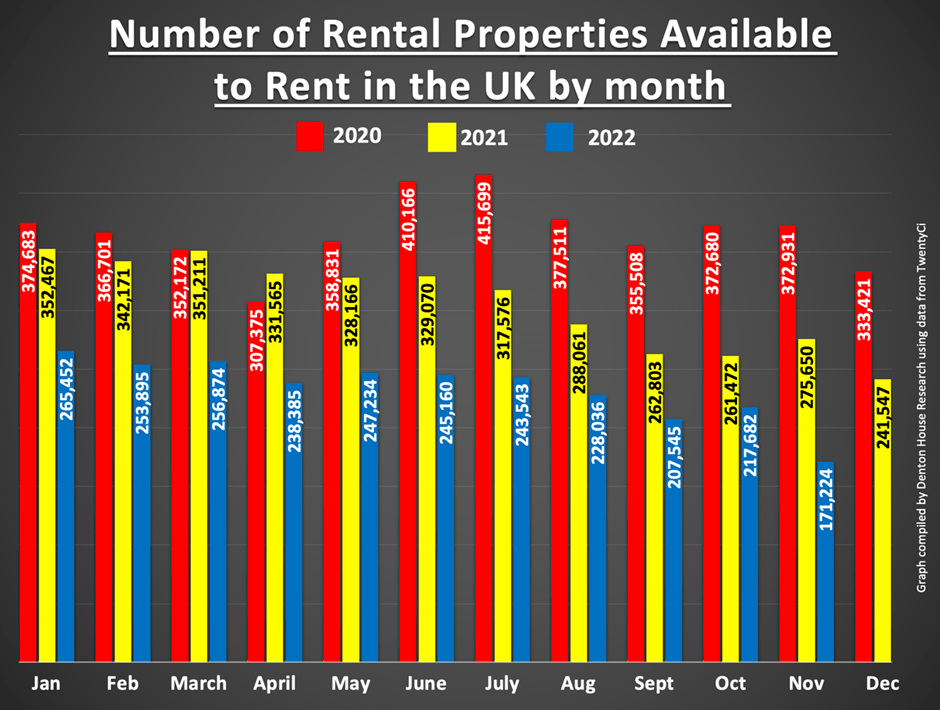
This reduction has been seen all around the UK as well. For example, on 1st November 2020, there were 372,931 properties to rent on portals. By the 1st November 2021, that had dropped to 275,650; by the 1st November 2022, that had fallen to 171,224.

That doesn’t mean the number of privately rented homes in the country has dropped by over half. Fewer properties are coming onto the market to rent. I will explain why in this article.

For tenants, especially over the last 12 months, it has become progressively more challenging to find a Hayes rental home, thus making the rent they must pay go up. This state of affairs in the property market isn’t showing an indication of getting any easier either, making for a hard time for Hayes renters.

So, what is the reason behind the Hayes rental property shortage, and what does this mean for existing Hayes landlords or those potential investors considering buying a Hayes buy-to-let property soon?

Several different components are making the perfect storm in the UK property market.

Firstly, the number of households in the UK.

The UK has not been building enough homes for the last 20 years. I appreciate that parts of Hayes seem like one huge building site, yet as a country, we are woefully undersupplied with property to live in. This has meant house prices continue to rise due to demand. 

The government have known about this issue for decades. The Barker Review of Housing Supply published in 2004 stated that the UK had experienced a long-term upward trend of 2.4% in real house prices since the mid-1970s because of a lack of house building. The report stated that 240,000 houses needed to be built each year to keep up with demand.

The average number of houses built since the mid-1970s has been around

165,000 per year, meaning the UK is short of 3,375,000 houses

(i.e. 45 years multiplied by 75,000 missing homes per year).

Several years ago, the government set a target to build 300,000 new homes each year to address this issue.

However, in 2019/20, the actual number of homes delivered stood at just 243,770. In 2020/21, the number of properties built dropped to only 216,000 new homes. In a nutshell, there are fewer available homes to buy, meaning fewer available homes to rent. 

Secondly, Hayes tenants are staying in their rental homes longer.

A Hayes first-time buyer’s average house deposit is £115,759

(the UK average deposit is £53,935).

The average rent of a Hayes property in November 2022 is £1,463 per calendar month (up from £1,309 per calendar month in February 2020).

These numbers translate into Hayes renters not being able to pay the rent and be able to save for a deposit, or if they are saving, it is taking a lot longer to save for a deposit due to the cost-of-living crisis and higher rent costs.

Also, many Hayes tenants have decided to stay in their existing rental homes because of the rent rises. Many landlords are less inclined to raise the rent on an existing property when they have a decent tenant who keeps the property in good condition and pays rent on time. Anecdotal evidence also suggests that rent arrears in those properties are dropping as tenants know if they don’t pay the rent, the chances are they will have trouble finding another property, and if they do, they will have to pay a lot for their next rental home. 

For Hayes landlords, this is all positive news – tenants are staying for longer in their Hayes rental properties, arrears are lower, and void periods are less likely. When it comes to the market there is less competition (because of the decrease in the availability of Hayes rental properties) so this makes the investment an even better bet.

Thirdly, landlords are selling up on the back of recently increased house prices.

It would be difficult for Hayes buy-to-let landlords to ignore the rising property prices in recent years.

The average property value in Hayes in the summer of 2022

was 8.9% higher than in the summer of 2021.

For some Hayes buy-to-let landlords, especially those who were classified as ‘accidental landlords’ (an accidental landlord is a landlord who never chose to become a landlord, it was just after the Credit Crunch of 2008/9, they found themselves unable to sell their property, so they temporarily let their own property out), they chose to ‘cash in’ on the higher house prices. This would have also contributed to the lack of available Hayes homes for rent.

Yet everything isn’t all sweetness and light for Hayes landlords.

Landlords have a few costs to consider before investing in buy-to-let, including everything from regular refurbishment costs, buildings insurance, letting agents’ fees, income tax, and, not forgetting, stamp duty.

Talking of costs, one issue some Hayes landlords are facing is their failure to plan financially for the recent mortgage interest rate rises. Some Hayes landlords may have become complacent to the ultra-low Bank of England base rates we have had since 2008 and, therefore, may need to sell their rental property, which, if bought by a first-time buyer, will remove another property from the Private Rented Sector.

Another hurdle to jump is the proposed new regulations requiring better energy efficiency for rental properties. It is proposed all new tenancies must have at least a minimum of a ‘C’ rating for their EPC (Energy Performance Certificate) from 2025 (and 2028 for all existing tenancies).

Therefore, as a buy-to-let Hayes landlord, it is wise to do your research to make sure the buy-to-let opportunity is correct for your rental portfolio, particularly when it comes to weathering any impending financial storms. 

Landlords need to consider the returns from their

Hayes buy-to-let investments.

Landlords can earn money from their buy-to-let investments in two ways. One is the property’s capital growth, and the other is the rental return (often expressed as a yield). In 96% of buy-to-let investments, there is an inverse relationship between capital growth and yield (i.e. properties that tend to go up in value quicker will have lower yields 96% of the time – and vice versa).

Getting the best balance of yield and capital growth depends on your current and future needs from your Hayes buy-to-let investment.

If you would like me to review your portfolio and ascertain if your existing portfolio will match your current and future needs for the investment – whether you are a client or not, feel free to drop me a line, and we can have a no-obligation chat and possibly organise a review.

What does all this mean for the Hayes rental market?

The continued shortage of Hayes rental properties means it will be more difficult than ever to find a Hayes property to rent, and so rents will continue to grow.

Unlike in Scotland, England and Wales do not have rent controls, with Westminster ruling out the possibility of introducing rent control here to deal with the cost-of-living crisis.

You would think rent controls would be a no-brainer, yet economists from around the world have proved for the last 75 years that rent controls might help tenants in the short term, yet ultimately it drives landlords to sell their investments in the long term, thus reducing the stock of available properties to rent out (not great for future tenants).

Therefore, it is highly likely that Hayes rents

will continue to rise for tenants.

Landlords who persevere with their Hayes buy-to-let properties or become a Hayes buy-to-let landlord are set to benefit because they have an asset in very high demand.

The housing shortage, not to mention the other issues discussed above that are affecting the supply of rental properties, is unlikely to be fixed anytime soon!

In conclusion, the Hayes rental market is a constantly changing picture. What is known is that the supply of rental properties is far from what is needed, which can only be to the benefit of buy-to-let investors rather than of tenants renting.

I see buy-to-let as a long-term investment. Everyone reading this knows that the real value in your buy-to-let investment is playing the long game, allowing your Hayes buy-to-let investment to grow over time. Like the crypto or stock market, getting sucked in by get-rich-quick schemes that are selling ‘apparent quick wins’ in property investment is very easy.

I regularly highlight the best buy-to-let deals for Hayes landlords with all the estate agents (not just my own). You don’t need to be a client of mine either to receive that information. Drop me a line or call (without any cost or obligation) if you are interested in making your first Hayes buy-to-let investment or considering adding to your existing Hayes portfolio.

HAYES LANDLORDS, HOMEOWNERS & THE AUTUMN BUDGET 2022

TheChancellor, Jeremy Hunt, gave his Autumn Budget 2022 at lunchtime, intending to deal with inflation and keep mortgage rates down for homeowners.

In this short and sharp post, I wanted to touch on what this would mean specifically for Hayes landlords and homeowners thinking of buying and selling

Capital Gains Tax Changes

In previous articles about the Hayes property market, I touched on the muted plans from 2020 to increase the Capital Gains Tax (CGT) headline rate.

Instead, in the Budget, the CGT relief allowance has been cut from £12,300 to £6,000 for the next tax year (2023/4) and then cut again to £3,000 for 2024/5.

Therefore, if you are a basic rate taxpayer, you will end up paying £1,134 extra in CGT after April 2023 (and £1,764 if a higher rate taxpayer) and a further extra 50% on top of those figures in tax year 2024/5

Only second homeowners and landlords pay Capital Gains Tax on the difference between the price you paid for the property and the price you sold it for. (Note- it is not paid on any gain of your principal residence)

This will be unwished-for news for Hayes landlords and second-home owners

Even if you have no intentions of selling your portfolio in the next five to ten years, there are things you could be doing now to reduce your CGT liability in the future. However, there are various reliefs [name of town] landlords can apply to HMRC for that will reduce the CGT liability. If you would like some names of good local Hayes accountants, drop us a line, and we can suggest some for you.

Is it worth selling your Hayes rental property now? Well, the average conveyancing time for UK property from sale agreed to exchange of contracts is 19 weeks, which takes us to 30th March 2022…all to save £1,764 …all at a time when rents have rocketed by 19% in the last two years.

Stamp duty cut to stay – yet only until 2025

Kwasi Kwarteng’s cut to stamp duty in England announced in his September Budget will remain until 31st March 2025.

Jeremy Hunt stated because housing activity will be slower in 2023/4, the stamp duty cuts announced in Kwarteng’s mini-budget will remain in place for the next two years and four months.

This means that the price of a property before stamp duty is paid will stay at £250,000, up from the previous level of £125,000 until March 2025, then drop down to the old rates.

This will be good news for Hayes home buyers and landlords in the coming years.

‘Is Now a Good Time to Buy a Hayes Home?’

This is the question many people are asking right now, and the answer depends on your circumstances.

I pride myself on my ability to provide objective, fact-based information on the Hayes property market so potential Hayes house sellers, landlords and buyers can make the best decision for themselves.

My role is to educate the potential Hayes house sellers, landlords and buyers and to provide them with the best possible information available, not to convince them to do something they don’t want to do.

To answer that big question in the title of the article (is now a good time to buy a Hayes home?), it comes down to three things.

  1. How much will you get for your Hayes home when you sell it?
  2. How much will you have to pay for your new home?
  3. How much will that move cost you in ongoing monthly mortgage payments?

To answer points 1 and 2 correctly, I need to address point 3, which relates to interest rates.

The click-bait newspapers and websites are pushing messages to potential sellers and buyers towards the top end of the sensationalised scale. I prefer to define what is happening, i.e. the reality.

On the face of it, it doesn’t look good.

The average 5-year fixed rate mortgage has risen from 2.11% at the beginning of January this year to 6.21% in early November.

Yet even though the Bank of England increased the base rate by 0.75% on the 3rd of November, the average 5-year fixed rate mortgage dropped by 0.22% between the 3rd week in October and bonfire night. As interest rates go up, mortgage rates are coming down even though interest rates are projected to increase to 4.5% by the autumn of 2023.

So, why did the Bank of England mention in the first week of November that the UK is facing a two-year recession? Some might think this controversial, yet the Bank of England wants a recession as it will aid in reducing inflation. It’s as plain and simple as that!

Instead of relying purely on interest rates to reduce inflation, the Bank of England is hoping if we go into some form of shallow recession, it will not need to increase interest rates much above the anticipated 4.5%.

However, whether it’s interest rates or a recession, both will slow the number of home sales in Hayes and will indirectly affect Hayes house prices.

So will Hayes house prices drop? By how much and what money will it save you if you wait?

I have spoken recently in my property blogs about the Hayes property market, and the prices that will be achieved for homes in late 2023/early 2024 will be between 5% to 10% lower than what is being achieved today. There is no point in repeating why (message me if you want those articles), but in essence, increasing mortgage rates, inflation and affordability will mean the price people can pay for a Hayes home will be curtailed because of those factors. Let’s assume a reduction of 10% in Hayes house prices.

Around 81 in 100 existing homeowners are buyers. When they sell their home, they almost always move upmarket regarding accommodation and location. Hence, they will pay more for the home they buy than the property they sell.

So, if you are in Hayes and live in a 1-bed apartment (average value £262,300) and want to buy a 2-bed apartment (average value £294,470), the difference between both would be £32,170.

If Hayes house prices dropped by 10% in a couple of years, that £262,300 1-bed apartment would drop to £236,070, and that £294,470 2-bed apartment would drop to £265,023, meaning the gap would drop to £28,953. Thus, saving the home buyer £3,217.

So, should they wait?

Yes, until you look at the monthly ongoing mortgage payments.

Assuming our Hayes homeowner has an existing mortgage of £150,000 and added the difference of moving up the property ladder to the mortgage. If our Hayes home mover moved now, their mortgage payments would be £959.26 per month (assuming a 35-year mortgage on a 5-year fixed rate at 5.34% with First Direct).

The other scenario would be if our Hayes buyer waited a couple of years for Hayes house prices to drop 10% (to save £3,217 as mentioned above) to make a move.

Everyone acknowledges interest rates will rise in the next two years, so the monthly mortgage payments when they move (even though they are borrowing less) would be £1,167.18 per month (based on a 5-year fixed mortgage being 7.19% in 2 years).

By waiting 2 years, it will cost the Hayes homeowner £207.91 extra per month in interest payments or £12,474.73 over the 5-year mortgage term.

The point is that because interest rates are forecast to go higher in the next couple of years, this provides potential Hayes buyers with the prospect of locking in their monthly housing expenses by moving now.

By buying now, it hedges against rising interest rates; consequently, your monthly mortgage payments are going to be higher. It offers an opportunity, through re-mortgaging, to lower your mortgage costs should interest rates fall.

What about Hayes first-time buyers?

I wrote an article on the Hayes property market only a few weeks ago. Even when we looked at house prices dropping by 18% in two years (because in the 1988 house price crash, the market dropped by 20% and 17% by 2008), the savings made on the purchase price were blown out of the water with the two extra years of rental payments, the higher deposit and higher interest payments.   

The actual crisis in the property market today is the rocketing rental rates.

Whilst a fixed-rate mortgage locks in your monthly housing costs, rental rates are rocketing upwards, and a tenant today can realistically expect higher monthly costs in the coming few years.

Though most of the press generally focuses on the monetary aspects of buying a home, there are also choices on homeownership that are not exclusively based on financial decisions.

Why are you considering buying a Hayes home?

Buying a Hayes home is very personal and predominantly driven by your life events like divorce/marriage, a job move, a new addition to the family, elderly parents moving in etc. These are often the influences that drive the decision to buy (or not buy) a home.

Homeownership has always been a foundation stone of the British dream.

Homeownership offers control and a sense of security that renting simply cannot provide.

The doom-monger headline-grabbing newspapers often overlook these non-economic factors affecting the desire of a potential home buyer.

The one important thing from the last few years since the first lockdown in 2020 is that people still want to own their own homes.

They still want to have their ‘castle’, to pull up the drawbridge when things get tough, a place that they and their family can call their own. Never forget that homeownership is much more than house prices and graphs; it’s about the ‘Englishman’s home is his castle’ dream.

Let us remember most people in the UK have been able to build and grow their family wealth through homeownership. That is why I like to provide the best information on the Hayes property market so you can make the best decision for yourself and your family. Please drop me a line if you wish to pick my brain on anything discussed in this article.

What will Rishi Sunak as PM mean for Hayes house prices?

I often get asked what is going to happen to Hayes house prices.

Many things affect house prices, and it comes down to simple supply and demand.

On the supply side of the equation, in the short-term, the number of people wanting to sell their property at any one time has a massive effect on house prices.

In 2007, the number of properties that came onto the market in Hayes jumped drastically. In January 2007, 330 properties were available for sale in Hayes and by October in the same year, that had risen to 561 properties.

This flooded the Hayes market with houses to buy whilst, at the same time, the banks almost stopped lending money because of the Credit Crunch, thus causing the house price crash of 2008.

Also, on the supply side of the equation is the total number of houses in the whole country (irrespective of whether they are on the market or not). This is an essential factor in house prices, although that has a longer-term effect. Governments can control the number of properties being built with changes in planning regulations, incentives for builders and the buyer schemes such as the Help to Buy plan.

On the demand side of the equation, property values typically rise if homeowners believe they will be wealthier in the future.

Typically, that occurs when the whole country’s economy is performing well as more Brits are in work and salaries are higher. The opposite is also the case when the economy goes into recession; people tighten their spending, lose their jobs, and thus, house prices drop. Inflation will affect British household budgets (because if more of the household budget is going on increased bills, there is less available for mortgage payments).

Another factor on the demand side for housing is when the population increases (through people living longer or increasing net migration) or when the divorce rate increases (making one family household into two single-person households). As always, rising demand typically means higher house prices.

One aspect of the demand side of housing that the Government can control is the taxation of moving home. In the late spring of 2020, the Government vastly reduced the tax (Stamp Duty) paid to buy a house, saving many home buyers thousands of pounds.

Also, on the demand side, property values usually increase if more home buyers can borrow more money with a mortgage to buy their home.

The more banks and building societies can offer mortgages, the more homebuyers can buy their future home, thus raising house prices.

However, the constraint is the amount a home buyer can borrow on a mortgage.

What someone can borrow depends on what they earn and if they can afford the monthly mortgage payments. The level of mortgage payments is dependent on three things.

  1. How much you borrow
  2. The interest rate charged
  3. The length of the mortgage

The lower the interest rates are, the lower the cost of borrowing to pay for your house is and thus more people can afford to borrow money with a mortgage to buy a home, meaning house prices tend to go up.

Hayes house prices have risen by 97.69% between 2010

and today, mainly fueled by low interest rates.

So, looking at everything above, apart from Stamp Duty and the incentives for buyers (which historically have made a minimal difference), the Government in the short-term, irrespective of who the Prime Minister is, makes little difference directly to house prices.

The most significant short-term factor which directly

affects house prices is interest rates.

However, the Bank of England (not the Government) sets the interest rate for the UK economy. That means the Government (and Rishi as PM) cannot directly make any differences in house prices (apart from the points raised above).

Yet, indirectly, as seen with the Liz Truss/Kwasi Kwarteng Mini-Budget catastrophe only a few weeks ago, what the Prime Minister (and their Government) does can make a massive difference to interest rates and, thus, the property market and house prices.

Since December 2021, the Bank of England has been slowly raising interest rates to combat inflation. Unfortunately, the downside is that it increases the mortgage rates homebuyers must pay if they are on a variable-rate mortgage or coming off a fixed-rate deal secured a few years ago.

As 17 out of 20 homebuyers have a fixed-rate mortgage, when a bank or building society calculates a 5 or 10-year fixed-rate deal, they consider what the Bank of England interest rate is today, but they also consider something equally important, something called the ‘swap rate’.

As Hayes homeowners and landlords, it is vital you should be aware of the swap rates as they are based on what the global money markets think future UK interest rates will be.

If the swap rate rises, then mortgage lenders will increase their rates on the mortgages they offer, and by doing so, (as discussed previously in this article), increased mortgage rates will affect affordability and, thus, house prices.

So, what affects UK swap rates? Mainly one thing, the price of government debt in the form of gilt yields

Given the vast increase of planned government debt originally announced in that mini-budget by Truss/Kwarteng, the money markets who would be lending the Government the billions of pounds to fund those tax cuts got worried the Government wouldn’t be able to pay back such a rise in borrowing, so wanted a higher rate of return on the money they were lending the Government. 

That return is measured in the ‘gilt yield rate’, and the gilt yield rate directly drives the ‘swap rate.’

That rise in the gilt yield rate/swap rate was the main reason mortgage rates rocketed after the mini-budget and helped in the collapse of Liz Truss’s Prime Ministership.

So, what can Hayes homeowners expect in the coming weeks and months with gilt/swap rates?

Rishi Sunak’s first job was to re-establish confidence in the money markets for UK plc. During the summer, the 5-year gilt rate rose steadily from 1.6% to 3.5%, in line with the general rise in Bank of England base rates. Yet when the mini-budget was delivered on the 23rd of September 2022, that rose almost straight away to 4.6%.

That meant every mortgage rate jumped in price by

1 to 1.5% almost overnight.

At the time of writing, the 5-year British gilt yield has dropped to 3.5%, and the others have either dropped below their pre-mini-budget rate or were moving in that direction, depending on the gilt type.

The gilt rate (which directly affects the swap rate, which in turn, directly affects mortgage interest rates) could drop further, subject to what Rishi Sunak and his Chancellor Jeremy Hunt have planned in the Budget (and supplementary report from the Office for Budget Responsibility) on the 17th of November 2022.

A drop in the gilt/swap rate is vital for any Hayes homebuyer buying a house or Hayes homeowner re-mortgaging to a new mortgage deal. Why? Because …

with the average Hayes home worth £413,649 (a rise of 7.7% over the past year), each 1% extra in the mortgage rate would cost every Hayes homeowner an additional £344.71 per month.

So, what does this all mean for Hayes house prices, then?

Greater certainty will keep the volume of housing transactions ticking over, yet not inescapably Hayes house prices.

In my blog articles on the Hayes property market, I believe Hayes house prices will be lower in 12 months, and I expect Hayes prices to return to where they were in the late spring/early summer of 2021.

And why is that? Unlike the 2008 Credit Crunch house price crash, today, the country has very low levels of unemployment and very well-capitalised banks (because the Bank of England subsequently forced them to keep lots of cash in their banks to cover downturns). Therefore, I don’t anticipate the kind of double-digit house price decreases seen 14 years ago.

If you would like to pick my brain about the Hayes property market, be you a potential Hayes first-time buyer, a Hayes homeowner looking at your options on re-mortgaging or selling, or, in fact, anyone with questions, don’t hesitate to drop me a line. I will gladly share my thoughts and opinions without cost or obligation.