Hayes Buy To Let Annual Returns Hit 13.28% in Last 10 Years

Many Hayes people ponder the best places to invest their hard-earned savings and the best piece of advice I can give you is to do your homework and speak to lots of people. It depends on your attitude to risk versus reward. Normally, the lower the risk, the lower the reward whilst a higher risk is normally associated with the possibility of higher returns, yet nothing is guaranteed. At the same time, higher risk also means higher possible losses on your investment – yet if one looks at the bigger picture, the biggest threat to investing, predominantly when the investment is made in the short term, isn’t risk but actually volatility.

So where should you invest? Building society, the stock market, gold or property are options. This article isn’t designed to give you advice – just show you how different investments have performed over the last decade.

Let me start with the humble semi-detached house in Hayes … which in 2009 was worth £258,900 … so assuming I bought that property for that figure, then I looked at what if I had invested the same amount of money in a building society, into gold and finally the stock market…

  Savings Account Gold Stock Market Hayes Semi Detached House
2009 capital £258,900 £258,900 £258,900 £258,900
2019 capital £258,900 £328,500 £337,100 £420,100
2019 capital & interest/rent £322,300 £328,500 £450,500 £577,000

Putting your money into the stock market (FTSE100) would have brought a return of 30.2% on your capital over those 10 years and an average of 3.79% a year in dividends (making an overall increase of 74%).

Gold doesn’t earn interest – yet it has increased in value by 26.9% over the same 10 years whilst putting your money in the building society, the money hasn’t increased in value, but would have earned you interest of 24.46% or the equivalent of 2.21% per year.

Investing in an average semi-detached house in Hayes over the last 10 years has seen the capital increase by 62% (an equivalent of 4.94% per annum) and the income (i.e. the rent) has provided a return, based on the original purchase price, of 122.87% or the annual equivalent of 8.34% … meaning the overall return, based on the original purchase price of an average semi-detached property in Hayes, is 13.28% per annum.

Notwithstanding No.11 Downing Street’s grab at the profits of buy to let landlords by hitting the buy to let sector with several fiscal punishments with a 3% stamp duty level, a decrease in high rate tax relief for landlords and an increase in rate of CGT on residential property profits, the facts remain that ‘bricks and mortar’ is still one of the preeminent and most constant investments available.

The bottom line is, the buy to let investment remains the mainstay of the British property market, serving to support aspiring homeowners as they work to conquer the, sometimes difficult, financial obstacles of home ownership. With Central Government over the last 30 years only paying lip service to address the lack of new homes being built or tackling the affordability on a consequential scale, it is highly probable this will continue for the next 5/10/15 years as there will always be a call for a respectable, and above all, honest buy to let landlords delivering decent housing to those that need it.

Which Hayes Properties are Selling the Best?

Moving home is said to be the third most stressful life event, following a member of your family dying or getting divorced. So it is always best to keep your stress levels down by investigating and doing your homework on both the particular area of Hayes (or nearby conurbations) where you live (i.e. where you are selling) and where you want to search for your next Hayes home. Being mindful of how fast (or slow) the different aspects of the Hayes property market is moving is key.. because it could save you much heartache and many thousands of pounds.

You see, if you know you are selling a property in a sluggish price range and buying in a faster moving price range in Hayes then putting your property on the market first is vital, otherwise you will always find the one you want to buy tends to sell before your property sells – there is nothing worse than pondering over a property only to find that someone else has bought it. Being primed with all the knowledge is key. On the other side of the coin, if you are selling in a fast moving market and buying in a sluggish market .. you can probably get a better deal on the one you are buying.

For buy to let landlords in Hayes, this evidence is particularly critical as purchasing a high-demand property in a well-liked area of Hayes will safeguard a surfeit of availability of tenants, as well as respectable house price growth. 

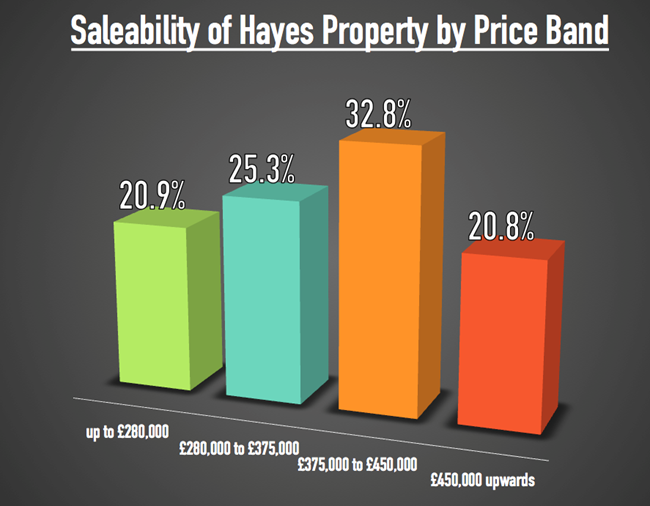
Being an agent in Hayes, I like to keep an eye on the Hayes property market on a daily basis because it enables me to give the best advice and opinion on what (or not) to buy in Hayes; be that a buy to let property for a landlord or an owner occupier house.  So, I thought, how could I scientifically split the Hayes housing market into sections, so I could analyse which part of the Hayes property market was doing the best (or the worst). I took the decision that the preeminent way was to fragment the Hayes property market into roughly four uniform size price bands (in terms of properties for sale). Each price band would have roughly around 25% of the property in Hayes available for sale .. then add up all the sold (stc) properties

  # Properties For Sale # Properties Sold (stc)
up to £280,000 140 37
£280,000 to £375,000 130 44
£375,000 to £450,000 135 66
£450,000 upwards 145 38

The best performing price range in Hayes is the middle to upper market £375,000 to £450,000 where 32.8% of all property in that price range has a buyer and is sold stc.

It’s not unexpected that the upper end of the property market (the top 25%) in Hayes is finding things a little tougher compared to the others. Even though the number of first time buyers in 2018 did increase over the 2017 levels, it was from a low starting point and the large majority of 20 to 30yo’s don’t want to or can’t buy their first home and the local authority has no money to build Council houses meaning an increase in demand as private landlords take up the slack – because everyone needs a roof over their head!

If you would like to pick my brains on the Hayes Property Market – pop in for a coffee or drop me a line on social media or email.

What Has Happened to the Hayes Property Market Since the Last Property Market Crash?

A handful of Hayes landlords and homeowners have been asking me what would happen if we had another property crash like we did in 2008/9?

The UK property crash in 2008/9 caused property prices in the UK to drop by an average of 18.37% in a period of 16 months.

On the run up to the Parliamentary vote on Brexit scheduled for March, a number of people asked what a no-deal Brexit would do to the property market and if there would be a crash as a result. I have discussed in a previous article on the chances of that (slim but always a possibility) … but assuming it happens, it is my opinion the outcome of a no-deal Brexit would be no worse than the country’s 2008/9 credit crunch property crash, the late 1988 property crash, the 1974 property crash, 1951 property crash … I could go on. The British economy would bounce back from the shock of a no-deal Brexit with lower property values and a continued low interest rate environment (together with an additional round of Quantitative Easing) and that would mean we would see a similar bounce back as savvy buyers saw it as a fantastic buying opportunity.

So, let me explain the reasons I believe this…

Many said after the Brexit vote in June 2016, we were due a property crash – but we all know what happened afterwards.

Initially, let’s see what would happen if we did have a crash, how quickly it would bounce back and then finally discuss how the chances of a crash are actually quite minimal.

Therefore, to start, I have initially split down the types of property in Hayes (Det/Semi etc.) and in the red column put the average value of that Hayes property type in 2009. Next in the orange column what those average values are today in 2019.

Hayes Property Market The likely effects of a Property Crash and Recovery
  Average Value in 2009 Average Value in 2019 Assumed Average Value by Q2 2020  (if Property Crash) Assumed Value in 2024/5
Detached £325,300 £525,600 £429,000 £561,100
Semi Detached £258,900 £420,100 £342,900 £449,700
Terraced £235,600 £377,700 £308,300 £401,300
Apartment £166,900 £257,000 £209,800 £266,400

Now, assuming we had a property crash like we did in 2008, when average property values dropped nationally by 18.37%, I applied a similar drop to the current 2019 Hayes figures (i.e. the green column) to see what would happen to property values by the middle 2020 (because the last crash only took 13/14 months).

…and finally, what would subsequently happen to those same property prices if we had a repeat of the 2009 to 2014 property market bounce back.

Of course, these are all assumptions and we can’t factor in such things as China going pop on all its debt … yet either way, the chance of such a crash coming from internal UK factors are much slimmer than in another of the four property crashes we have experienced in the last 80 years. Why, you might ask?

The seven reasons I believe are these …

  1. The new Bank of England mortgage rules on lending 2014 to stop reckless lending that fuelled that last crash.
  2. Low inflation.
  3. Low mortgage rates (the average Brit’s fixed rate mortgage is currently 2.26% and the variable rate mortgage of 3.07%).
  4. Wage rises are forecast to continue to outgrow inflation.
  5. Unemployment figures dropping to 4% (down from 8.4% in 2011).
  6. The high percentage (67.7%) of all British mortgages being on a fixed rate.
  7. And notwithstanding the distractions of Brexit over the last few years, it cannot be denied that the British economy has slowly and steadily been heading in the right direction for a number of years, built on some decent foundations of a steady housing market (unlike the 1988 and 2008 crashes when the housing market got overheated very quickly on the run up to the crashes).

So as the circumstances are much different to the last two crashes, the chances of a crash are much slimmer. Yet if we do have a crash, for the very same 7 reasons above why the chances of a crash are unlikely, those 7 reasons would definitely contribute to making the ensuing recession neither too long nor substantial in scale.

One final thought for the homeowners of Hayes. Most people when they move home, move up market, meaning in a decreasing market you will actually be the winner, as a 10% drop on yours would be much smaller in £notes than a 10% drop on a bigger property … think about it.

One final thought for the new and existing buy to let landlords of Hayes. Well, the questions I seem to be asked on an almost daily basis by landlords are: –

  • “Should I sell my property in Hayes?”
  • “Is the time right to buy another buy to let property in Hayes and if not Hayes, where?”
  • “Are there any property bargains out there in Hayes to be had?”

Many other Hayes landlords, who are with us and many who are with other Hayes letting agents, all like to pop in for a coffee, pick up the phone or email us to discuss the Hayes property market, how Hayes compares with its closest rivals (Southall, Hillingden and Northolt), and hopefully answer the three questions above. I don’t bite, I don’t do hard sell, I will just give you my honest and straight-talking opinion. I look forward to hearing from you.

Hayes Property Market vs Sth East and UK Property Market

Anyone would think that national news, especially when it comes to talking about the property market, is just focused on London centric. In fact, over the last 5 years, the London property market has really manipulated the UK on averages to such an extent that many lenders like the Halifax and Nationwide publish two indices, a national one without London and one with.

Now it’s true the London property market has undergone some quite acute property price falls. In the upmarket areas of Mayfair and Kensington, the Land Registry have reported values are 11.3% lower than a year ago, yet in the UK as a whole they are 1.3% higher. Yet look around the different areas and regions of the UK and Northern Ireland, property values are up 5.8% year on year, whilst over the same time frame, the East Midlands is 3.9% up and Yorkshire is 3.7% up. So, what exactly is happening locally in Hayes and what should Hayes landlords and homeowners really be concerned about?

Well, to start with, as I have been saying for a while now, property is a long game, and making decisions on the short-term fluctuations is something that could cause a nervous breakdown.

I wanted to look at how Hayes had performed over the long term, when compared to the South East and the UK as a whole. Yet it is hard to compare differing locations when the average value of a property in Hayes differs greatly to eye-watering £20m apartments in Chelsea, a 10 bed mansion in North York moors with 10 acres for £600,000 or a £125,000 studio apartment in Dagenham (yes you can buy studio for that in Dagenham!). So, I decided if I wanted to compare like for like, I needed to see what would happen if I had spent £100 on property in Hayes in 1979 and what would that £100 be worth today, and then do the same exercise for the South East and UK. So, looking over the last 40 years…

See how the growth of that £100 was broadly similar between 1979 and 2007 on all three strands of the graph and then we had the credit crunch drop between late 2007 and 2009? However, after 2009 Hayes went on a different trajectory to the South East and the rest of the UK. Whilst the UK was generally subdued between 2009 and 2012, the South East as a whole did better, yet Hayes kicked on like a mule. In 2012, every area of the country had a temporary blip (including Hayes), but in 2013 everything took off again. We have seen good growth from the UK since then, even more impressive growth from the South East region, yet Hayes went into overdrive and up like a rocket!

Now you can see Hayes (and the South East) has dipped slightly in the last year (whilst the UK has continued to rise), so the hot question for everyone has to be – are price falls likely to spread (as they did in the previous property recessions of 1989 and 2007) to other places in the UK? The Bank of England’s opinion is that a London house price drop is unlikely to be the beginning of a countrywide trend. Looking at the graph again, it can be seen London has been in decline for 2 years, whilst the rest of the country has been moving forward.

So, what does all this mean for Hayes

homeowners and landlords?

Well what happens in London does have an impact, but there are other issues that will have a bigger impact on the local property market. The simple fact is over the last 40 years, we have had 392.9% inflation, yet looking at a typical Hayes terraced house…

A Hayes terraced house has jumped in

value from an average of £35,311 to £379,950

since 1979 – a rise of 1467.5%

Property has in the long term been a good bet. Yes, we might have some short-term blips and as long as you play the long game – you will always win. In the short term, my concern isn’t over monthly up or down property values, Brexit or another General Election. With property values still rising faster than salaries in many parts of the country, what really matters is how much of householder’s take home pay goes into housing costs as opposed to other spending items. If housing gets too expensive – other things will suffer, like holidays and the nice things in life to spend your money on. Only time will tell!

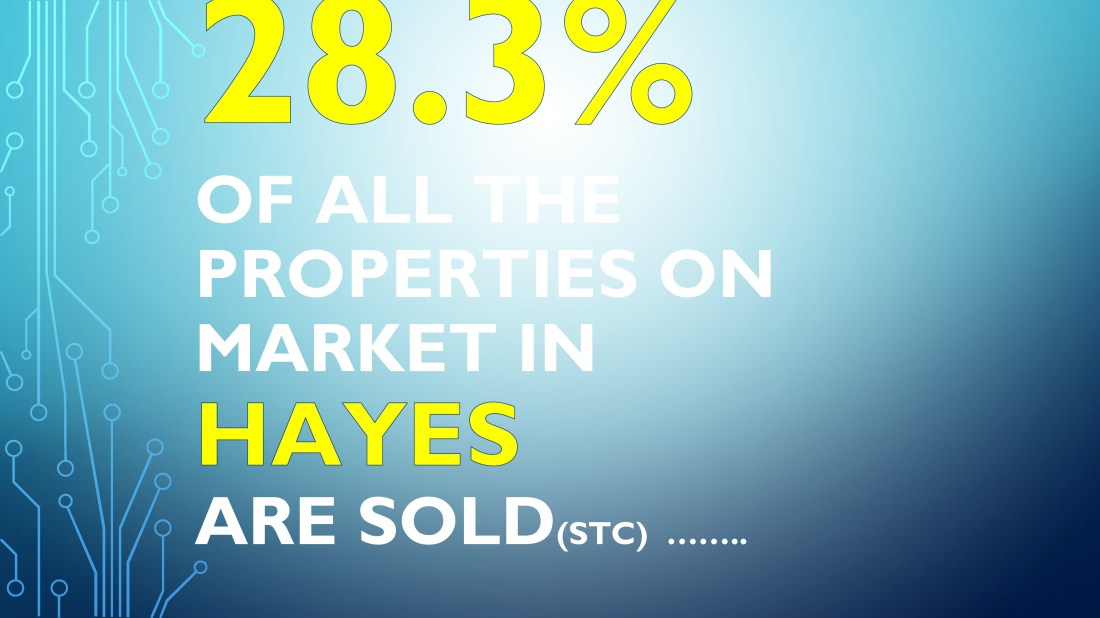
As 28.3% of Hayes Property on the Market is Sold Are there any bargains because of Brexit?

Bargains – well yes and no – and let me explain why. To find a bargain you need to know the ‘market’, yet there is not one ‘property market’ in the UK. In fact, the British property market is like a fly’s eye, it looks one whole but in fact it is split into lots of fragmented pieces and the same goes for the Hayes property market as that too is split into different patches… in fact it can even come down to two streets adjacent to each other, one street selling like hot cakes for top dollar whilst the next street can stick and at comparatively lower prices (i.e. if there is a school catchment boundary or differing postcode).

According to Coutts, property values in ‘Prime London’ have dropped by 14.7% in the last 5 years … yet look closely at those stats and Prime London is considered anything within a 1,500m radius of Kensington High Street above £4.6m – a totally different world to the average property in Hayes, which is worth just under £370,000 and has risen in value over those same 5 years by 39.0%  .. a different world!

I have noticed that the top end of the market above £750,000 in Hayes and the surrounding areas is proving a little tougher to shift than a few years ago, yet this can’t all be blamed on Brexit, as buyers have long been flinching at overestimated asking prices and excessive stamp duty rates.

In Hayes, 34.5% of properties for sale have

reduced their asking price in the last 3 months by

an average of 4.8%

A lot less than the reductions that are being seen in central London. In fact, the property market in Hayes is looking reasonably good with

28.3% of properties on the market in Hayes being

shown as under offer and Sold subject to contract

…Interesting when compared with the aforementioned London Prime market where only 5.86% of the properties for sale are sold .. some bargains to be had there!

So, where are the bargains in Hayes? Well, to start with, it’s all about knowing the local Hayes market. It’s all about comparing and contrasting property, so to start with, check out the property web-portals such as Zoopla and Rightmove to see what’s for sale. The art here is to click on the ‘include Sold stc’ in the filters .. then arrange them in price order. Then you will get a feel for what properties are roughly selling for. Also look at recent sales, so in Rightmove click on ‘House Prices’ on the main menu, on the proceeding drop down menu click on ‘Find Sold House prices’ and now you can type in a street, or even a street plus 0.25miles/0.5miles .. click on ‘List View’ and they are in date order. There is a similar function in Zoopla (feel free to contact me if you need a hand with that).

Then once you have found what you think is a bargain .. view it. Ask the agent why the sellers are moving.  By doing your research on the seller, seeing how long it has been on the market, whether they have reduced the asking price (if you ask an agent they have to tell you and by how much)  — you could cut a better deal if they are compelled to sell. Push home your advantage i.e. if you are a first-time buyer, don’t have a property to sell, chain free or cash purchaser it can all make a difference.

Looking at the numbers above, some savvy Hayes landlords and home buyers are taking advantage of the doom and gloom newspaper headlines as property owners’ expectations are probably at the lowest they have ever been since the Credit Crunch, especially if they are in the ‘got to sell’ category instead of the ‘would like to sell’ category.

Like anything in life .. buying a property bargain comes down to putting the hard-work in, doing your homework and jumping at opportunities. 8