Do We Have the Right Sort of Hayes Homes For the 21st Century?

Would it surprise you to know that in some parts of Hayes, predominantly prosperous areas with high proportions of mature residents, the housing crisis is not one of supply so much as dispersal of that supply? Theoretically, in Hayes there are more than enough bedrooms for everyone – it’s just they are disproportionately spread among the population, with some better-off and more mature households living in large Hayes homes with many spare bedrooms, and some younger Hayes families being over crowded.

Yet it is not the fault of these well-off mature residents that this is the current situation. Let’s be frank, Hayes doesn’t have enough housing full stop (otherwise we wouldn’t have the large Council House waiting list and all the younger generations renting instead of buying), but up until now it hasn’t been clear that Hayes actually also has the wrong types of properties.

We’re not building the smaller homes in Hayes that are needed for the starter homes and we aren’t building enough bungalows for the older generations, so they can be released from their larger Hayes homes, thus allowing those growing Hayes families to move up the ladder.  

Looking at th e stats for Hayes, and UB3 in particular…
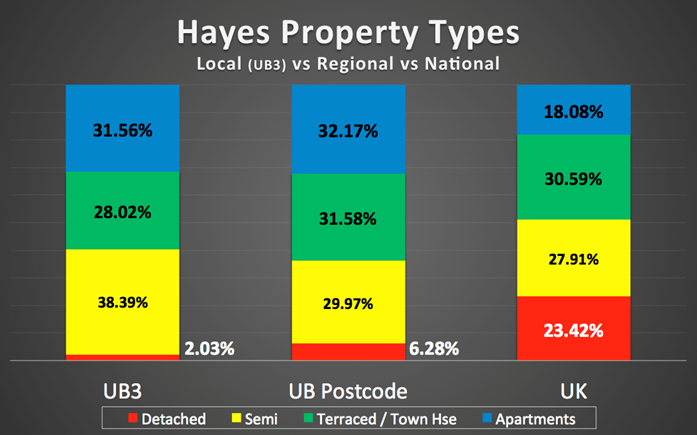
Property type UB3 UB Postcode UK
Detached 2.03% 6.28% 23.42%
Semi 38.39% 29.97% 27.91%
Terraced / Town House 28.02% 31.58% 30.59%
Apartments 31.56% 32.17% 18.08%

When I compared Hayes (UB3) with the regional stats of the UB postcode, the locality has proportionally 28.1% more semi-detached homes, yet 67.7% less detached. Looking nationally, Hayes (UB3) has proportionally 74.6% more apartments and not surprisingly, proportionally 91.3% less detached.

I am finding that there has been a shortage of smaller townhouses and smaller apartments being built in Hayes over the last 20 years, because most of the new builds in the last couple of decades seem to have been either large executive houses or the apartments that have been built were of the larger (and posher) variety, even though demand for households (as life styles have changed in the 21st Century) have been more towards the lower to middle sized households.

The builders do want to build, but there’s a deficiency of building land in Hayes, and if there’s a shortage of building land, then of course new homes builders build whatever gives them the biggest profit. The properties that give them the largest profit are the biggest and most expensive properties and they certainly are not bungalows as they take up too much land. So who can blame them?

Yet would it surprise you to know that it’s not a lack of space (look at all the green you see when flying over the UK), it’s the planning system. Green belts must be observed, but only 1.2% (yes 1.2% – that isn’t a typo) is built on in this country as a whole with homes – we need the planners to release more land (and then force/encourage builders to build on it – not sit on it). Another problem is that of the smaller new homes that have been built, most of them have been snapped up for renting, not owning.

So, what’s the answer? Build more Council houses? Yes, sounds great but the local authority haven’t enough money to cut the grass verges, let alone spend billions on new homes in Hayes. The Government did relax the planning laws a few years ago, for example for changing office space into residential use, yet they could do more as currently new homes builders have no incentive to build inexpensive homes or bungalows that the system needs to make a difference.

So, what does this mean for Hayes homeowners and Hayes landlords?

Changing the dynamics of the Hayes, regional and national property market will only change in decades, not years.  The simple fact is we are living longer, and we need 240,000 to 250,000 houses a year to stand still with demand, let alone start to eat into 30 years of under building where the average has been just under 170,000 households a year.

That means, today as a country, we have a pent-up demand of 2.25m additional households and we need to build a further 4.2m households on top of that figure for population growth between 2019 and 2039. So, irrespective of whether we have short term blip in the property market in the next 12/18 months, investing in property is, and always will be, a great investment as demand will always outstrip supply.
15% less homes for sale in Hayes than a year ago

One of the key factors of the health of the Hayes property market is the number of properties for sale at any one time. The issue with housing is that when demand goes up, unlike with a chocolate bar factory, who can add a couple of hours overtime to increase supply/production to satisfy demand, it takes a good 18 months to two years from planning permission to someone moving into a home.  I have talked at length (and proved) in previous articles that we are still not building enough homes in the long term in the Hayes area.. yet for the short term, a good indicator is the number of properties for sale and how long they have been on the market.

How long a property has been on the market is important as a guide to how the property market is performing – potential buyers can always find this information on the Rightmove and Zoopla listings (if you don’t know where – drop me an email or message and I can let you know).

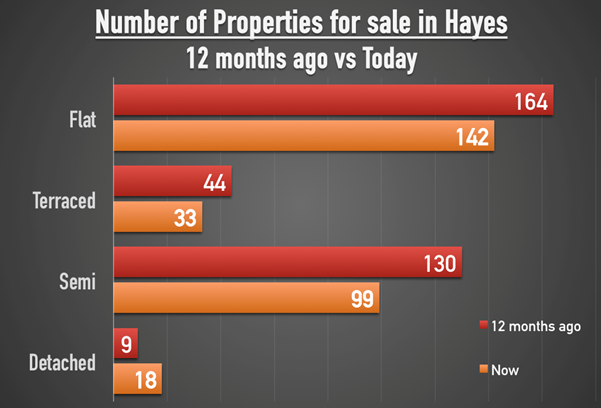
So, let’s have a look at what is happening in Hayes, both in terms of the number of properties for sale and how long they have been on the market compared to a year ago, then discuss what that means for the current state of play of the Hayes property market. So to start, let’s look at the number of properties for sale in Hayes compared to a year ago.

Interestingly, you can see there has been a proportional increase of 100% in detached properties on the market in Hayes, yet a 25% reduction in terraced property .. overall in the last year there are 15% less properties on the market in Hayes, compared to a year ago. Now, let’s look how long they have been on the market ..

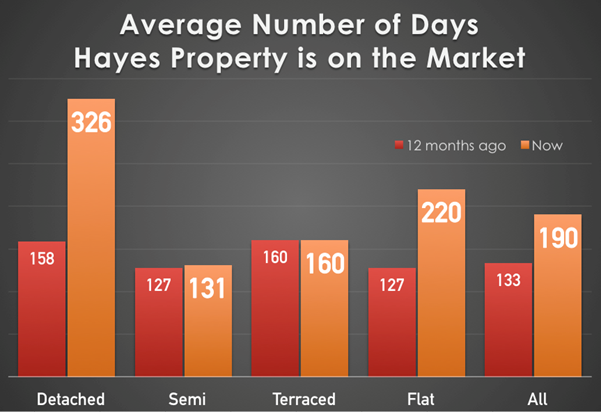
Interesting to see that the biggest jump in the number of days on the market is detached houses, from 158 days to 326 days .. demand and supply working again. Also, the length of time an average Hayes property has been on the market has increased by 43% in the last year.

So what does this all mean for Hayes Buy To let landlords and Hayes homeowners looking to buy and sell?  Well, if you are thinking of selling, as the number of properties on the market has decreased and the length of time Hayes properties are on the market has increased – you have to be mindful that realistic pricing is the key to get the property sold. If you are a buyer, that means you find yourself in a better position to negotiate a good deal on your Hayes property purchase.

There is an argument to suggest that property buyers see excessive days on the market as an indication that the seller is becoming desperate to sell because the property hasn’t sold. Buyers are also mindful to believe that there might be something wrong with the home, a defect that caused other buyers to pass it up. This can concern them when they view the property – if they view it at all, as that possible and perhaps made-up defect is on their minds, even if it is sub-consciously.

Normally, both assumptions are wrong. A property can loiter on the market for several reasons. The most common reason for a property sticking on the market is overvaluing or overpricing. In an effort to get the property on the market, some estate agents may have deluded the seller into believing the property was worth more than the property market will bear. Don’t get me wrong, if you don’t ask, you don’t get and homeowners naturally want to get the best price for their home, and so test the market. Yet, if you aren’t getting a steady stream of viewers after a few weeks, then that testing can back fire. You see, by setting the asking price too high to see if they can find someone to pay that inflated price, then finding there is nobody in the market that will pay the price, here lies the biggest trap for house sellers on keeping the inflated asking prices for too long.

Sellers can also get stuck on an asking price and they are willing to wait out the market until it catches up to what they want for their property – yet we aren’t in that type of property market at the moment. Consumer champion Which said that if you have to reduce your asking price by 5% or more, it adds an extra 64 days to the sales process meaning you might lose the property of your dreams.

Also, I have seen countless times, house sellers insist on an inflated asking price, reduce 12 weeks later, yet buyers think there is something wrong with it so the homeowner gets fed up and accepts a lower offer to get the property sold, whereas if the house seller had gone onto the market at the right asking price, they would get much nearer to what they deserve for their property.

So, if you are looking for a bargain to buy – all the Portals (Rightmove, Zoopla and On The Market) allow you to search and sort by the length of time on the market as well as the asking price.. who knows – there could be a bargain waiting for you!

Unemployment – the Secret Driver of the Hayes Property Market?

If you have been reading my articles on the Hayes property market recently, you will see that in the three years since the referendum of the ‘B’ word (that word is banned in our household), we have proved beyond doubt that it (whose name shall remain nameless) has had no effect on the Hayes property market (or the UK as a whole).

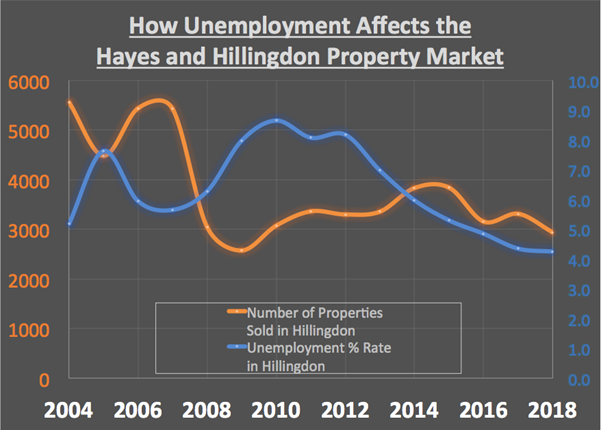
So one might ask, what does affect the property market locally? Well many things on the demand side include wages, job security, interest rates, availability of mortgages, confidence in the economy, inflation, speculative demand … the list goes on. Yet as my blog readers will note, I like to delve deeper into the numbers and I have found an interesting correlation between unemployment and the number of properties sold (i.e. transactions).

Why transaction levels and not house prices? Well just looking at Hayes house prices as a bellwether has flaws. Many property market commentators and economists believe transaction numbers (the number of properties sold) give a more accurate and candid indicator of the health of the property market than just house values alone. The reason is twofold. First most people when they sell also buy, so if property values have dropped by 10% or risen by 10% on the one you are selling, it would have done the same on the one you are buying – meaning to judge the health of a property market is very one dimensional. Secondly, the act of moving is very much a human thing. Property habitually conveys a robust emotional connection with homeowners – a connection that few would attribute to their other investments like their savings or stock market investments. Moving home could be described as a human enterprise, moving from one chapter of one’s life to another. When people move home, it shows they are moving forward in their lives and so this gives a great indicator of the health of the property market.

If we look at the national picture since 2004, there has been an inverse relationship between unemployment and housing transaction levels (i.e. as unemployment rose nationally in 2008/09 – housing transactions dropped – yet as the national economy started to improve in 2011, unemployment dropped and housing transactions increased) yet Hillingdon has bucked that trend.

Year Unemployment  % Rate in Hayes and Hillingdon Number of Properties Sold in Hayes and Hillingdon
2004 5.2 5558
2005 7.6 4481
2006 6.0 5437
2007 5.6 5430
2008 6.3 3047
2009 8.0 2572
2010 8.7 3073
2011 8.1 3361
2012 8.2 3298
2013 7.0 3355
2014 6.0 3831
2015 5.3 3839
2016 4.9 3155
2017 4.4 3311
2018 4.3 2938

Whilst outside the M25 there has been a link between unemployment and housing transactions, this is not the case in Hillingdon (and most of London as whole in fact when I checked the stats for other Borough’s in the capital).

In future articles, I will explore the unique nature of the Hayes (and London) property market compared to the rest of the UK, but to finish off this week’s article, I want to discuss how we as a country (and indeed here in Hayes) over the last 40 years, we have seen a shift in the outlook over the purpose of housing and the development of the religion of following house prices (and I appreciate the irony of me writing these articles on Hayes – feeding that habit!) Yet, when did owning a home turn from buying a roof over your head to an out and out investment vehicle? I do wish people would stop fretting about their intrinsic value being associated with their Hayes home. Now of course, I am not dismissing the current levels of Hayes house prices – we just have to take into consideration other metrics alongside them when judging the health of the property market locally.

One final thought, looking on a broader scale in the UK, those towns and cities whose property markets bounced back after the Global Financial Crash had high levels of employment and low unemployment whilst places with high unemployment and relatively low employment have, on the other hand, typically underperformed. 

So the next time you are considering a house move or buying a buy to let property in Hayes … don’t make your judgement on house price growth alone.

Property transactions in Hayes dropped by 52.63%, whilst unemployment in Hayes rose by 41.15% during the 2007 to 2009 Global Financial Crash

Hayes House Prices Up 2% in a Year

What does that mean for local Landlords and Homeowners?

The balancing act of being a Hayes Buy To Let landlord is something many do well at. Talking to numerous Hayes landlords, they are very aware of their tenants’ capability to pay the rent and their own need to raise rents on their rental properties.  Despite the ‘perceived ‘dark clouds of Brexit, evidence suggests many landlords feel more confident than they were in the Summer and Autumn of 2018 about aiming to push rents higher on their Hayes Buy To Let properties.

Looking at the data for the last 7 years, this shows that throughout the Summer months, the rents new tenants have had to pay on move in have increased at a higher rate than during the colder months of Winter.  This is because the Summer months are normally a time when renters like to move, meaning demand increases for rental properties yet supply remains pretty ridged.

Yet the Winter stats buck that trend and this is great news.

Rents in Hayes on average for new tenants moving in have fallen 0.5% for the month, taking overall annual Hayes rents 3.7% higher for the year

However, several Hayes landlords have expressed their apprehension about a slowing of the housing market in Hayes and I believe, based on this new evidence, they may be overstated.  Before we get the bubbly out though, the other part of investing in property is what is happening to capital values (which will also be of interest to all the homeowners in Hayes as well as the Hayes Buy To let landlords).   I believe the Hayes property market has been trying to find some form of balance since the New Year.   According to the Land Registry….

Property Values in Hayes are 2% higher than they were 12 months ago

Yet, these figures reflect the sales of Hayes properties that took place in the Spring of 2018 and only exchanged and completed during the Summer months of last year.

The reality is the number of properties that are on the market in Hayes today has risen by 4% since the Spring

and that will have a dampening effect on the property market.  As tenants have had less choice, buyers now have more choice .. and that will temper Hayes property prices as we head into the middle of 2019.

Be you a Hayes landlord or Hayes homeowner, if you are preparing to sell your Hayes property in 2019, it’s important, especially with the rise in the number of properties on the market, that you are pricing your property realistically when you bring it to the market.  With the likes of Rightmove, Zoopla and OnTheMarket on everybody’s mobile phones and laptops, buyers have access to every property on the market and they will compare and contrast your home with other properties like yours – and will more than likely dismiss your property rather than view it.

To all the Hayes homeowners that aren’t planning to sell though – this talk of price changes is only on paper profit or loss.  To those that are moving .. most people that sell, are buyers as well, so as you might not get as much for yours, the one you will want to buy won’t be as much.  Look at the deal as a whole, the difference between what you sell yours for and what you buy at.  Finally, all the Hayes landlords – keep your eye’s peeled – I have a feeling there may be some decent Hayes buy to let deals to be had in the coming months.

New Home Building in Hayes and Hillingdon 2018 rises to 33.6% above the post Millennium average

Nationally, the number of new homes created in 2018 was 222,194, the highest since 1989. Yetsince 2002, the average number of properties built in the UK has only been 146,700 per year. You would think, seeing all the new homes sites around, you could ask are we building too many houses, especially off the back of those impressive 2018 build figures? However, to keep up with the ever-growing population, lifestyles and people living longer, official reports state the Country actually needs 240,000 new homes built every year to just stand still.

It is estimated, by the Chartered Institute of Housing, that the current national backlog of new homes required is in the order of 4.7 million (i.e. because of the bottled-up household formation by younger adults living with parents, shared housing and unaffordability). As a Country, we cannot meet all these needs immediately and it will take time to build up an effectual plan to address these issues.

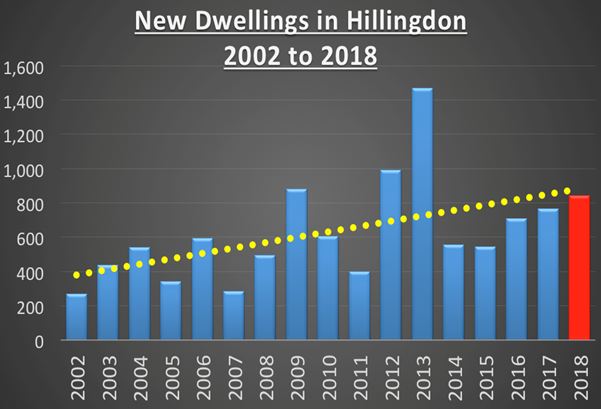
Looking closer to home, you will also see from the graph below the long-term trend of new homes building (the yellow dotted line) has been going in an upward direction. In fact, the 2018 new homes build stats for Hillingdon are 33.6% above the post Millennium average.

But, we still need more homes… yet who is going to build (and pay) for them. Some Hayes people will say why can’t the local authority build most of them?

In 2018, 842 new dwellings were created in the Hillingdon Council area and of those 842; interestingly 47 were Council and Housing Association homes

So, if our local authority had a more ambitious annual target of say an additional 500 homes on top of those figures, where could they be built and how would they be paid for? Of course, there are the normal apprehensions about infrastructure issues such as roads, schools, hospital capacity and doctors’ surgeries but our local authority has a Local Plan and that has the locations of where they envisage the new housing will be built (and the infrastructure that goes with it).

The Tories lifted the cap on what local authorities could borrow to build Council houses in late 2018 meaning Councils could borrow more money to build more Council houses. Let’s say we built those 500 homes a year for the next 5 years in Hillingdon, that would cost the local authority £375 million to build, which would produce in total £17.4 million in rent. At current interest rates, the interest would be £9.5m per year leaving a surplus of £7.9m for property maintenance and management – meaning the Council houses pay for themselves!

Therefore, what does all this mean for Hayes homeowners and Hayes buy-to-let landlords?

Well, the chances of our local authority getting the full funding for an extra 500 homes a year is slim as there is only so much money to borrow. If every UK local authority got funding for 500 additional homes a year for the next 5 years, an impressive 867,500 homes would be built in those 5 years but that would require the councils to borrow £130.1bn – and Central Government doesn’t have that kind of money for Councils to borrow (more like £10bn to £15bn).

The 4.7million long term housing shortage means house prices will remain strong in the long term (despite blips like Brexit etc). Demand for private rental properties will continue to grow and if you read my recent article on Hayes rents, this can only be good news for Hayes landlords. This attention on the housing crisis by the Government is good news for all Hayes homeowners and Hayes buy to let landlords, as it will encourage more fluidity in the market in the longer term, sharing the wealth and benefits of homeownership for all. However, in the short term, demand still outstrips supply for homes and that will mean continued upward pressures on rents for tenants and stability on house prices.