Is Hayes Too Densely Populated?

Has England’s green and pleasant land all of a sudden become England’s green and overcrowded land?

With the nation’s ever-increasing population and the double whammy that people are now living longer, this means as each year goes by, there is an ever-growing strain on public services and in particular my favourite topic – housing. It’s no wonder some people are saying things are at crisis point when it comes to infrastructure (like roads, schooling etc) and in particular housing.  I hear it all the time, people complaining that Hayes looks like a building site and, we are packing people in like sardines into our Hayes homes. Yet I wanted to find out exactly what the truth was.

Starting with the UK as a whole, there 698 people per square mile whilst in England, there are 1,103 people per square and finally in Greater London 14,587 people per square mile  … these all sound quite awful numbers, until you drill down and realise a square mile is an awfully big area – there are only 93,600 square miles in the whole of the UK and that includes the wilderness areas of Scotland!

Let’s look at more realistic areas of land … and I want to look at my favourite – the acre. To those born after the mid 1970’s, an acre is roughly half the size of a football pitch or a square roughly 63 metres by 63 metres and there are just less than 2.5 acres in a hectare.

The population of Hayes is 48,133 (UB3) and the total area is 3,484 acres, meaning 13.82 people live per acre in Hayes

So, how does that compare to neighbouring areas and towns…

Location and Postcode Population Area in Acres Population Density – # People per Acre
Hayes – UB3 48,133 3,484 13.82
Southall – UB1 40,374 1,309 30.85
Hounslow – TW5 29,463 1,549 19.03
Northolt – UB5 45,955 2,174 21.14
Feltham – TW13 36,258 2,530 14.33

As you can see, only just under 14 people live per acre in Hayes, interesting when compared to both Greater London, which has density of 23.26 people per acre and London’s most crowded suburb, Pimlico at 92.32 people per acre. Yet even Pimlico is nothing to the Collblanc district in Barcelona, which has 214.8 people living it per acre.

So, is Hayes over populated? Yes, it seems that way at school time or rush hour when sitting in traffic that Hayes is over populated – yet the stats show – we aren’t.

Evidently, we are never going to have an even spread of population as can be seen from the figures in the table, and the remote nature of some parts of the Country would not be able to withstand high densities of new people without enormous infrastructure investment.

Yet could we accommodate a much larger population in the UK (and Hayes) although there would be trade-offs? Look back at the 17th and 18th century and certain sectors of society were warning about population growth. The population of the UK in 1801 was 10.5 million and even with the growth of the population since then, only 1.2% of the UK is currently built on for housing purposes.

The question, it seems to me, is not can we manage but how

would a larger Hayes population change our way of life,

both for better and possibly worse?

The planners have a responsibility to ensure Hayes provides its fair share of new homes to accommodate this population growth in the coming years. The local authority has a responsibility towards adequate provision of the infrastructure of roads, hospitals and schools etc., to match the growth in housing. This is not a political topic and I hope once the ‘B’ word is finally sorted we can get on with addressing the shortage of affordable new homes for future generations.

Hayes Homeowners can now build larger extensions without planning permission.

The need for more homes has always been one of the biggest issues with regard to the Country’s housing crisis.  One of the main reasons for families wanting to move home is the need for more accommodation as their families grow and so in 2013 and 2015, the planning permission rules were relaxed to try an alleviate this issue.

Initially in 2013, Nick Clegg, as Deputy Prime Mister, brought in temporary planning rules to allow larger single storey rear extensions without the requirement of a full planning application.  The temporary rules allowed terraced and semi-detached homes to be extended by just over 19ft, whilst detached houses were able to add even bigger extensions of up to 24ft.  Since those rules were relaxed six years ago, 109,320 people have taken advantage of the temporary rules (aka “permitted development size guidelines”).

Homeowners wanting to extend within these permitted development guidelines, must still inform the local authority of the extension beforehand, and local authority officials still need to then notify the neighbours.  If the neighbours object, the local authority could still stop the extension being built, but only if it is likely to damage the character or enjoyment of the neighbourhood.  The planning process exists for a reason and whilst these relaxed planning rules are popular with property owners, it does mean local authorities have little chance to deliberate the impact of these extensions on their locality.  However, 22,779 permitted developments had been refused in the same time frame meaning, 17.2% of permitted development planning applications have been refused since 2013.

Now these temporary rules have been made permanent recently as the Government believe these measures will help households extend their properties without fighting through the time-consuming red tape of obtaining planning permission.  The government believes this is part of a package of planning reforms to build more households, build them better, quicker and make the housing market work, meaning families can grow without being forced to sell and move… or does it?

The average size of a property

in Hayes is 840 sq.ft

.. internally (962 sq.ft  externally), whilst to the national average 929 sq.ft internally (1,081 sq.ft externally).  Interesting when compared to the average size of a new homes built nationally which is 12.1% lower at 818 sq.ft internally (927 sq.ft externally).

These relaxed rules are only for single-storey extensions though, when most growing families don’t need an extra downstairs reception room, they need an additional upstairs bedroom.  This means if families do want an extra bedroom upstairs, they will still have to go through the rigmarole of submitting a full planning permission.  Although, many Hayes people have used these rules in the last 6 years to build a decent size granny-annex – there are other options less explored out there.

There was a second (less advertised) temporary change the Government made to planning rules in 2015, that has also been made permanent recently, many may have missed it, yet it has a bigger potential impact on the housing market.  The new rules make permanent the removal of planning rules to allow office blocks and shops to be converted into residential homes without a full planning application being made.  Since 2013, 11,090 office blocks and 1,750 shops have been converted into residential households.  This doesn’t sound a lot, but in 2017 alone, converted shops and office blocks provided 37,000 new households alone in the Country (or 17% of the new household created in 2017).

Over the next decade, more and more office blocks and shops will be converted into residential properties … and this will slowly change the dynamic of the housing market and the high street … and I’m not sure whether that will be for the good or bad … only time will tell?

Which Street in Hayes has seen the most homeowners moving in the last 3 years?

Lots of people say moving home is one of the top ten most stressful events in your life. Fortunately, there is a way to mitigate your stress. In a nutshell, start as early as you can, plan ahead and do everything you can to make it easy on yourself, your family and even the family pet. As an agent in Hayes, my team and myself have been helping homeowners, landlords, buyers and tenants move, sell and let their Hayes homes for many years. So I thought I would share some top tips for making your move as stress free as possible – then find out which streets in Hayes have moved the most in the last 3 years.

The first tip is to plan ahead and write a list; because whilst it is taking between 15 and 20 weeks at the moment from finding a buyer to moving, those few weeks will fly by in no time as day to day life carries on. Next, get yourself a decent home removal company as they are worth their weight in gold on moving day – and if you need to know a good one in Hayes – drop me a line and I will let you know who my clients are raving about.

Next, a cluttered Hayes home doesn’t sell or let well, so maybe consider decluttering before you market the property. It will sell/let better and when it comes to the move – the job will be so much easier. Know where you plan to put all your important documents (like Passports and Bank PIN etc). Tell your utility providers and it is a good idea to create electronic copies of significant documents by scanning and saving them onto a USB stick and don’t forget to get your mail redirected.

On the day of moving home stress levels will be high and I know you will want to get everything packed away and have the tea on by 5.30pm! Those who have moved many times know that isn’t the case. Be realistic, as it’s doubtful you are going to unpack all your boxes in your new home by the end of the first day.

Make sure to keep your ‘Moving Day Survival Equipment’ close by, change of clothes, wash equipment, cold bottles of water, biscuits, kettle, tea/coffee/milk, crisps (even G&T??) to keep your spirits, morale and energy up – you will be fine.. but it will take a few days to completely unpack and get your new Hayes home the way you would like it to be. As long as you have your bed set up and made by the end of moving day – you can have the rest of the weekend to get ship shape. 

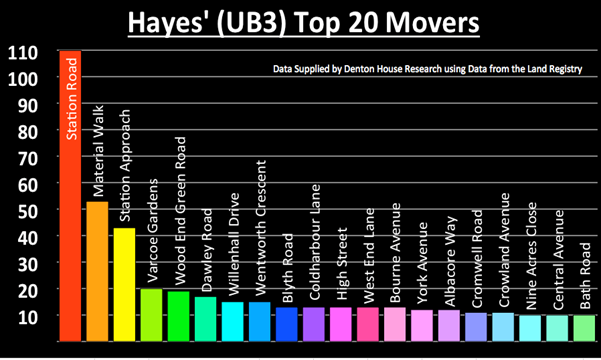
So, which street or road in Hayes (UB3 to be more precise) has put themselves through one of the most stressful moments in their life over the last 3 years? Which street has seen the most home moves and experienced the trials of moving home.

Station Road comes in at the top spot, with 110 home movers in the last 36 months with a total property value of £32,950,000 sold, interestingly there are 317 properties on the road … so have a look at the top 20 and see if your street is in the Top 20!

… but before you go, if you do need any help or guidance about moving home or advice about the current state of the Hayes property market, then feel free to drop me a line or read the other articles in my blog on the Hayes Property market.

UB3 Street or Road Number of Properties Sold
in the last 36 months
Total Value
of Property Sold
Station Road 110 £32,950,000
Material Walk 53 £18,409,000
Station Approach 44 £13,977,000
Varcoe Gardens 20 £7,106,000
Wood End Green Road 19 £6,867,000
Dawley Road 17 £6,198,000
Willenhall Drive 15 £3,801,000
Wentworth Crescent 15 £6,552,000
Blyth Road 14 £3,921,000
High Street 13 £3,951,000
West End Lane 13 £3,820,000
Bourne Avenue 13 £4,276,000
Coldharbour Lane 13 £4,601,000
York Avenue 12 £4,616,000
Albacore Way 12 £4,052,000
Cromwell Road 11 £3,990,000
Crowland Avenue 11 £4,506,000
Bath Road 11 £2,966,000
Church Road 10 £4,473,000
Roseville Road 10 £4,348,000

The Affordability of Buying Property in Hayes

Looking back at the 75th Anniversary of the D-Day landing a few months ago, it reminded me of the huge changes that have happened to Hayes and more specifically the Hayes property market since WW2. Back in 1946, the average wage in Hayes was just over £5 a week and to buy an average car would cost you just under £600, yet this is a property blog, so…

The average value of a Hayes property in 1946 was £1,365

In fact, in those 75 years, the average Hayes house had doubled in price by 1961, then again in 1971, 1975, 1980, 1988, 2000 and 2006. Now a lot of those increases (especially in the 1970’s) were caused by hyperinflation, yet since the start of the 21st Century inflation has been kept low and since the Credit Crunch (2008/9), whilst property values have been rising, they haven’t been at the rates experienced in the latter half of the 20th Century.

Now what a property sells for is irrelevant, its whether someone can afford it.

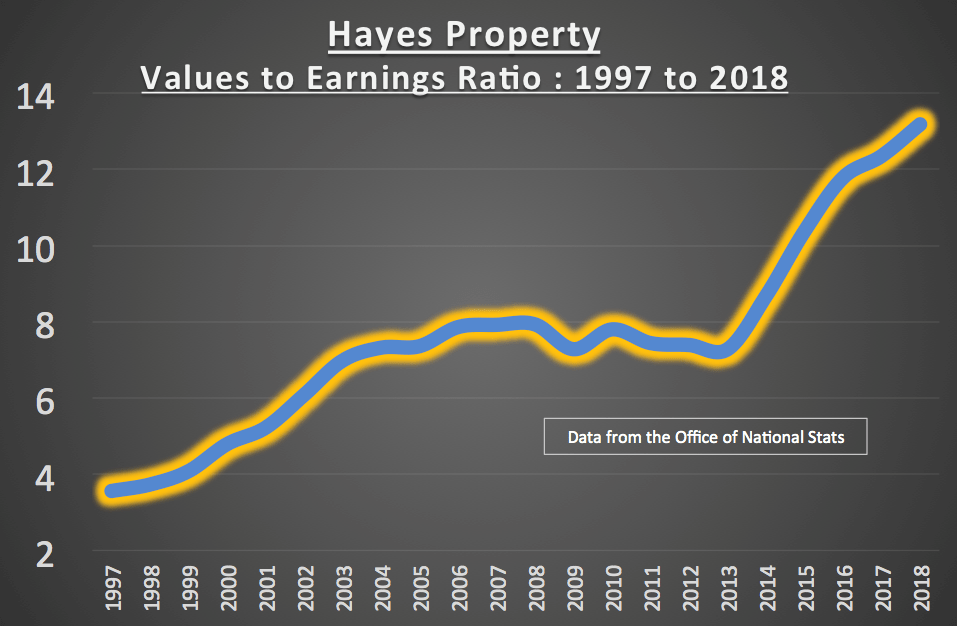
Increases in Hayes property values have produced huge increases in equity for many Hayes homeowners and Hayes buy to let landlords, yet on the other side of the coin also making housing unaffordable for other people. The best measure of the affordability of housing is the ratio of Hayes property values to Hayes average earnings (i.e. salary/wages). The ratio works on the basis the higher the ratio, the less affordable properties are.

In 1997, the average value of a Hayes property was 3.6 times higher than the average annual wage in Hayes, in 2006 it peaked at 7.9, yet three years later it had dropped to 7.3 and since then has slowly risen to 13 times higher!

It can be seen that even though property in Hayes became more affordable after the 2007/8 property crash (i.e. the ratio dropped), in subsequent years, with house values rising but earnings/salaries not keeping up, the ratio started to rise. This has meant there has been a decline in affordability of property in Hayes over the last five years – so for those on particularly low incomes or with little capital, it unfortunately means that buying a Hayes home will never become an option.

Therefore, the demand for private rented properties in Hayes will continue to grow as many young Hayes people are deciding to rent instead of buy their own house (knowing when their parents pass away, the equity built up in their parents property will be passed down – and then they can buy in their 50’s and 60’s – just like it happens in Germany).

Yet, that is many decades away and with fewer Hayes people wanting or able to save up the 5% deposit required by mortgage lenders, more and more people are looking to rent. Tie this in with the subtle shift in attitudes towards renting since the Millennium and less people jumping the on the bottom rung of the property ladder, this has driven rents and demand up in Hayes over the last few years. Yet (and it’s an important proviso) the type, location and demands of Hayes tenants has changed over that same time frame meaning you can’t just make money from buy to let as easily as falling off a log like you did in the early 2000’s.

If you are an existing landlord with us (or even another agent in Hayes) or someone thinking of becoming a first time Hayes landlord looking for advice and opinion and what (or not to buy in Hayes), one source of information is the http://www.hayespropertyblog.com – or drop me an email or phone call and let’s start a conversation – I don’t bite and I don’t do hard sell … and maybe, just maybe, I could help you get better returns from your property portfolio.

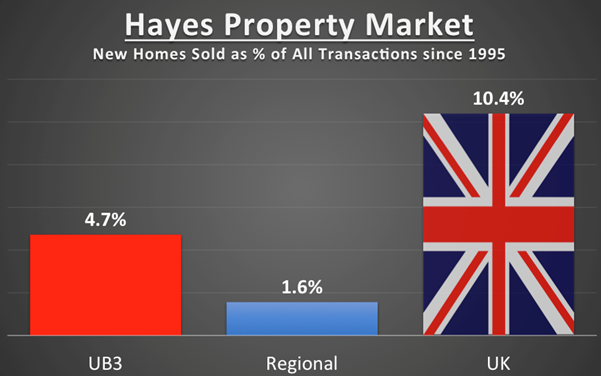
4.7% of all Properties Sold in Hayes are New Builds

Of the 14,700 houses and apartments sold in Hayes (UB3) since 1995, 1,030 of those have been new homes, representing 4.7% of property sold. So, I wondered how that compared to both the regional and the national picture …and from that, the pertinent questions are: are we building too many new homes or are we not building enough?

Roll the clock back a few years and in 2013 the Government expressed its disappointment that, as a Country, builders weren’t building enough new homes to house our citizens. They promised to hasten new homes building to the fastest rate since the 1980’s when the Country was building on average 168,100 private households a year. The Housing Minister stated he wanted the private sector to build in excess of 180,000 households a year, a figure which seemed unachievable at the time. In 2013, private house building was in the depths of a post Credit Crunch dip, with just 96,550 private new homes being built that year. Yet, in the five years since then, private new-build completions have climbed steadily, rising by 59.5% to 154,100 new home completions in 2018..so on appearances alone, whilst the growth is impressive, the new homes builders haven’t met their targets….. or have they?

In addition to the 154,100 new homes completions in 2018, the private sector also provided an additional 29,700 new households gained from change of use between office, industrial and agricultural buildings to residential homes meaning, last year, the private sector created 183,800 new households. When we look at the public sector, there were 30,300 Housing Association new homes and 2,950 Council houses built last year, meaning after making a few other minor adjustments, the total number of new households/dwellings created in the UK in 2018 was 222,190.

Most of the growth can be credited to an improving economic framework, though continued help for first time buyers with the Help to Buy Scheme has enabled some younger buyers to bypass the issue of saving for a large deposit for a mortgage when buying a home, thus supporting confidence among new home builders to commit to large building schemes. Yet there is more to do. The Government wants the Country to return to the halcyon days of the 1960’s where, as a Country, we were building 300,000 additional homes a year  .. and they want that to happen by 2025, a 36% increase from current levels.

In 2019, the country will create 257,500 households, so we are on our way to meeting that target but maintaining this level of house building will be a test. Even the Governments’ Auditors (the Office of Budget Responsibility) is predicting net additional dwellings will plateau at about 240,000 in the first few years of the next decade.

So, how does Hayes sit within this framework?

The UK currently has 27.2m households, of which 2.45m (9%) of those have been built since 1995, whereas in Hayes, of the 19,500 households in UB3, 1,030 were built since 1995 (representing 5.3% of all households), meaning Hayes has a lower proportion of new homes building in the last couple of decades than the national figures.

I certainly feel there is an over reliance on the private sector to meet the Country’s housing needs. Local Authority’s need to step up to the plate and build more houses, and its true central government has released more cash for them to do just that, but probably only 20% to 25% of what is required. In the meantime, unless the Country starts to build 300,000 households a year, property prices will retain and improve their value in the medium to long term – which is good news for Hayes landlords and Hayes homeowners.