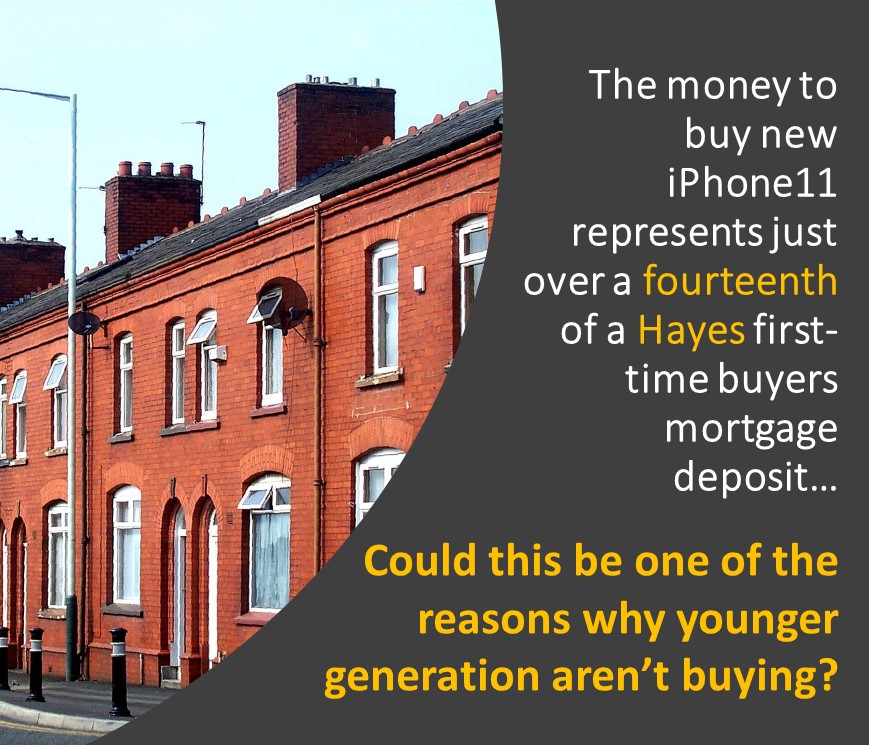
The money to buy a new iPhone11 represents just over a fourteenth of a Hayes first-time buyers mortgage deposit

Many mature readers of this Hayes property market blog will remember buying their first home as 20 or 30 somethings, probably in Hayes many years ago, yet read the newspapers now and feel it is all doom and gloom for todays’ first-time buyers.

So, I wanted to look at the facts, instead of newspaper headlines.

Back in 1995, the average Hayes first time buyers house cost £44,040, whilst official figures state today it is £248,400

So, looking at today’s property prices, it could be perceived that owning a home is beyond the reach of most Hayes first time buyers and that renting is the only way for younger members of Hayes society to have a roof over their head .. or is it?

100% mortgages (so no deposit needed to be saved) were rife in the 2000’s and Northern Rock were famous for their 125% mortgages (i.e. you borrowed 25% more than what you were paying for the house, again with no deposit). Yet when the credit crunch hit in 2008 such mortgages disappeared overnight – ending the dream of homeownership for many. Yet would it surprise you to hear that 95% mortgages (i.e. the first-time buyer would need to save a 5% deposit) have been available since late 2009 and 100% mortgages (i.e. no deposit) were made available in 2016.

It is £229 per month cheaper to buy a typical Hayes first-time buyer home than to rent the equivalent property.

Prospective Hayes first-time buyers could make a saving of £2,753 per year on average if they moved from renting to owning. My calculations assume that first-time buyers raise a deposit of just 5 per cent and make mortgage payments over 35 years with the Barclays 95% mortgage with a fixed interest rate of 2.48 per cent interest. At this level…

Today, the average deposit needed by a

Hayes first-time buyer is £12,420

Those able to raise that deposit, would pay £876 pm on average in mortgage payments, while the average rent for the same property would be £1,105 pm and the household income to support such a mortgage would need to be from £52,440 pa.

Of course, buying your first home is a massive financial commitment and investment with up-front costs to ponder on, yet long-term the financial benefits can be substantial. With annual savings of £2,753 a year, this can really mount up over time and, of course, once the mortgage is paid off, one will have a valuable asset.

Yet, the elephant in the room is the raising of the 5% deposit

Well most first time buyers, even most of you who are now in your 50’s and 60’s may have used the Bank of Mum and Dad to help with the deposit, yet it’s only fair that most parents still expect their offspring to contribute to the deposit and this is where it comes down to choice. I have spoken to many of my friends and family to reconfirm my initial thoughts that it comes down to priorities and choices in life. To save the deposit mentioned above, sacrifices are required to save that amount of money.

According to a survey in 2018, the average millennial goes out two nights a week and spends on average £63.36 per night out, that’s nearly £6,600 per year – a very expensive hobby. Nearly a third of millennials surveyed had smashed their mobile phone in the last 12 months. Then there is the obsession of having the latest tech, with the need to constantly be upgrading one’s mobile phone. In fact, the cost of the brand new iphone11, recently released, is just shy of £900. Even those on contracts can expect to pay upwards of £80 per month for the newest phone upgrade, yet if they kept their old phone after two years, a sim only deal with the same minutes and data would set them back no more than £25 per month … it comes down to choices. Save for a deposit and reduce your expenditure on socialising and mobiles etc and have a valuable asset at the end of your mortgage or continue as you are.

I am not here to make a judgement – everyone is free to make their own choices in life – all I am doing is highlighting the real situation – so you are aware of the full story.


Is This the End of No-Fault Section 21 Evictions for the 12,218 Hayes Tenants?

In the late spring, the Government announced that they were planning to end no-fault evictions for tenants living in private rented accommodation.

I have had a number of Hayes landlords contact me anxious that removing a tenant from their Hayes buy-to-let property in the future had possibly become a lot more problematic. Yet, at the launch of the consultation on the changes to the piece of legislation relating to no-fault evictions (called the Section 21 amendments), the Government wanted to assure British landlords that they would be protected by the bolstering of the existing Section 8 legislation. The current Section 8 allows landlords grounds for recovery of their properties for reoccupation of the landlord, non-payment of rent and other legitimate factors.

3,678 Hayes (UB3) landlords are affected by this

 potential change in the law

Yet, it is comforting for Hayes landlords and tenants in the fact that most competent letting agents very rarely have to evict a tenant. In the worst-case scenarios the tenant needs evicting (normally because rent hasn’t been paid) or because the landlord is either selling their buy-to-let investment or moving back into their property. Look at the consultation – it has been indicated that those grounds will not be removed from section 8 powers during the government’s consultation and the talk is they will be bolstered and improved. To put the removal of Section 21 notices into some context…

Only 22,527 section 21 notices made it to Court last year, out the 4.5million private rented households

Scotland banned no fault evictions (i.e. their own version of a Section 21) two years ago, and the model suggested by Westminster is similar to that of the new Scottish system. Landlords, tenants and agents have had to adapt north of the border, and there hasn’t been the mass exodus of landlords from the market since then.

Yet the call in the lettings and legal profession is … if the Government is intent on making these changes, we need well-funded courts which specialise in housing and tenancy matters (like there are for family law and children). Especially when the landlord manages the property themselves (without an agent), the issue of eviction comes about from a breakdown in communication between landlord and tenant. The courts could use their mediation skills to make it simpler and faster for tenants and landlords to obtain quick and available justice instead of the existing drawn out procedures under Section 8, which helps no one (not even tenants). This is important as the demand for Hayes rental properties is growing and people need a home to live in – fact.

Hayes (UB3) needs an additional 175 buy-to-let properties per year

for the next decade to meet the demand from Hayes tenants

As an agent in Hayes, I know most Hayes landlords consider buy-to-let in Hayes as a long-term investment, with the average landlord looking to retain their buy-to-let property for at least 10 years and beyond. Talking to other agents around the country, over 90% of Section 21 notices are made by the tenant, not the landlord. Removing the Section 21 notice could affect tenants more than landlords.

Replacing Section 21 with a process that requires a landlord to firstly have a good reason, and secondly go through due process, will likely remove the more unprincipled landlords from the property market. That is great news as those unprincipled landlords will either sell their properties to new buy-to-let Hayes landlords, or to tenants who want to buy them. So, it could be a small win for people looking for a new Hayes home, and a disappointment for unprincipled landlords simply looking for a cash cow ‘have no care about the property or tenant’ investment vehicle.

If you are a Hayes landlord and want to know more about this, whether you are a landlord of ours, a Hayes landlord with another Hayes agent or a self-managing landlord, feel free to drop me a line or pick up the phone (I don’t bite) to chat about the implications of this and other legislative changes that are on the horizon.

Mending the Broken Hayes and Hillingdon Property Market

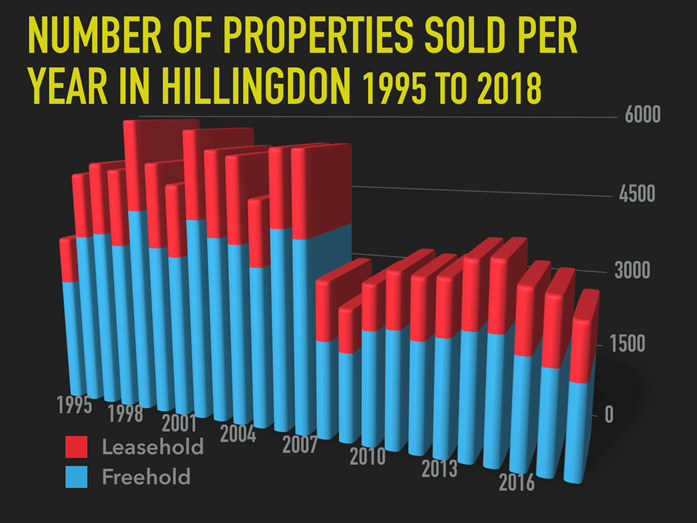
The long-lasting issue of the Hayes and Hillingdon property market are laid bare as the final 2018 property transaction figures have just been published and they continue the post credit crunch trend of less people moving.

36% less of Hayes and Hillingdon people are selling their homes annually since the credit crunch, when compared to the post Millennium years of 2000 to 2005

This is not just an issue of the Hayes and Hillingdon housing market slowing down since the credit crunch – the challenge is to split out shorter-term factors such as Brexit and the elections from longer-term structural issues of the UK society, because when these most recent property transaction figures are seen against longer-term trends for Hayes and Hillingdon, they suggest more significant issues in the Hayes and Hillingdon housing market.

In the late 1990’s, 4,860 properties were sold annually in the Hayes and Hillingdon area, then in the same area, the Millennium boom saw transactions rise to 5,217 per annum. Property sales then dropped by more than a third to 3,032 per annum in the challenge of the global financial crash and subsequent retrenchment of the mortgage market. Post credit crunch (2012 and beyond) locally, on average, 3,337 properties have sold annually.

So, whilst there was a recovery from 2011 onwards, it was rather uninspiring when compared to the pre-credit crunch years, with a lacklustre performance in property transactions since mid 2010’s.

You might ask why we should be concerned about the number of property transactions and not the change in property values?

The number of transaction numbers are a far more exact bellwether for the health and potency of the local housing market.

As less people have been selling their homes locally, this is not only bad for the Hayes and Hillingdon housing market but for the economy locally, especially when you consider how many allied businesses (builders, decorators, solicitors, removal vans, estate agents, mortgage arrangers and other people) lose out as a result.

Some say the deficiency of supply of property, mainly affordable first-time buyer property, is the chief reason why transaction figures remain stubbornly low. Others suggest the absence of suitable housing stock up the property ladder (particularly bungalows for the older generation), combined with rising demand, is causing a bottleneck in our local housing market.

I know there has been much talk from Westminster about grand home-building programmes, yet we now require them to deliver on these undertakings and even then, it will be a few decades before we see a seismic change in the Hayes and Hillingdon property market.

In the short-term, a quicker improvement may come from modifications to stamp duty. First time buyers don’t need to pay Stamp Duty up to a certain level, yet those Stamp Duty concessions could be extended to those mature homeowners looking to downsize. This could liberate a meaningful number of mature family homes occupied principally by these mature generation and the tax lost through Stamp Duty could be replenished by a revaluation of the Council Tax bands?

Council Tax bandings were set in 1991 and the seven bands, the highest band starts at £320,000 (based on 1991 values). It seems irrational to us that upper value band, set in the 1991 revaluations, has not been increased, particularly as house prices in London have risen by over 400 per cent during in the last 25 years.

That would mean higher tax for those who don’t move yet less tax for those that do move – because we believe it would boost a far more liquid Hayes and Hillingdon property market.

Just a thought of mending the local property market – what are your thoughts?

How long is an average Hayes property on the market for?

If you are either selling or buying a property in Hayes, there are a few reasons why it may be taking some time to sell your Hayes home or find that perfect place to call your new home. It may be taking longer than you thought to find a buyer for your home because of the current state of the property market or finding that perfect Hayes home may be taking too long because of a lack of properties to buy.

So, taking everything into consideration, all of these factors invite an obvious question; how long is too long to persist in the Hayes property market?

If you are looking to sell your Hayes property, it may have become infuriating when your home has been on the market for longer than you anticipated. Perhaps the property market is purely in a position where it’s challenging to get a property sold quickly, or sold at the price you want to achieve for it. If you do live in a Hayes home that is towards the upper reaches of the price band, you have to be open to the idea that because it’s worth so much more than the average property in Hayes and so more than most individuals can afford, you will have to wait longer to get it sold.

Your Hayes home might be taking longer to sell because your asking price is simply too high. Even if you are prepared to take a realistic offer, if you have an unrealistic asking price your overpriced Hayes property will undoubtedly turn off potential buyers from even being inclined to book a viewing.

Looking at the market in Hayes (UB3) compared to a year ago makes very interesting reading…

When it comes to the average length of time on the market, it’s the detached homes and apartments in Hayes that appear to be taking longer to sell, yet the length of time Hayes semi-detached and terraced homes seem to be on the market has dropped.

The overall average length of time a Hayes property remains on the market has risen by 5.2%, from 116 days a year to 122 days today

The question that remains is, if you are having no luck selling should you leave your Hayes property on the market or not? This is basically down to your personal circumstances – a big decider has to be if you are moving up market or downsizing.

Buyers will compare your Hayes property to all the other homes on the market using the portals such as Rightmove, On the Market and Zoopla and even if your asking price is realistic, if your marketing (brochures, pictures, even video walk through) isn’t top dollar, they will dismiss your property.

Remember, the average buyer only views 4.5 properties before they buy and on average, each buyer will only spend just over 25 minutes viewing each home  …

The more properties that are on the market, the greater the choice for buyers (yet more competition for house sellers), so we wanted to look at how many homes were for sale in Hayes now, compared to 12 months ago.

As you can see, there are hardly any differences between the property types in Hayes.

  12 months ago Now Percentage Change
  Hayes
Detached
12 18 50.0%
  Hayes
Semi
109 108 -0.9%
  Hayes Terraced/Town House 41 42 2.4%
Hayes
Apartment
173 141 -18.5%
Overall Hayes
Average
335 309 -7.8%

As for buying a Hayes property, searching for that dream house can take time as you have to consider the needs of your spouse, children, schooling, etc., what you can realistically afford and whether your current location can accommodate you until you find that perfect Hayes home.

Don’t forget that upwards of 10% of homes do not make it to the portals (the portals are Rightmove, Zoopla and On the Market), so don’t just rely on the portals to let you know what is coming on the market. The number of times I speak to disappointed buyers who missed out because other buyers registered directly with the agent for property, whilst they relied on the portals.

When it comes to buying a Hayes home, and so you do not make any decisions you will regret later on, taking your time is always the more practical option. The amount of money that is involved in buying a home and all the costs connected with it means that you should not rush into buying or selling without due consideration.

64.6% of Hayes OAP’s own their own home … and they are worth £592.1m

Yes, that number is staggering isn’t it ….

Of the 2,719 households in Hayes where the head of the household is 65 years or older, an astounding 1,756 (or 64.6%) of those are owned, which is below the national average of 74.1%, which sounds great – yet nothing could be further from the truth.

I chat with many Hayes pensioners who would like to move but cannot, as there is a scarcity of such properties for Hayes mature people to downsize into.  Due to their scarcity and high demand, Hayes bungalows on average get a 12% to 22% premium per square metre premium over two storey properties.  To add insult to injury, a recent NHBC reported that only 1% of new builds in the Country were single storey bungalows (compared to 7% in the mid 1990’s).

Hayes OAP’s are sitting on £592.1m of equity in these Hayes homes

In a survey conducted a couple of years ago by YouGov, they established that just over one third of homeowning people aged 65 and over in the Country were looking to downsize into a smaller home. Yet, the Tory’s over the last nine years have appeared to target all their attention on first-time buyers with stratagems such as Starter Homes to safeguard the youngsters of the UK not becoming perpetual members of ‘Generation Rent’.   Equally though, this doesn’t address the long-lasting under-supply of suitable retirement housing essential to the needs of the Hayes’s hastily ageing population.  Lamentably, the Hayes’s housing stock is tragically unprepared for this demographic shift to the ‘overextended middle age’, and this has created a new ‘Generation Confined’ quandary where older people cannot move.

Also, those older Hayes retirees’ who do live in the limited number of Hayes bungalows are finding it difficult to live on their own, as they are unable to leave their bungalow because of a lack of sheltered housing and ‘affordable’ care home places.

Meaning those older Hayes retirees can’t leave their Hayes bungalows, younger Hayes retirees in their larger 2 storey family houses can’t buy those Hayes bungalows (occupied by the older retirees) and those Hayes people in the 30’s and 40’s can’t buy those larger 2 storey family houses (occupied by the younger retirees) they need to for their growing families … it’s like everyone is waiting for everyone because of the bottleneck at the top.

For those wanting to see the complete stats for Hayes as whole …

  Hayes OAP’s by Tenure of their Home
Owned Shared Ownership Council Housing Private Rented Living Rent Free
64.6% 0.6% 27.4% 5.7% 1.7%

Hayes’s (and the rest of the UK’s) property prices have soared over the last 50 years because the number of properties built has not kept up with demand.  With restrictive planning regulations, migration, people living longer and excessive divorce rates (meaning one family becomes two) we need, as a Country, 240,000 properties to be built a year since the Millennium to just stand still.

At the turn of the Millennium, the Country was constructing on average 180,000 to 190,000 households a year, that figure dropped in the five years after the Credit Crunch to 135,000 and 145,000 households a year.  Although we built 217,000 last year, we still have all those 19 years to make up for.

The answer …. allow more land for starter homes, bungalows and sheltered accommodation because land prices are stifling the property market as the large building firms are more likely to focus on traditional houses and apartments than bungalows (because they make more money from them).

My thoughts for the savvy Hayes property investors  – until the Government change the planning rules and allow more land to be built on – Bungalows, especially ones that need some TLC after someone has passed away bungalows are a great bet for flipping and even potential rental returns for future property investment as more and more OAP’s will be renting in the decades to come?