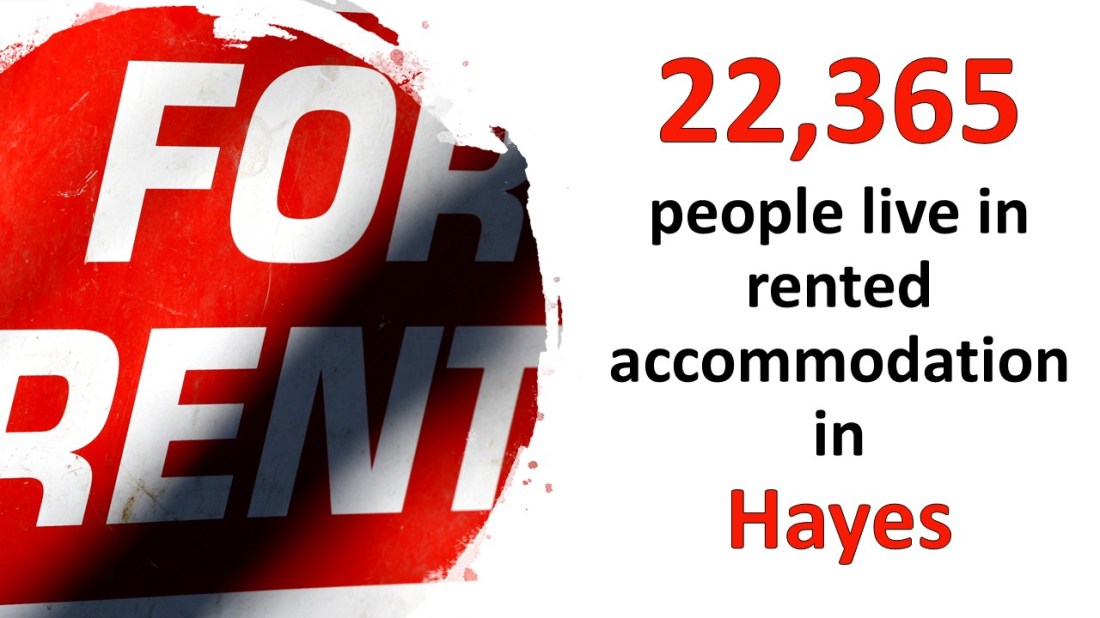
22,365 People Live in Rented Accommodation in Hayes

That number surprised you didn’t it? With the General Election done, I thought it time to reflect on renting in the manifestos and party-political broadcasts and ask why?

As the best way to tell the future is to look at to the past, so we decided to look at the number of people who rented a century ago (1920’s), and surprisingly 76% of people rented their home in the UK (as renting then was considered the norm). Yet in the latter part of the 1920’s, builders of the suburban housing estates with their bay fronted semis started to sell the dream of home ownership to smart renters.

Up until the mid 1920’s, the mortgage had been seen as a millstone around your neck. Now, due to some clever marketing by those same builders, it was started to be seen as a shrewd long-term investment to buy your own home with a mortgage. It fuelled the ambitions and goals of the up and coming well-to-do working class who reclassed themselves as lower-middle class. Meanwhile, the Government encouraged (through tax breaks) people to save in Building Societies whom in turn lent the money to these up and coming new homeowners thorough mortgages.

Roll the clock forward to the decade of the young Elvis, Chuck Berry, and Bill Haley (1950’s) and still 72% of Brits rented their home. Homeownership had boomed in the preceding 30 years, yet so had council house building. Then, as we entered the 1960’s and 1970’s homeownership started to grow at a higher rate than council housing.

The rate of homeownership started to drop substantially after the mid 1990’s, and now we roll the clock forward to today, there is no stigma at all to renting … everyone is doing it. In fact, of the…

47,800 residents of Hayes (UB3), 22,365 of you rent your house

from either the council, housing association or private landlords – meaning 46.8% of Hayes people are tenants. Yet read the Daily Mail, and you would think the idea of homeownership is deeply embedded in the British soul?

24,195 Hayes (UB3) people live in an owner-occupied property

(or 50.6%)

So, we have a paradox – homeowners or renters? The reason I suggest this, is, I noticed on the run up to the Election that housing was used at the General Election as way to get votes. This is nothing new, as all parties have always used housing to get votes, although previously it was about which party would build more council houses in the 1950’s through to council Right to Buy with Thatcher (and everyone since) – running election campaigns promising everybody their own home in one way or another.

Yet, did you notice at this election something changed? The parties weren’t talking so much about increasing homeownership but about protecting the tenant. It seems the link between homeownership as the main goal of British life is starting to change as we are slowly turning to a more European way of living. Renting is here to stay in Hayes and incrementally growing year on year. You see, in Britain there is no property tax based on ownership, which many other western countries have. Instead Council Tax is paid by the occupier of the home (meaning the tenant pays – not necessarily the owner).

Both parties wanted to end no-fault evictions (which is a good thing), yet Labour went further and mentioned rent controls in their manifesto. As I have mentioned before in other articles on the Hayes property market, rents since 2008 (even in central London) have not kept up with inflation – so again was that another headline to grab votes/election bribe? The fact is the majority of new British households formed since the Millennium can now expect to rent from a private landlord for life – therefore the parties focus on this important demographic.

Yet even with the new mortgage relief tax rules for landlords and the 200+ of legislation that govern the private rental sector, buy to let is still a viable investment option for most investors in Hayes. There has never been a better time to purchase buy to let property in Hayes … but buy wisely. Gone are the days when you would make a profit on anything with four walls and a roof. Most importantly do your homework, take advice and consider your options.
Are the Tory’s Selling Off the Final Part of the Family Silver? 1,379 Hayes Housing Association Households & the Right to Buy Their Homes

In 1979, Margaret Thatcher was voted in on a Tory landslide with the ‘right to buy your own council house’ being a mainstay of Conservative policy. She encouraged people to buy their own their own council flats and houses, although it might interest you to know, that the council tenant right to buy idea was first proposed in the late 1950s and formed part of the manifesto of the Labour party. Yet Maggie’s version was based on massive discounts for tenants and 100% mortgages (i.e. no deposit). However, the real bugbear was that half the monies raised form the house sales went to central Government and the other half to the local authorities … but that money had to be used to reduce the local authorities debt rather than building new houses – so houses were being sold and not replaced.

7,004 council homes in the Hillingdon area have been

bought in the last 40 years (an average 175 per year)

Interestingly, the Tories relaxed the rules in 2012 for right to buy and raised the highest discount on a property to £75,000 (it has subsequently increased further, to £100,000, in some parts of the UK) meaning 590 council houses have been sold locally since the rule change, raising £91,178,223 since 2012 alone.

The issue, stated by many existing council house tenants, is that those tenants turned homeowners subsequently sell on their ex-council homes at a huge a huge profit, meaning the demographics of those areas has become ever more transient, more specifically, properties that were once council homes are now owned by buy-to-let landlords who rent them out on a short-term basis.

Yet up to this point in time, nothing has been said about ‘other’ type of social housing – housing association properties. Whilst council houses are properties owned by the local authority providing low cost social housing, housing associations also provide lower-cost social housing for people in need of a home, yet they are private, non-profit making organisations.

The Tory’s state one of the biggest divides in our British society is between those who can and cannot afford their own home, so plan to establish a new national model for shared ownership which allows people in new housing association properties to buy a proportion of their home while paying a lower/subsidised rent on the remain part – helping thousands of lower income earners get a step onto the housing ladder. 

So, what for the tenants of the existing 1,379 housing association households in Hayes (UB3 to be precise)? The Conservatives have said they will work with housing associations on a voluntary basis to determine what right to buy offer could be made to those Hayes tenants, although there are already existing rules which give most housing association tenants the right to buy their home, yet with only modest discounts of £9,000 to £16,000 depending on where you live. So, what does all this mean for the current homeowners and landlords of Hayes properties?

The Tory’s sold off 4,658 council houses in Hillingdon whilst in power between 1979 and 1997

This really created waves in the housing market in the 1980’s and was a contributary factor to the housing crash of 1987 when Dual-MIRAS tax relief was removed by Nigel Lawson. By the selling off of council housing in those years they were accused of selling off the family silver cheaply, thus created the foundation of the buy-to-let boom of the early to mid 2000’s, because of major shortage of affordable housing being sold in the previous two decades.

Yet this time round, note the Tory’s state it is just for new housing association properties, not existing. Also, that tenants will have the right to go into shared ownership – NOT OUTRIGHT OWNERSHIP. This means this policy will have hardly any effect … unlike the Thatcher policies of 1979.

Labour Party’s U-turn on the £263,511,780 grab on Hayes landlord’s wallets

Well, with the General Election just over the horizon and having been asked by a number of Hayes homeowners and Hayes buy to let landlords what the different main parties would do to the local property market, in this week’s article we focus on Labour’s contentious Right to Buy proposal for private tenants. Launched in September, the plan was designed to force landlords to sell their buy to let investments to their tenants who wished to buy them…. at a substantial discount.

Shadow Chancellor John McDonnell told the FT in September that, under a new Labour government, tenants would be given the Right to Buy their tenanted home with a hefty discount – just like the Tory Right to Buy policy for Council house renters that came into force after the 1979 General Election.

Yet it was not certain who would have been expected to pay for discounts on buy to let homes sold to tenants. Four years ago, Jeremy Corbyn advocated using the £14bn of tax allowances that UK landlords had at the time to pay for these discounts, allowing tenants to buy their tenanted home at the same discount as they would a local authority home without leaving the landlord out of pocket.

However, these tax allowances have been substantially reduced with the changes in the way mortgage interest relief on landlords’ mortgages is calculated, meaning that this method of funding would no longer be feasible. In fact, bankrolling a project at a modest 20% discount for the whole of the UK would cost £177.84bn; a lot more than the £14billion quoted by Mr Corbyn. So, what would that policy cost Hayes (UB3) landlords?

Labours policy of 20% Right to Buy discount could

cost Hayes landlords £263,511,780

 … and if Hayes tenants got the maximum discount of 35% that Council tenants have with the Right to Buy scheme that would cost Hayes landlords £461,145,620.

However, it appears Mr McDonnell has re-considered the original suggestion and done a (slight) U-turn, stating it should apply only to the richest landlords and not those who only own a couple of rental properties. He was quoted in The Times as saying, “There’s a large number of individuals or families who have bought another property as an asset for the future and we wouldn’t want to endanger that”.

Yet, even this somewhat watered-down account still creates threats to the private rental sector and Hayes’ overall stock of private rented homes. John McDonnell seems to have altered his initial thought to permit all private tenants the right to buy from their landlords to apply only to those with more than a couple of buy to let properties. The shift appears to be aimed at pacifying middle England small time landlords who are probably swing voters with smaller property investments and instead, Labour’s focus is on the larger scale buy to let investors. Looking at the stats, and being generous that we are only looking at landlords with 6 or more (not the couple that Mr McConnell suggested) ……

Of the 3,678 rental properties in Hayes, 1,004 are owned by Hayes landlords with 6 or more properties in their portfolio

To target these larger scale landlords, who would unquestionably leave the property market in their hordes if their buy to let investments could be so easily destabilised. There would be mass sell offs before the legislation became law, thus making the tenants homeless (and who would house them??) ..and even if that didn’t happen, it would be very damaging and someone (probably landlords) would have to stump up the £48.54bn national bill (£71,931,980 in Hayes alone).

If Labour want to fix the property market, it needs long term certainty and confidence, yet even these revised policies would instantly challenge this

And don’t think I am just Labour bashing here as the Tory 2014 Help to Buy scheme hasn’t really helped either as their scheme which gave first time buyers (FTB) a 20% interest free loan, if they put down a 5% deposit, has been a boon for new home builders.

The Tory’s announced recently another £10bn of taxpayer’s money will be pumped into a scheme which, quite frankly, wasn’t needed to boost an already decent property market. The banks were already giving 95% first time buyer (FTB) mortgages from 2010 and the Help to Buy scheme was only allowed on new homes purchases, meaning it didn’t help the larger second-hand market. That £10bn could have been better spent building Council houses, not helping the large plc builders line their pockets with Government cash.

Hayes Buy to Let – Past, Present and Future

Investing in a Hayes buy to let property has become a very different sport over the last few years.

In the glory days of the five years after the turn of the Millennium, where we had double-digit house price growth, mortgage companies (notably Northern Rock, HBOS and their ilk) desperate to get on the buy to let mortgage bandwagon with rates so low it would make the belly of a snake seem high and an open mildness to give loans away with not so much more than a note from your Mum and with hardly any regulatory intervention… anyone could make money from investing in property – in fact it was easier to make money than fall off a log! Then we had the unexpected flourish of the property market, with the post credit crunch jump in the property market after 2010, when everything seemed rosy in the garden.

Yet, over the past five years, the thumbscrews on the buy to let market for British (and de facto) Hayes investors have slowly turned with new barriers and challenges for buy to let investors. With the change in taxation rules on mortgage relief starting to bite plus a swathe of new rules and regulations for landlords and mortgage companies, it cannot be denied some Hayes landlords are leaving the buy to let sector, whilst others are putting a pause on their portfolio expansion.

With the London centric newspapers talking about a massive reduction in house prices (mainly in Mayfair and Prime London – not little old Hayes) together with the red-tape that Westminster just keeps adding to the burden of landlords’ profit, it’s no wonder it appears to be dome and gloom for Hayes landlords … or is it?

One shouldn’t always believe what one reads in the newspaper. It’s true, investing in the Hayes buy to let property market has become a very different ballgame in the last five years thanks to all the changes and a few are panicking and selling up.

Hayes landlords can no longer presume to buy a property, sit on it and automatically make a profit

Hayes landlords need to see their buy to let investments in these tremulous times in a different light. Before landlords kill their fatted calves (i.e. sell up) because values are, and pardon the metaphor, not growing beyond expectation (i.e. fattening up), let’s not forget that properties produce income in the form of rent and yield. The focus on Hayes buy to let property in these times should be on maximising your rents and not being preoccupied with just house price growth.

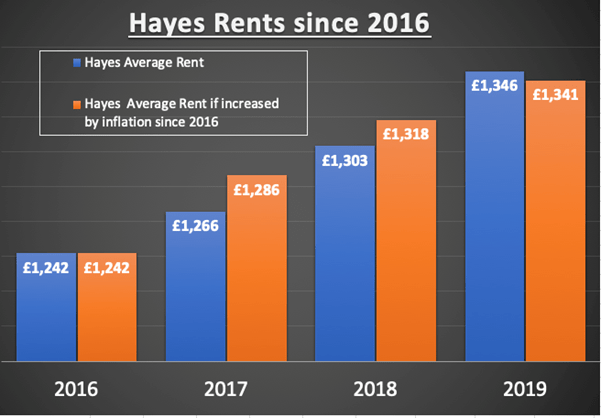
Rents in Hayes’s private rental sector increased

by 3.31% in the past 12 months

Rents in Hayes since 2008 have not kept up with inflation, it is cheaper today in REAL TERMS than it was 11 years ago and some landlords are beginning to realise that fact with our help.

Looking at the last few years, it can be seen that there is still a modest margin to increase rents to maximise your investment (and it can be seen some Hayes landlords have already caught on), yet still protect your tenants by keeping the rents below those ‘real spending power terms’ of the 2008 levels.

Buy to let must be seen as a medium and long-term investment ….

Rents in Hayes are 8.38% higher than they were 3 years ago and property values are 4.69% higher than Jan 2016

…and for the long term, even with the barriers and challenges that the Government is putting in your way – the future couldn’t be brighter if you know what you are doing.

Investment is the key word here… In the old days, anything with a front door and roof made money – yet now it doesn’t. Tenants will pay top dollar for the right property but in the right condition. Do you know where the hot spots are in Hayes, whether demand is greater for 2 beds in Hayes or 3 beds? Whether town centre terraced houses offer better ROI than suburban semis? With all the regulations many Hayes landlords are employing us to guide them by not only managing their properties, taking on the worries of property maintenance, the care of property and their tenants’ behaviour but also advising them on the future of their portfolio. We can give you specialist support (with ourselves or people we trust) on the future direction of the portfolio to meet your investment needs (by judging your circumstances and need between capital growth and yields), specialist finance and even put your property empire into a limited company.

If you are reading this and you know someone who is a Hayes buy to let landlord, do them a favour and share this article with them – it could save them a lot of worry, heartache, money and time.

Hayes Property Values 3% Lower Year-on-Year

It seems that quite a few Hayes homeowners and Hayes landlords have become acclimatised to living with the uncertainty of Brexit throughout most of 2019, as figures show many of them decided to get on with living life, started reinvesting their money into Hayes property and buying and selling their Hayes homes and BTL investments. Land Registry stats confirm that. Current data shows that…

Hayes property values are 3% Lower than 12 months ago

Whilst the newspapers were stating prime central London property values were now 17% below the levels being achieved a couple of years, that message seems not to have been heard by certain sectors of the Hayes property market!

Speaking with other property professionals in Hayes, many weren’t expecting the usual autumn rebound after the summer holidays. Many were anticipating a dormant Hayes property market on the run up to Christmas believing many Hayes home-movers would put off the their home moving activities until the new year, yet in many sectors of the local property market, I have seen (and the stats back this up) that those Hayes property buyers who are able to hold their nerve (whereas others were hesitant) have found themselves in a better negotiating position to get a great property deal. Putting aside the fluff of newspaper headlines, the real foundations of Hayes housing market remain sound with record low unemployment, ultra-low interest rates and low inflation.

Interestingly, there are 11% more homes for sale in Hayes (UB3) compared to two years ago, meaning more choice for buyers

However, there are still parts of the Hayes property market that remain stagnant, with some homeowners being slightly unrealistic with their marketing pricing. To them, the property market appears to be slow, as they stare at their ‘for sale’ board for months on end, yet nothing could be further from the truth.

The key to a balanced (and healthy) property market is realistic pricing by the homeowners when they place the property on the market, mortgage affordability for buyers (which was discussed a couple of weeks ago in the Hayes Property Blog) and buy to let landlord activity which creates and maintains forward momentum. One measure of momentum is how long a property remains on the market, and interestingly…

The current average length of time a Hayes (UB3) property remains on the market is 112 days, up from 75 days two years ago

Now the number of properties sold locally is slightly down year on year (even though we had a burst of property sales in the summer locally) and interestingly, Rightmove reported recently that nationally, the number of properties sold in the UK was only just over 3% less year on year, so a similar picture nationally.

So, what does all this mean for Hayes homeowners and Hayes landlords?

We have always had issues that were game changers for the housing market; for the last few years it’s been Brexit, 10 years ago the credit crunch, 18 years ago the dot com crash, the ERM and 15% interest rates issue 27 years ago, dual MIRAS 32 years ago, hyper-inflation 40 years ago, the 3 day week 45 years ago – the list goes on. Everyone needs a home to live in, the local authority just has not got the money to build council houses, so buy to let will continue to grow for the foreseeable future which in turn creates a stable foundation for all homeowners. Maybe you should use this time, like many are in Hayes to take advantage of the property deals to be had in Hayes.