The Rights, Obligations & Responsibilities of the 1,489 Hayes Landlords & 3,678 Tenants During the Virus Outbreak

The last three or four weeks, unquestionably, have been one of the most life-changing times we have seen since WW2. The imminent threat of the Coronavirus has taken over the world, the UK and Hayes and will challenge you, our families, our relationships and test us all.

The drive of this worldwide action of social distancing is not just to stop you from getting ill with the virus; the bigger drive is to slow down the development of this virus so the NHS will not become overwhelmed with those who are most likely to need hospital care. Yet the issue of social distancing has certainly raised many questions around the landlord/tenant/agent relationship, so in this article I wanted to share with all the 1,489 Hayes (or UB3 to be precise) landlords their rights, obligations and responsibilities to their Hayes tenants. I also wanted to highlight the rights, obligations and responsibilities of the 3,678 Hayes tenants in return.

These will be trying times for Hayes landlords and Hayes tenants alike, so let’s start…

A landlord has the responsibility to ensure the property is fit for habitation, so what if the Hayes landlord/agent is incapable of undertaking an emergency repair (or say the annual gas safety check) because the tenant is self-isolating or actually has the virus? The answer is the landlord should use their best efforts to fix the problem if it’s an urgent repair, yet if the landlord/agent are unable to do so they should record this fact and that it is related to the Coronavirus epidemic. One should then re-try as soon as is possible and appropriate, having full respect for information on self-isolation, personal-safety and social-distancing and ensure that you make a written note for future issue. My advice is that you or your agent (as we are with our Hayes tenants) need to uphold good lines of communication with the tenants touched by these current circumstances, so they are clear on what action you are taking and the timescales for this.

Yet at the same time, there will be very few situations in the coming weeks when the contractors who the landlord/agent use will also be in self-isolation, meaning a handful of the 3,678 Hayes tenants might have to wait for repairs to be sorted. We have some excellent Hayes contractors with their own backup plans and so together we will use our best endeavours to find an alternative contractor to fix any issues. If your agent has issues, then maybe we can help – do call me. Yet whatever you do, if this occurs, document everything and that it is related to the Coronavirus epidemic.

The total rent paid by Hayes tenants

each month is £4,454,100

It’s true the UK government has demanded that building societies and banks give a three-month mortgage holiday to those landlords that are unable to make mortgage payments. This is not free cash, the mortgage payments are basically postponed with interest to be collected at the end of this crisis, meaning your obligation as a Hayes tenant to pay the rent still exists. HM Government is offering employers an 80% wage support with the furloughing to avoid having to make people redundant and the rent for your Hayes rental home will be treated in the same way as the landlord’s mortgage.

The average Hayes rental payment currently

stands at £1,211 per month

Therefore, if you are incapable of being able to pay your rent, it will still build up and accumulate during this virus predicament and you will need to start a payment plan to pay it back on top of your normal monthly rent.  So if your rent is £1,211pm and you have already been living there for 2 months into a 12 month tenancy, there is still £12,110 to be paid over the next 10 months, so should you not pay anything for 3 months your rent would increase by 43% a month for the last seven months or you face eviction due to arrears (remember arrears have been put on hold – not removed during the virus outbreak). One option, subject to status and agreement by all parties, could be to renegotiate a new longer lease to pay off the arrears over a longer period. Again, the point here is communication from all sides – making sure there are no nasty surprises.

So, if you are in this predicament, there is a lot of help accessible from the HM Government including Universal Credit or Employment Support as soon as possible to escape any interruptions to your payments. Remember, your Hayes landlord will need proof of your Universal Credit or Employment Support claims to give to their mortgage company to be able to start the mortgage holiday, so my advice to all the 3,678 Hayes tenants is keep in contact with your agent to ensure your Hayes landlord doesn’t suffer any avoidable hardship (which ultimately may end up with your home being repossessed because the mortgage payments were missed because you were unable to furnish the landlord with your own claim documents).

Communication is the #1 priority here. Whilst most agent’s premises are closed including our own, all are open for telephone and email enquiries, with staff working from home. This is a fast-changing time for everybody, for the 1,489 Hayes landlords and 3,678 Hayes tenants correspondingly and we will be ever vigilant to oversee the financial and monetary backdrop in the coming months.

These are going to be tough times for the people of Hayes (and the world), financially and mentally; yet together we will come out of this stronger. By working together, working in partnership, again keeping lines of communication open with regards to your finances and your housing, by keeping safe and protecting our families and most of all by being kind to each other … we will get through this, a little battered and bruised – yet hopefully better human beings for it?


Hayes Village – The Nestles Factory Legacy

Recently I was invited out by Saira and the team at Barratts homes to the launch of their second building in Hayes Village, the old Nestles Factory near Hayes town. Saira was kind enough to show me around the show flat and explain what they are doing here. As I was coming into the new development what struck me right away was the lovely open space that was created with the original Nestles art Décor building still standing at the end of the green area. It was great to hear that they were keeping the art décor front of the building.

Arriving in the sales building I could see it was busy with potential buyers walking around and speaking to all the sales staff there I questioned Saira to see what proportion of the first building was sold to end users and what proportion was sold to investors and I was surprised the vast majority were end users.

Saira showed me around the large luxury model that was stationed in the middle of the show room and pointed out some great amenities that will be available in this development. The site will have its own coffee shop, gym and there also talks for an onsite health centre aswell.

model of development

I can see from the design they have tried to be mindful of the environment and the historic site. They have including a new public park, gym, running track and lots of green open spaces and play areas. They are also opening large parts of previously inaccessible parts of the canal which can be accessed by the public. There’s also a car club on site for residents to use and help keep this development environmentally friendly as possible. This is in keeping with the great art deco look of the buildings.

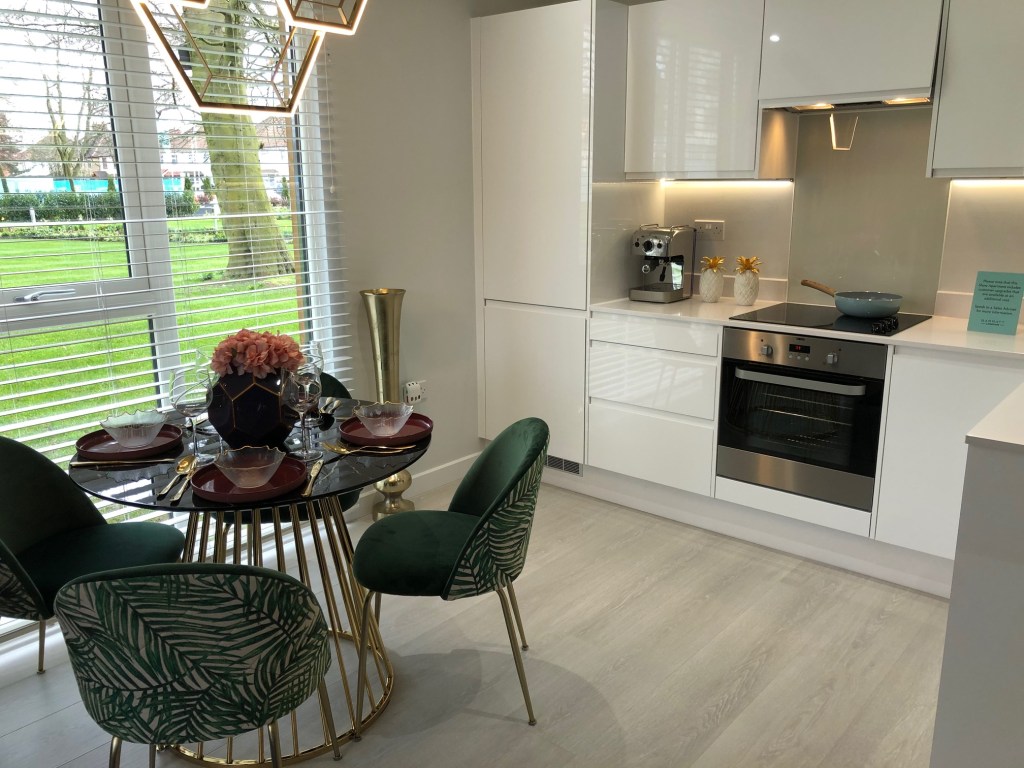
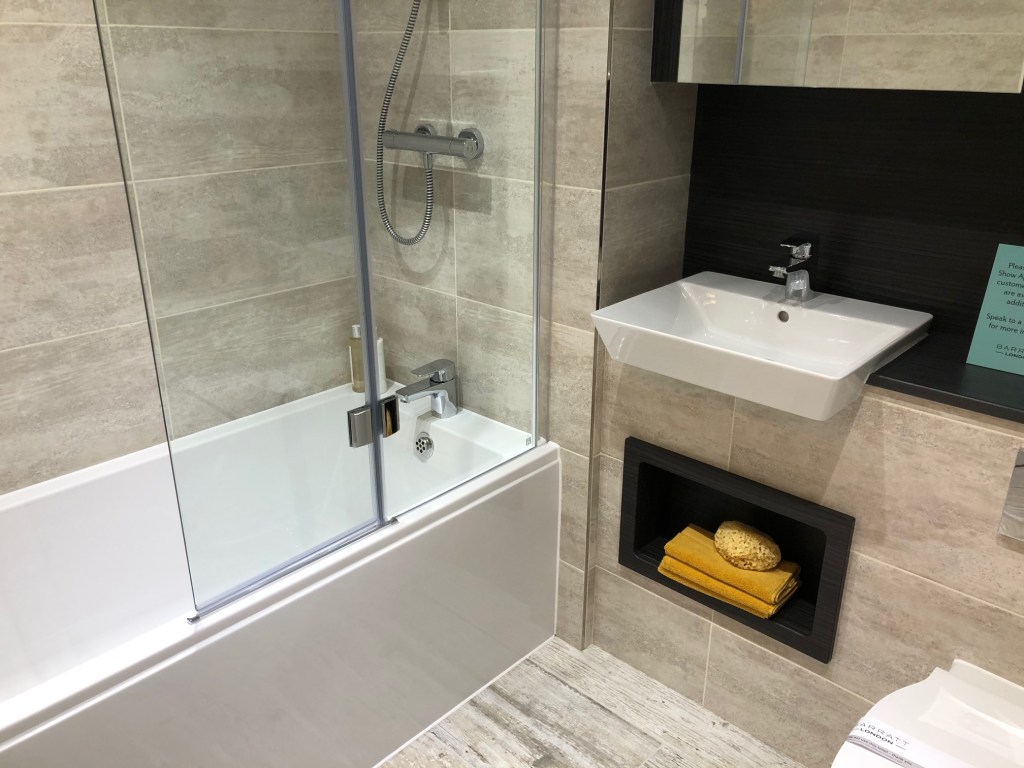
The flats themselves look great from the inside with spacious living areas and large wall to ceiling windows on the front facing apartments modern kitchens and bathroom fittings provide an excellent finish.  She also mentioned that when clients reserve an apartment, they work with them to help designed to their needs. They had a case where they had a wheelchair bound client and assisted in redesigning the apartment to their needs.  

If you are looking at this site as an investment in my opinion a 2 bed 2 bath flat would give you a rental income of between £1450 to £1550 PCM as they are on par with the build to rent apartments around the station and also the High Point Village apartment.

All in all, I would say looking at the development is coming along it would be a great addition to Hayes and its worth while a look at their sales office on Nestles Avenue. If you would like to discuss anything further, please give me a call and I can go over a few things or I can put you in touch with the team on site.

show flat living room
show flat kitchen
show flat bedroom
show flat bathroom
sales suite

Hayes Property Market: What is going to happen to Stamp Duty on 11th March?

If you are buying a home in England costing more than £125,000, you will have to pay Stamp Duty Land Tax on the purchase of your new home. In the provinces, it’s called something slightly different, so if you are buying a property in Scotland over £145,000 you will pay Land and Buildings Transaction Tax (LBTT) and for any property over £180,000 in Wales you will pay Land Transaction Tax (LTT). Whatever the tax is called, it is an important factor when moving, when you consider that

Last year the average UK house buyer paid

£10,150 in Stamp Duty Tax alone

Now as soon as the date for Rishi Sunak’s budget was set for 11th March 2020, conjecture in the Press began about what stamp duty changes he may disclose on budget day. The Chancellor only sets the budget for England and Northern Ireland, yet this is just as relevant for Wales and Scotland. Even though Derek Mackay, the Scottish Finance Secretary said on 6th February he has no plans to change Scotland’s version of Stamp Duty (LBTT), more often than not, Stamp Duty rule changes in England are often adopted in Wales and Scotland at a future date.

Some are asking if Sunak will impose what was promised in the Conservative manifesto with the 3% additional Stamp Duty surcharge on non-UK resident buyers? I have certainly heard in the Estate Agent community that foreign buyers are trying to rush through their sales in central prime London (Park Lane/Mayfair etc etc) before 11th March to ensure they don’t get hit with a new tax. Or will he go even further, and will we see a reappearance of Boris Johnson’s hitherto specified aim of eliminating Stamp Duty below £500k, consequently theoretically saving homebuyers many thousands of pounds?

However, opinions are divided on what, if anything, will be included in the budget.

Most believe that the extra 3% for foreign nationals is an almost certainty, and if it isn’t implemented straight away, it will be in the Autumn Statement. Many believe the Chancellor could also decide to repay the favour to those in the North who turned the Election map ‘blue’ on the evening of 12th December with actions to enhance the housing market north of the M62 with stamp duty changes. The best way he could do that is to raise the threshold from the current £125k.

When Boris ran for Tory leadership back in May 2019, he said that he wanted to expand the threshold at which you begin paying stamp duty from £125k to £500k, which when you consider 7 out of 8 residential sales in 2019 were for homes below £500k, that would have a considerable effect. If the Stamp Duty threshold had been raised to £500k in 2019, then 700,400 homebuyers in England would not have paid any Stamp Duty Tax.

93.4% of Hayes properties sold last year were below £500k

Of the 943 properties sold in the last 12 months within half a mile radius of Hayes, only 62 of those properties sold were over £500,000 (interesting when generally in Greater London 44.9% of properties were below the £500k level).

Yet the cost to the HM Treasury would be significant. If all properties below £500k were exempt, the government would lose £2.22bn in tax receipts according to Savills. Of course, this could be made up with extra tax on empty properties or increasing the second homes Stamp Duty levy from the current 3% to say 5%, which would raise an additional £1.12bn on top of the current £1.68bn it raises for the Treasury, yet it would have a negative effect on buy-to-let landlords buying additional homes.

What almost unquestionably won’t happen is the earlier idea of switching the Stamp Duty liability from homebuyer to home seller

this would stall the property market, would probably cause political fallout among 688,300 homebuyers who paid Stamp Duty last year alone, make homes ‘appear’ more expensive as house sellers would inflate the asking price to try and recoup some of the tax, yet ultimately could be seen as ‘re-arranging the deckchairs on the Titanic’.

The 3% additional levy for foreign buyers is almost certain (of which we don’t get many in Hayes – as they tend to buy in prime London areas which is of course the City of Westminster and the Royal Borough of Kensington & Chelsea, and parts of the boroughs of Hammersmith and Fulham, and Camden), yet I have a feeling that ultimately the Government doesn’t want to rock the boat on the wave that is being rode by the property market on the ‘Boris Bounce’ since December. I also doubt any changes will be made to first time buyer Stamp Duty relief, as 22% of all property transactions in 2019 were to first-time buyers, and whilst it cost the Treasury (or saved the first-timer buyers) a total of £539m in Stamp Duty relief (an average of £2,411 each), the Government are keen for first time buyers to get onto the housing ladder.

Ultimately, we can only wait until Mr Sunak opens his red leather box on 11th March to find out what will happen. I will of course report back after 11th of March on what (if any) changes to the tax regime will affect the Hayes property market going forward.

Hayes Property Market – Is it Time to ‘Plan’ to Get the Builders In?

Even though the new legislation was placed on hold because of the recent General Election, it is expected the Government will start fining around half of all UK local authorities for failing to build enough new homes as Westminster starts to force local authorities to build more homes with the new laws.

The Conservative Government has gone on record with an ambition to build 300,000 new homes each year from the mid-2020s (aspiring as the average for the last 13 years has only been 177,000 pa). So Downing Street see the planning system as requiring root and branch change to ensure local authorities deliver on that promise.  The Ministry of Housing, Communities and Local Government’s ‘Housing Delivery Test’, which should be launched on an undetermined date this year, will hold local authorities to account for ensuring they hit their own specific house building targets.

If a local authority is unable to show that it has a five-year stock of land for building new homes, it gives builders greater rights and liberties to build their new homes where the builder wants (not where the local authority wants).

This will mean there will be a house-building free-for-all

as the council will have less control over the setting, types of properties, contribution to infrastructure and location of any new home development.

Only 44% of local authorities have a local plan that is less than five years old.

Locally, Hillingdon isn’t in that 44% of local authorities. The current situation is, a local plan is in place but it’s over 5 years old.

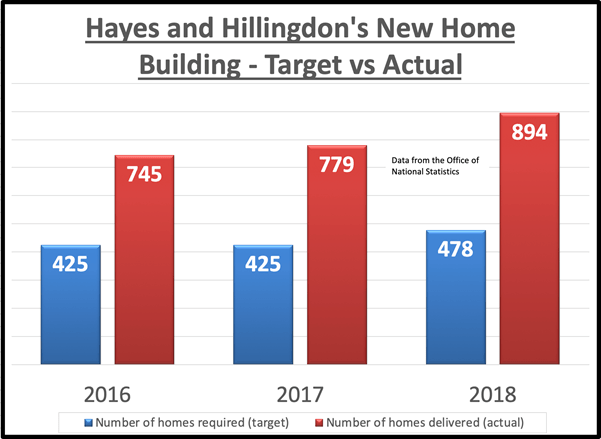
Yet, the original question of this article was to find out if we are building enough homes in Hayes and the surrounding local authority area i.e. should we get the builders in? Well, the Government set targets for local authorities for the number of homes they should build each year. The latest set of data is for 2018, so for the three years up to and including 2018 i.e. 2016/2017/2018,

Hillingdon’s new home building target was 1,328 new homes, yet it achieved 2,418, a surplus of 1,090 new homes

So, what does that all mean for the Hayes property market?

Even with the surplus, there are positive and negatives to this. The Hayes property market is not broken, yet it does need to get the builders in. Irrespective of the results from the last three years, we have over three decades of under building, which has created issues regarding affordability of homeownership and older generations being stuck in homes too big because there aren’t enough suitable homes for them to move to, i.e. bungalows. The stabilisation of the General Election has been a net positive to overall confidence in the local property market, meaning Hayes homeowners and Hayes landlords looking to sell their home in the coming spring and summer will find decent demand (although sellers still need to realistic with their pricing).

Unfortunately, the negatives are that many Hayes renters that want to buy, are unable to as they can’t save after paying their rents and feel as if they’ve been left behind. I know the Government recently launched their “First Homes” scheme for selected first time buyers at the start of February, where a 30% discount would apply to “a proportion of new homes” and would be subsidised out of contributions from builders, the Tory’s have previously promised to build 200,000 cut price homes for first time buyers back in 2015, yet the National Audit Office has recently confirmed they never built a single one!

The simple fact is, we as a country need to build far more affordable homes in the areas where people want them. This means the dream of homeownership will be a greater possibility for our children and grandchildren in the future. Our local authority needs to continue to plan the housing needs (and associated infrastructure) to ensure that as we live longer and continue to grow as country – we have the homes in place to live in that are suitable for every generation.

Hayes Homeowners £822,009,300 Windfall Since 2014

In the latest, and most recently published, set of UK mortgage data (for the month of November 2019) 18,470 pound-for-pound re-mortgages were made (i.e. the borrower went from one rate to another with no additional borrowing).

However, since the 1970’s, the British have seen their homes as cash cows and cash machines, with many homeowners re-mortgaging at the end of their mortgage’s introductory term (usually after the initial two, three or five years) to avoid being passed on to their mortgage lender’s more expensive standard variable rate.

For some borrowers re-mortgaging allows them an opportunity of raising additional cash whilst for others it enables them to follow interests and activities; such as big holidays, home improvements, new cars, debt consolidation or financially helping family members (e.g. paying off credit cards or helping with house deposits).


Interestingly, in November 2019 alone (the most recent figures) an eye watering £957,856,700 was borrowed on top of existing mortgages by 18,610 UK homeowners re-mortgaging and borrowing, on average, an additional £51,470. Therefore, one has to ask, are we borrowing too much? Looking at these numbers, one might think we are over-extending ourselves, yet as regular readers of my blog about the Hayes property market will know – I like to drill down and look at the historical figures. Back in 2006, just before the crash, British homeowners were actually borrowing in excess of £5bn per month over and above the re-mortgage amount – much more than the £1bn we experienced in November!

Looking at statistics from the Bank of England for the UK as a whole, even with the data mentioned above, British property owners have increased the equity in their homes by just over £270 billion since 2010 compared with a £275 billion withdrawal during the 2000s. This reveals that the last decade (the 2010’s) is the first since records began in which Brits have increased their equity. This is partly due to the fact that the number of housing transactions crumpled during the Credit Crunch, and many homeowners chose to reduce their mortgages, rather than continually increasing them – even if their property started going up in value after 2013.

So, what has happened in Hayes regarding mortgages and does it match the national picture? Well interestingly…

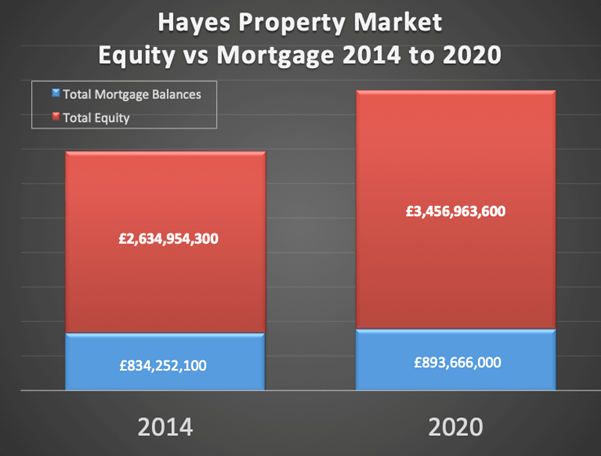
Hayes homeowners have injected over £800m into their Hayes properties over the last six years; overturning a trend stretching back to the 1970s.

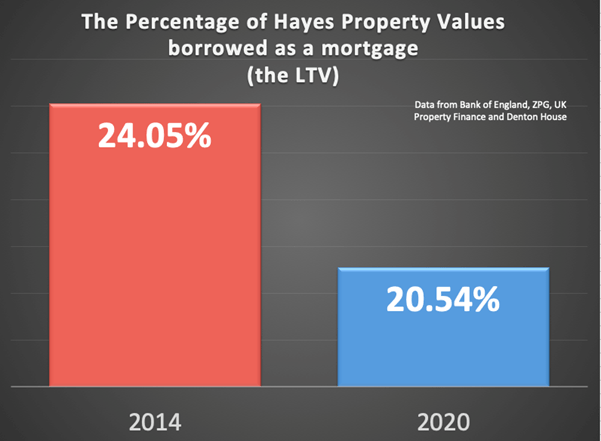
Considering the exact figures, it can be seen whilst the total value of mortgages has increased slightly since 2014, as a percentage this has gone down, meaning Hayes homeowners and Hayes landlords have increased their equity since 2014 by £822,009,300 (one might call it a windfall?).

It can quite clearly be seen that the financial insecurity sparked by the Credit Crunch crisis has created a generation of Hayes homeowners/landlords who are savers and improvers rather than movers and excessive borrowers, using excess cash to invest in their property and pay down debt or to excessively borrow on their equity growth, as can be seen on the graphs and table.

 20142020
Total Value of Property in Hayes£3,469,206,400£4,350,629,600
Total Mortgages in Hayes£834,252,100£893,666,000
Total Equity in Hayes Property£2,634,954,300£3,456,963,600
% of loan/mortgage to value (the LTV)24.05%20.54%

As the percentage of mortgages (the loan to value) has decreased since 2014 from 24.05% to 20.54% in Hayes, this is good news for every Hayes homeowner and Hayes landlord because, irrespective of whether the ‘Boris Bounce’ is short or long lived, it shows the Hayes property market is in a better state than ever before to ride out any storm that it might encounter because less people will be in negative equity or have prohibitively high