As Unemployment hits 7.4% in Hayes, What Effect Will This Have on the Hayes Property Market in 2021?

12 months ago, the unemployment rate in Hayes stood at 2.2% of the working population, yet with Coronavirus hitting the UK, what impact will this rise in unemployment have on the Hayes property market?

As I have discussed a number of times in my articles on the Hayes property market, this summer saw the Hayes property market do exactly the opposite of what was expected when Covid hit.

The Stamp Duty holiday added fuel to pent up demand for people to move to property with extra rooms (to work from home) and gardens. This prompted a brief hiatus in the number of people selling and buying their home in Hayes over the last summer and autumn.

Yet, insecurity around rising unemployment, led to many mortgage companies becoming more cautious in the later months of summer, predominantly when lending to self-employed or first-time buyers borrowing more than 85% of the value of the home (as they wouldn’t want to lend money to someone that could not afford a mortgage due to an insecure income or not having a job).

Back in the late spring, economists were predicting that UK unemployment would rise to a peak of 6.5% in Q3 2020, returning back to the 2019 levels (3.4%) by 2022.

As we speak (Christmas 2020), nationally the unemployment rate stands at 6.3%. The toll Covid has had on people’s livelihoods has been massive, with an additional 1,434,515 people out of work, although it is important to note this unemployment rate is still lower than the five years following the Credit Crunch years 2008 to 2013.

So, with such a growth in unemployment and the spectre of a ‘No Deal Brexit’, this may hold back the enthusiasm of many companies to take on more staff, reducing any rebound in employment. If unemployment remains high, this will influence perceptions of employment and personal/household financial security, which are the ultimate drivers both for house prices and whether people buy and sell.

4,300 Hillingdon people were unemployed a year ago and today that stands at 14,575.

Looking at all the study papers on the topic, there is a link between unemployment and house prices, yet it’s not as strong as you would think. The larger factors are the demand and supply of property on the market and interest rates. Interestingly, in the past two recessions, the comparatively richer regions of London and South East, house prices have been more sensitive to unemployment and house price changes than the rest of the UK, yet London and the South East also bounced back quicker and higher after the two recessions. 

The concept behind this is that more expensive house prices in the South drop more than lower priced houses in the rest of the UK. Why? Because those more expensive regions have, by definition, more expensive house prices meaning the homeowners have higher mortgages, so if they become unemployed, their homes are more likely to be repossessed (because of the high mortgages), and consequently that reduces house prices in that area quicker because repossessed houses tend to sell much more cheaply compared to normal house sales.

The health of the Hayes property market in 2021 and beyond really depends on what is happening to the economy as a whole and more specifically what is happening in the Hayes economy.

When we drill down though, unemployment has hit different sectors of the economy to a lesser or greater extent. For example, for office workers, people who work in tech, sciences and the professional services, the impact on jobs has been comparatively mild, with many personnel able to work from home. Yet for others, such as those who work in the hospitality, leisure, retail, entertainment and catering industry, remote working is simply not an option and these have been hit the hardest.

Unfortunately, the industries mentioned above are the ones that tend to employ the younger generation, who invariably live in private rented accommodation, rather than own their own home. Being made redundant puts their dream of buying their first home back even further as they try and get themselves back on their feet by initially finding a job (let alone save for a deposit).

Housing markets will recover quickest in towns and cities, where jobs are in the more resilient employment sectors.

For example, in London, unemployment jumped really quickly (and high) in 2009 with the Credit Crunch, yet came down just as quick in 2011, just as the property market in London started to take off.

If we have a determined economic contraction, with a lengthier and leisurely economic recovery, impeded by financial stress, that will lead to much higher unemployment in the 10% to 12% range in the summer of 2021. However, before I get to the initial question, I need to highlight another interesting fact, because …

What is particularly interesting is the increase in unemployment in Hayes amongst men has been higher than women, with a growth of

6.1 percentage points for men compared to 4.3 percentage points with women.

So, what is the prediction for the Hayes property market under the cloud of this growth in unemployment?

One massive redeeming factor that could just save the Hayes property market is low interest rates. This will keep mortgage payments low, meaning repossessions should be kept to a minimum (therefore there shouldn’t be a flood of cheaply priced Hayes properties coming onto the market all at the same time and dragging Hayes house prices down with it, as it did in the previous two recessions of 2009 and 1989).  

Yet, irrespective of the ultra-low interest rates, I still consider property prices in Hayes at Christmas 2021 won’t be much different from today, and in fact could be slightly lower.

This is because people have been paying top dollar in the last six months to secure their dream Hayes home, quite often spending the money they saved on Stamp Duty on the purchase price. When Stamp Duty Tax returns in April 2021, there will be less money to pay for the property … thus Hayes property values will be, by implication, lower in a year’s time.

What about Hayes landlords and the rents?

Nationally, rents fell just over 2.3% between 2008 and 2010, following the Credit Crunch, while national house prices fell 15.9%. I anticipate Hayes rents will also remain comparatively robust in the coming months and years.

Rents are very much tied to the rise and fall of wage growth and I can’t see why this relationship shouldn’t continue. Rents will rise in Hayes by between 13% and 15% in the next five years, yet if property prices do rise in 2023/24, that means future rental yields will be marginally lower in 2023/4 comparative to today, especially as ultra-low interest rate expectations (according to the money markets) seem to be here to stay for a long time.

Therefore, something tells me there could be some interesting Hayes buy-to-let investment opportunities for Hayes investors willing to play the Hayes buy-to-Let market for the long term.

To conclude, these are just my personal opinions. If you are a Hayes landlord looking for advice and opinion on what to buy to maximise your returns, please don’t hesitate to contact me. If you are a Hayes homeowner, looking to buy or sell and need any advice or an opinion on where the market is and where your Hayes home sits in the bigger Hayes property market picture – again feel free to drop me a line. 

No Deal Brexit- The Prediction For Hayes House Prices

Roll the clock back to April 2020, and major financial economists and property market commenters were sounding the alarm. The very best-case scenario was a 5% drop in property values by the end of the year, and most were in the 10% to 15% range. They forewarned the Covid-19 stimulated recession would trim tens of thousands of pounds off the value of Hayes homes.

Yet the Hayes property market seemed not to get the memo on that, and now as we find ourselves at the end of 2020 and the worst of lockdown restrictions appear to be passed, vaccinations on the way and economy starting to grow, Hayes property prices seem to be doing quite well.

What happened to the Hayes house price crash that wasn’t?

Before I answer that, it reminded me of what the Treasury said in 2016 about a leave vote on the Brexit referendum. The considered opinion of the Treasury was house prices would drop by 18% if the Country voted to leave the EU, so let us see what that would have done to Hayes house prices if that had taken place and then what exactly has happened in the last four and half years …

 Average Value
2016
Predicted Drop By The Treasury because
of Brexit
Average Value
Today
Uplift in Value
in Last 4.5 Years
% Increase Since
Brexit Vote
Hayes
Detached
£459,000£376,400£527,400£68,40015.9%
Hayes
Semi
£409,900£336,100£432,800£22,9004.6%
Hayes
Terraced/ Town House
£340,500£279,200£386,200£45,70014.4%
Hayes
Apartments
£263,500£216,100£259,500-£4,000-2.5%

So why has the Hayes property market not matched the property pundits twice in the last five years or so?

Well for most of us, owning a property is about having somewhere to live rather than an investment (an Englishman’s home is his castle??). Nevertheless, once a homeowner is on the proverbial ‘property ladder’, it cannot be denied that it is eternally beneficial to know, as a homeowner, that you have made a healthy investment in your home and that the value will rise to alleviate the ache of trading up market — or down market when you retire.

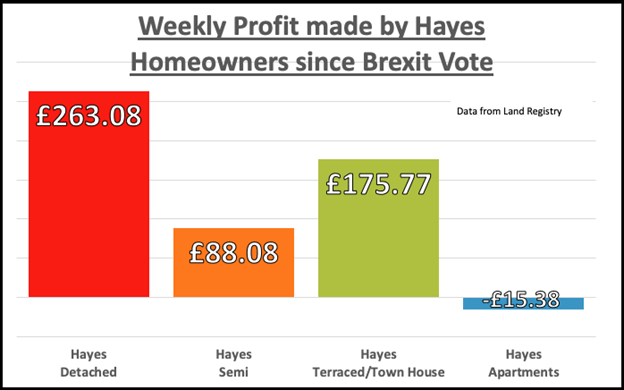
Those Hayes homeowners who own detached homes would have made an average of £68,400 profit, a rise of 15.9% or a weekly profit of £263.08 — calculated between the price they would have paid in the summer of 2016 and the price they would sell for today. Looking at the weekly profit for all property types in Hayes since the Brexit vote …

  • Hayes detached homes weekly profit of £263.08 per week
  • Hayes semi-detached homes weekly profit of £88.08 per week
  • Hayes terraced homes/town houses weekly profit of £175.77 per week
  • Hayes apartments weekly loss of £15.38 per week

Whilst it is no surprise the property market boom was inspired by the Chancellor’s Stamp Duty holiday, this is not exclusively the Chancellor’s achievement. The three ‘D’s have been with us throughout 2020, Covid or no Covid (Debt, Divorce and Death), together with a huge shift in the way Hayes homeowners see their homes.  With us cooped up during the lockdown and working from our dining room tables, the want and need of Hayes people to have a home with an extra bedroom to work from, together with a garden, has been one of the most challenging this year… hence the rise in demand.

So, what of 2021? It’s true that the country will have high unemployment, yet at the same time, we have ultra-low interest rates and for the last 20 years, on average we have only built 150,000 households per year as a nation, but needed 300,000 per year to keep up with immigration, people living longer and changes in the way households are made up (compared to the Millennium).

Many people can predict what will happen – yet none of us really know what will actually happen to the Hayes property market in 2021.

Covid was a black swan event and the fallout from that, I believe, has changed Hayes peoples’ lives and their lifestyles, especially how they see their home. Instead of making predictions, nothing can get away from property market fundamentals, which have driven price booms on the back of high demand for homes and low supply (i.e. properties coming onto the market) and price crashes on the back of over-supply and low demand. Only time will tell if, in 2021, the Hayes property market will see a flood of properties coming to the market because of debt or the demand for larger homes continues to rise unabated.

Please do let me know your thoughts on the matter.

Will the Hayes Property Market Crash in 2021?

and the three reasons why it will not be the catastrophic scenario some are predicting

In the last few months, the Hayes (and UK) property market has resisted and flouted every economist’s prediction. With the economy a shadow of its former self, unemployment set to hit 11.9%, the Government on track to borrow nearly half a trillion pounds to pay for Coronavirus support packages etc., all of this has had no effect on Hayes homeowner’s enthusiasm or capability to want to move home. It highlights the influence of both the emotional impact of lockdown and the enticing appeal of saving thousands of pounds on your Stamp Duty Tax bill.

For the last few months, the Hayes property market has been akin to a surfer, riding an unexpectedly large wave. The question is, will the surfer crash down (i.e. the property market) onto the rocks or will it calmly arrive at the beach unscathed? Well looking at house prices firstly…

UK house prices are 4.7% higher than they were 12 months ago according to the Land Registry, whilst in Hayes they are 1.8% higher

Looking at the data over the country, things overall are looking good for property prices. Yet it must be remembered the Land Registry data is on completed house sales and is always a couple of months behind, so this data is for house sales up to September that were agreed in the spring. Also, it does not take into account the prices being paid today on Hayes homes (as they will only show in statistics the Spring and Summer of 2021 when the sale completes).

Hayes house prices will inevitably ease in 2021

Anecdotal evidence over the last few months has suggested buyers are using their Stamp Duty savings on the price they are prepared to pay for the Hayes home of their dreams, so when the Stamp Duty holiday finishes in Spring 2021, we will see a reduction in the price Hayes properties sell for, as buyers will now have to hold back some of their cash to pay the Stamp Duty tax.

Mortgage approvals at a 13 year high

A better statistic to judge the property market is by the number of mortgage approvals. As the vast majority of house buyers need a mortgage, that is another good place to look at the numbers as they are much more up to date than the Land Registry figures. The Bank of England recently stated 97,500 mortgages were approved last month, up from the long-term average of just over 65,400 per month. This was the highest number of mortgage approvals since September 2007, and a whole third higher than mortgage approvals in February 2020 when we had the Boris Bounce in the property market.

As a country, we are due to smash through 2019’s 524,000 total number of mortgage approvals this month, despite the fact that the property market was closed for nearly three months in the spring. It’s vital to remember, that mortgage approvals do not equate to people moving home, as many of you reading this can attest to … property sales do fall through.

I do have apprehensions that many Hayes people, buying and selling their Hayes homes and in a chain, may not be able to realise the move before the Stamp Duty rules change at the end of March 2021, as there is a massive backlog with mortgage lenders, local authorities’ and the searches, chartered surveyors surveying the property and solicitors with the legal work, all combining to slow down the house selling and buying machine.

If you are in chain at the moment, you must constantly be talking to all the parties involved and ensuring everything is focused on getting the sale complete by the end of March. You have a responsibility to get information requested back in hours, not weeks … because if you don’t, you might not get your Hayes home move through before the end of the Stamp Duty holiday, and without that discount, someone in your chain may pull out of the sale altogether and the chain will break. 

The number of people moving home in Hayes is anticipated to drop sharply after the Stamp Duty holiday ends at the end of March 2021

And that is probably going to be the biggest impact on the Hayes property market in 2021. Yes, there will be a slight readjustment in the prices paid after March 2021 (as mentioned above) yet, a reduction in the number of people selling their Hayes home does not inevitably lead to a house price crash.

Yes, there will be a number of people who have to sell in 2021 because they have lost their jobs (i.e. ‘forced sales’). In the last two ‘Property Market Crashes’ of 1988 and 2008, there were a large number of forced sales in a short period of time (because business owners had to sell their home as their business had gone bankrupt because of the Credit Crunch, as well as people who had lost their job), increasing the supply of properties coming to the market in 1988 and 2008.

This in turn pushed Hayes house prices down as the property market was flooded with lots of property to sell in a short period of time. Yet this time, we have had the cushion/parachute of Bounce Back Loans, Furlough and Mortgage Holidays over the last 9 months.

Also, another important factor about the last property market crashes were the levels of interest rates and the amount borrowed.  

Interest rates are the key to the future of the Hayes property market

In 1988, mortgage interest rates were an eye watering 11.5% and 6% in 2008, meaning mortgages were much more expensive compared to the 0.1% rate we have today. Also, with 77.2% of mortgagees with fixed rate mortgages, and only 1 in 21 mortgages owing more than 90% of the value of their home (and 1 in 303 mortgagees owing more than 95% of the value of their home), negative equity should not be so much an issue like it was in 1988.

This means most Hayes homeowners are in a much better place to weather the storm of 2021, than they were in 1988 and 2008

I foresee many Hayes sellers will simply wait until activity in the Hayes property market picks up again before placing their property on to the market. This means fewer properties will be placed onto the market for sale in the later part of 2021, meaning Hayes house prices will tend to hold up. The people that will be affected by less properties coming onto the market will be estate agents, solicitors and home removals people.

I also believe there will be ‘interesting investment opportunities’ to be had for Hayes buy to let in the latter half of 2021 with the potential changes in Capital Gains Tax regulations, although those won’t go on the open market, so do keep your ear to the ground and build relationships with all the letting agents in Hayes so you get to hear of the property portfolios coming up for sale (as they tend to sell ‘off market’). Again, if that’s something that interests you – do drop me a line.

So, where is the Hayes property market heading in 2021?

Well, the Hayes property market (aka our “surfer”) has seen house price growth of 70.1% since 2009 … and this has been fuelled on the back of…

  1. Ultra-low interest rates mean money is cheap to borrow and so mortgage payments are low. With the Bank of England pumping £150bn into the economy in November with Quantitative Easing (QE) to add to the £725bn they already spent on QE since 2009 – interest rates will continue to stay low for some time.
  2. There has been an increase in the demand for housing with annual net migration of 214,400 since 2009 (meaning 96,700 additional households per year have been required since 2009 just to house those people – a total of 1,063,700 households).
  3. The average age of death has risen by 2.1 years since 2008 in the UK. People living longer, delays property from being released back onto the property ladder. For every extra year of life the average Brit lives, an extra 290,850 households are required in the UK.

None of these things have changed because of Covid.

As a country, we have only built on average 165,100 homes a year since 2009. Supply and demand show that whilst we will probably have a turbulent choppy ride on the 2021 wave (because of the economy) our surfer (aka the property market), with long term demand for housing outstripping supply since the 1980’s, will continue to ride the wave (probably not as large as it has been in 2020) as the ultimate long-term outlook for the property market in Hayes looks good.

All this means demand for decent, private rented Hayes property will be good as long as the property ticks all the boxes of the tenants. If you are a Hayes landlord, whether you are a client of mine or not, feel free to drop me a line to pick my brain on the future of the buy to let market in Hayes.

Hayes Landlords and Second Homeowners Will Probably Save Money from the Proposed New Capital Gains Tax changes

If the proposals were adopted in full, some Hayes landlords would pay £13,000 less Capital Gains Tax than they would currently

The government borrowed £394bn this financial year (April ‘20 to April ‘21). This figure does not include the cost of November lockdowns and support measures, which means the final bill will probably be over half a trillion pounds. Ultimately these billions will need to be paid back to cover the cost of Coronavirus.

The Office of Tax Simplification (OTS) published a report for tax reform and, as was predicted by many in the press, the Government Dept suggested the Chancellor contemplate readjusting current Capital Gains Taxation (CGT) rates with a person’s own Income Tax rates. This would mean increasing the rate of CGT for selling a buy to let property from 28% to 40% for high-rate taxpayers and 45% for additional rate taxpayers. To add salt to the wound, the OTS is suggesting cutting the £12,300 annual CGT allowance.

This has led to many Hayes buy-to-let landlords contacting me in the last few weeks, wondering if this is the time to exit the Hayes buy to let property market, especially as they have been hit by growing levels of rental legislation and higher taxes.

With tax bills about to go through the roof, is this the time to leave the Hayes buy to let property market?

Yet, like all things, the devil is in the detail as Hayes 2nd homeowners and Hayes landlords may well finish up having lower CGT tax bills with these new taxation proposals, even though the CGT restructurings are being introduced to raise the much-needed cash for the Government.

Apart from the suggested cut of the annual CGT allowance and increase in the CGT percentage rates, the OTS report also proposed reintroducing rebasing and indexation. In layman’s terms, the OTS are suggesting all gains made before 2000 would not be taxable (rebasing) and any capital gains would be calibrated to account for inflation.

So, what would that actually look like for a Hayes landlord? Let us assume we have a Hayes landlord who bought a Hayes buy to let property in 2000.

Under the current CGT rules

  • The average value of a Hayes property in 2000 was £124,100
  • Today, that same Hayes property has increased in value to £378,700
  • Meaning a profit of £254,600
  • As our Hayes landlord is a high-rate taxpayer (earning £60,000 a year), their CGT bill after the annual allowance would be £67,844

Under the new proposed CGT rules

Under the new proposals, the CGT payable (assuming the CGT rate of 40% and a lower annual allowance of £5,000), the same Hayes landlord would only pay £55,047 – a saving of almost £13,000.

And the savings don’t stop there. Remember, under the new OTS proposals, all capital gains made before 2000 would also be tax-free.

However, let us not forget the responsibility of the OTS is to report on tax simplification opportunities, not to set Government taxation policy. None of us have a crystal ball on what Rishi Sunak will do with CGT on buy to let property or second homes. Although, as time has always taught us with investments, often the worse thing to do is to make impulsive decisions on what MAY happen.

You have to remember, CGT only gets charged when you sell or transfer your investments, and most people use their rental investments to provide their income. If you did sell up, the best 90-day building society accounts are obtaining 0.8% pa, the stock market is a rollercoaster (good luck with that) and Government 10-year bonds are paying a princely 0.324% pa … where else are you going to invest to get the income Hayes property investments provide?

Property is an asset you can touch, feel and ultimately understand. Maybe, this is the time (if you haven’t already) to take portfolio advice on your Hayes buy to let investments? Many Hayes landlords do so, whether they use our agency, another Hayes agency or you manage your property yourself. The service is free of charge, we don’t need to meet face to face as we can do it over Zoom and it’s all without obligation. I promise to tell you what you need to hear – not what you want to hear… what do you have to lose?

The 2020 Review of the Hayes Property Market

Looking back at the Hayes property market for 2020, it can certainly be seen as a frenetic game of two halves, albeit with a very long half time in the spring. Between the General Election in mid-December and Christmas, many Hayes agents saw an unusually higher uplift in activity in the property market just as we were getting ready for Christmas 2019. Yet once the New Year festivities were out of the way, that pre-Christmas uplift in the local property market was nothing when compared to the bang on Monday 6th January 2020 with the fabled ‘Boris Bounce’ of the Hayes property market. January, February and most of March were amazing months, with the pent up demand from people wanting to move from the Brexit uncertainty of 2018/9 being released in the first few months of 2020.

The pandemic hit mid-March, and the Hayes property market was put on ice for nearly three months (as was almost everyone else’s lives). Yet at the end of spring, the property market was one of the first sectors of the economy to be re-opened. Every economist predicted house price drops in the order of 10% in the best-case scenario and 25% in the worst yet nothing could be further from the truth.

When the lockdown restrictions were lifted from the property market, those three months allowed Hayes homeowners to re-evaluate their relationships with their homes. The true worth of an extra bedroom (for an office) became priceless, as people working from home were having to take calls and work from the dining room table. Hayes properties with gardens and/or close to green spaces all of a sudden became even more desirable. More fuel was put on the fire of the Hayes property market with the introduction of the Stamp Duty Holiday, meaning buyers could save thousands of pounds in tax if they moved before the end of March 2021. This stoked the local property market and now …

Property values in Hayes are set at 4.1% higher today compared to a year ago.

The fallout of that increased demand for a new home meant those Hayes properties on the market coming out of lockdown in early summer with those extra rooms and gardens were snapped up in days for ‘full’ price. Hayes buyers were having to spend their Stamp Duty savings on paying top dollar for the home of their dreams. Yet the increased number of properties coming onto the market in the late Summer quenched a lot of that demand and the prices being achieved became a little more reasonable and realistic. This increased the number of properties sold (stc), so much so that, nationally, almost two thirds more homes have been sold (stc) than would be expected at this time of year!

However, as we all know, just because a property is sold (stc), it doesn’t mean the property is actually sold. The number of people who have moved home in the last 12 months in Hayes, is as you would expect, much lower. Over the last 10 years, on average 673 Hayes homes have changed hands per year, compared to only 234 Hayes homes in the last 12 months.

So, what is a Hayes property worth today? Drilling down to the four types of homes locally, some interesting numbers appear. Looking at the table, you can see what the average property types are worth locally, and within each type, the average price paid in the last 12 months. (So, if the average price paid for the last 12 months is higher than the overall average, that means more higher priced property in that type has sold in the last year compared to the overall average – and vice versa). 

 Average Overall Value TodayAverage Price Paid in the Last Year
Hayes Detached£537,940£490,230
Hayes Semi-Detached£428,450£438,860
Hayes Town House/Terraced£374,640£376,890
Hayes Apartments/Flats£263,400£236,980

Of course, these are overall average values. To give you an idea what Hayes properties are selling for by their square footage, these are those averages …

Average Value per sq. ft. (internal)
Hayes Detached£363.33
Hayes Semi-Detached£394.49
Hayes Town House/Terraced£383.15
Hayes Apartments/Flats£380.00

So, what about 2021? Well normally when the country’s GDP drops like a stone (as it did in the Summer of 2020), the property market follows in unison. Yet as the economy went south, the house price growth and activity in the property market went north. This would appear to be a quite remarkable outcome given that economic framework, but it is gradually becoming clear that, as far as the Hayes property market is concerned, people’s time in lockdown has been spent reflecting on what they really wanted from their home and has meant that the normal rules of the game simply do not apply…. for now.