The Busiest December for the Hayes Housing Market Since 2006

Over the last six months, the Hayes Property Market has been flourishing. As soon as an estate agents ‘For Sale’ flag went up, neighbours would be checking out Rightmove to see the internal pictures and compare the asking price to their own home (go on .. admit you do that too – every Hayes homeowner does). Flabbergasted by optimistic asking price tags, those same Hayes homeowners stand open-mouthed to see a sold slip added to the board a few weeks later.

Property values in Hayes are 6.6 per cent higher than a year ago.

The newspapers are full of stories of this mini property market boom, which has been fuelled by the Stamp Duty Tax cut, which ends on the 31st March 2021. Not only has it pushed up values in Hayes, but it has also theoretically brought forward house moves from 2021 into 2020.

The most up-to-date transaction figures (i.e. the number of people moving home) endorse it too. In the UK, 137,200 property sales/transactions took place in December, the highest number of sales/transactions in December since 2006 (when it topped 149,200 transactions, only for it to fall to 32,700 transactions in December 2008 at the height of the Credit Crunch).
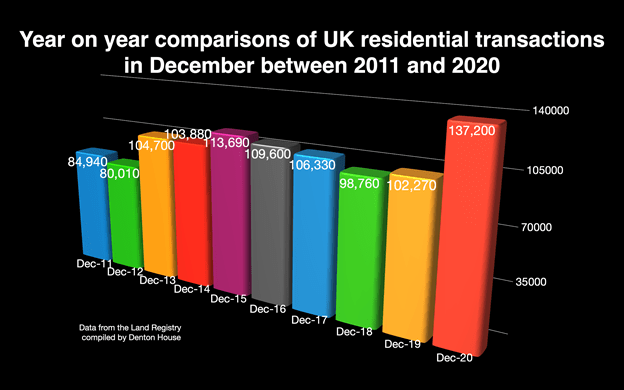
The exact figures from the Land Registry for Hayes won’t be available for another six weeks or so, yet in December 2019, 48 properties changed hands in Hayes. Looking at anecdotal evidence of for sale board changes, my database and the portals, I believe we will end up around 64 to 73 Hayes property sales/transactions for December 2020.

So, how does all this compare to other years?

The number of UK transactions continued to be relatively stable between November 2019 and March 2020. That decreased by around half in April/May 2020 compared to April/May 2019, triggered by economic impacts relating to the public health restrictions introduced. Since the first lockdown was lifted in the late spring, sales/transactions have increased steadily upwards each month, mirroring the relaxing public health restrictions for the property market during the summer and autumn of 2020 and introducing Stamp Duty Tax Holidays.

Before we all get the Champagne corks flowing, what the December national figures (and the corresponding provisional Hayes stats) don’t tell us, is that April to December 2020 transactions ended the year 13.7 per cent down compared to April to December 2019 transactions — the lowest since 2012. Don’t get me wrong, 13.7 per cent is impressive given that we are in the middle of a recession and even more remarkable considering there was a 48.7 per cent fall in transactions in 2008 (compared to 2007) when the Credit Crunch hit.

The biggest question though, is, how much of the urgency since the summer to buy property can be credited to the …

  • existing pent-up demand that built up in 2018/9 and was starting to be released in the ‘Boris Bounce’ in January/February 2020
  • new demand from home workers looking for bigger properties
  • people moving out of the big city centres
  • the Stamp Duty Tax cut

— or a mixture of all four?

Nobody can categorically know whether the UK property market would have ricocheted as quickly without the Stamp Duty Tax cut.

Talking to many buyers, sellers, agents and solicitors in the Hayes property market over the last three or four months, the anecdotal evidence I have collated from those people seems to imply that the outbreak of activity in the Hayes property market has mainly been put down to the lifestyle factors (bigger house with office space etc) and pent-up demand, meaning the Stamp Duty Tax Holiday is seen as the icing on the cake for most people. Yet, there will be some buyers, whose motivation has been purely to save money on the tax duty. Overall though, in the vast majority of house purchases, this allows us to be reasonably hopeful about what will happen once the Stamp Duty Tax Holiday is withdrawn on the 31st March.

However, some newspapers are preaching a story that the property market will collapse without a Stamp Duty Tax Holiday extension. Nobody can argue that a phased withdrawal from the Stamp Duty Tax Holiday would be better than some homebuyer’s sales falling through, when the tax holiday finishes in late March. Even if your motivation isn’t to save money on the tax holiday, it could be the motivation of a buyer in your chain – meaning it becomes your issue. Nobody knew in July, when the tax holiday was announced, that we would get another two national lockdowns with the inevitable delays from remote working by solicitors, mortgage providers and local authority search departments. My advice to all people currently sold subject to contract is to ask the question, “What if we don’t complete the sale by the end of March?”. Better to sort it now than have a nasty surprise in the last week of March.

All property taxation is long overdue for reform, from Stamp Duty to Council Tax. When Margaret Thatcher tried to change local Rates to Poll Tax in the late 1980’s, those who are old enough can remember the Poll Tax Riots, hence the nervousness of any party since to make any changes. There is no way the Government will abolish Stamp Duty when it raises between £11bn to £13bn a year, yet with all the upheaval we have experienced in the last year, there could be an appetite to change the way property is taxed.

The Government has already spent £271bn on interventions due to the pandemic and needs every penny so that it can start to repay those debts over the coming decades.

I have a feeling most Hayes property buyers and sellers would compromise on the price they pay for their next home to cover the cost of the Stamp Duty Tax after April, rather than lose the chance of owning the forever home they longed for during the first lockdown.

Therefore, don’t be alarmed when we see property values ease slightly in Q3 2021 when the price paid for property reflects the lower price to account for the Stamp Duty that will need to be paid from the 1st April.

If you are a Hayes homeowner or Hayes buy to let landlord and you would like a chat about where you and your Hayes property stands in the current Hayes property market, don’t hesitate to give me a call or drop me a line.

11% drop in Hayes Homes ‘For Sale’ in Last 3 Months

What does this mean for Hayes property owners?

With most Hayes families home schooling their children in lockdown and the forthcoming Stamp Duty Holiday deadline on the 31st March 2021, less Hayes, UB3 properties have been coming onto the Hayes property market since the new year. This has prompted a 11% drop in the supply of Hayes homes for sale compared to November 2020.

For the past couple of decades, like clockwork, Hayes estate agents’ busiest times for putting property onto the market is the new year to Easter rush, with a smaller flurry of new properties coming onto the market in the mid/late summer. Yet, since the ending of lockdown 1.0 in the late spring 2020, nothing has been normal about the Hayes property market.

Throughout the summer, the number of properties coming onto the market in Hayes steadily rose to its peak in November and the number of properties then becoming sold subject to contract (stc) rose even higher (and whilst statistics don’t exist for the properties sold stc, anecdotal evidence suggests there were just under 50% more Hayes properties sold stc in the last six months of 2020, compared to the same 6 months in 2019).

However, back to the number of properties for sale…

the peak of the number of Hayes properties on the market in autumn was 387 –  that now stands at 341.

The first lockdown caused many Hayes homeowners to want to move with the need for extra space to work from home and in some cases larger gardens. This was further exacerbated by Hayes home movers also trying to take advantage of the Stamp Duty Holiday to save themselves money on this tax.

This meant many more Hayes properties came onto the market (more than a “normal” year) in the last 6 months of 2020. However, those Hayes home movers motivated to move for the extra space/save money on the tax, did so in the summer/autumn and have already placed their home on the market (and are probably by now sold stc rushing to get their house purchases through before the deadline on the tax savings).

So, how does Hayes compare to other property markets, and what does this reduction in Hayes properties on the market mean to Hayes homeowners and Hayes landlords?

There are 39% more properties on the market today in Hayes, compared to 12 months ago.


Interesting when compared that to the London and national picture. There are 39.5% more properties for sale than a year ago in London, whilst nationally, according to Zoopla, there are 12% less properties on the market today (compared to a year ago). Yet it gets a lot more interesting when you look at what type of property is on the market in London.

There are currently 47,900 apartments for sale in London compared to January 2020, when there were only 32,600 – a rise of 46.9% … all the more interesting when there are only 15.1% more London semi-detached houses for sale and 1.8% more London detached homes over the same 12-month period.

The jump in London apartments for sale is being pushed by an upsurge of London up-sizers eager to trade their city living apartment up to suburban houses, and a small handful of panicky London buy to let investors who are wanting to exit the London property market following falling rents for apartments. Looking closer to home in Hayes, there are…

75% more apartments for sale in Hayes than a year ago, whilst there are 21% less detached homes.

So, whilst there are some differences between the supply of individual types of property in Hayes (e.g. apartments vs detached houses), the overall reduction in the number (i.e. supply) of properties for sale can only mean one thing, when there is a reduction in the supply of anything and demand remains stable, this will mean continued upward pressure on Hayes house prices in the short term (although I suspect there will be some downward pressure on Hayes apartments with that level of increase in supply – maybe some interesting ‘opportunities’ for all you Hayes landlords?).

Will overall demand for Hayes property continue to be stable?

Lockdown 3.0 will probably cause another wave of Hayes people who want to move home (thus increasing demand). The last property crash (the Credit Crunch in 2008/9) was caused by a huge increase in the supply of properties for sale in London when people lost their jobs and interest rates were much higher. People couldn’t afford their mortgages and so dumped their homes onto the market all at the same time – causing an oversupply of property for sale and hence house prices dropped.

The number of London properties for sale increased from 66,250 in early 2007 to 100,200 in May 2008, a rise of 51%.

It was this increase in the level of property for sale in London that caused Hayes property prices to drop between 16% and 19% (depending on the type of property) in Hayes over the 12 to 14 months of the Credit Crunch. So, whilst the Hayes property market is slightly top heavy with apartments, as long there is no sudden change in the demand or supply of properties and interest rates remain at their current ultra-low level – the medium-term prospects for the Hayes property market look reasonably good (especially detached homes).

If you are a Hayes homeowner or a Hayes buy to let landlord and want to chat about the future of the Hayes property market – do drop me a line.

Hayes Property Market: Is it Time to Stamp Out Stamp Duty?

Most people pay Stamp Duty Tax when they buy a property, house, apartment or other land and buildings over a particular price in the UK. The Chancellor, Rishi Sunak (quickly followed suit by the Welsh and Scottish Governments), announced last July that Stamp Duty was partially being suspended on all English property transactions up to £500,000 (£250,000 in Wales and Scotland) – a Stamp Duty Holiday.

That meant only 1 in 8 English buyers would pay any Stamp Duty Tax on their home purchase (if it was over £500,000), saving any buyer up to £15,000 in tax on the purchase. The problem is the property needs to have been purchased and bought by the 31st March 2021. Complete the transaction a day later, and those buyers will have to pay Stamp Duty.

The issue is local authorities are snowed under with local search requests, mortgage companies and conveyancing staff are working from home, so property transactions are taking much, much longer. This means many Hayes (and UK) buyers who have currently sold (subject to contract) will miss out on the stamp duty saving.

Most (not all) estate agents have been warning the buyers and sellers in their property chains that some deals might not make the 31st March 2021 deadline and pleasingly, most people aren’t moving because of the Stamp Duty Holiday (they are moving because they need extra space because of the pandemic). However, it only takes one person in the chain not to be ‘singing off the same hymn sheet’ for the whole chain to collapse … so keep in touch with your estate agent.

A campaign by one of the national newspapers and an online petition to extend the stamp duty holiday has meant the topic could be debated in Parliament in the next few weeks, after 100,000 home buyers and sellers signed that petition, asking for an additional six-month Stamp Duty Holiday. The home buyers and sellers are worried the property market will collapse after March 31st when the Stamp Duty Holiday is removed.

The last time British home buyers were conscious of upcoming Stamp Duty changes, it distorted the number of properties sold. The bigger question though is, did it change the overall number of people moving home?

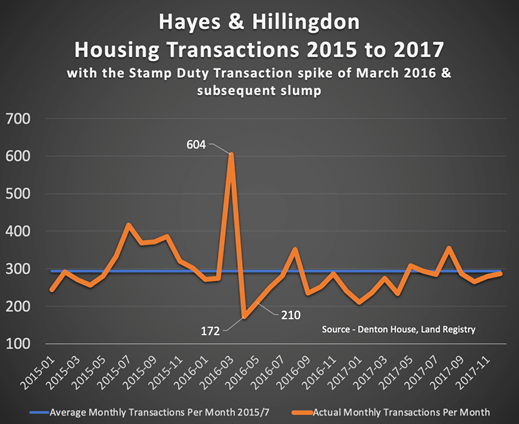
In November 2015, the then Chancellor, George Osborne, announced in his Autumn Statement that buy to let landlords would have to pay an additional 3% in Stamp Duty (over and above owner occupiers) for all property bought after the 1st April 2016. As shown in the graph below, this caused a surge in property buying (which we have seen since this summer with the Stamp Duty Holiday), with many Hayes buy to let landlords completing their property purchase in March 2016, as they dashed to complete their property purchase before the tax increase.

In the 3 years of 2015/6/7, the average number of Hayes properties sold (transactions) per month was 294 per month, yet in the month before stamp duty was changed in March 2016, transactions rose to 604, an uplift of 105.6% from the average or an extra 310 transactions in that month alone. Yet, look at the months of April and May, the property transactions numbers slumped, meaning in those two months combined, there were 206 less transactions.

So, if the Stamp Duty Holiday isn’t extended, what will that mean for the UK and Hayes property market?

London and the South East seem to be particularly exposed to the removal of the Stamp Duty Tax break because it has such a high proportion of property priced between £300,000 and £500,000. These areas benefit from the highest tax savings relative to house price.

Yet, with the average value of a Hayes home at £373,900, the stamp duty cost if the sale is delayed after the 31st March 2021 is £8,695 – a figure that shouldn’t break the bank

So, if the Stamp Duty Holiday isn’t extended – it might not be such the nightmare scenario as some people believe.

My advice to all buyers and sellers is to be constantly talking to your estate agent, your solicitor and your mortgage broker. With your estate agent to ascertain if they have asked every person (or asked the other agents in the chain to ask the question), “What if we don’t meet the stamp duty deadline?” With your mortgage broker and solicitor to give them all the information they need to ensure there are no delays with any information they request from you.

One final thought, some mortgage providers allow insurance policies to be purchased by your solicitor in case your searches (from the local authority aren’t back in time) … the cost of those will be much lower than the cost of the stamp duty … again, speak with your solicitor.  Irrespective of whether you are a client of mine or not, if you would like a chat about anything mentioned in this article, don’t hesitate to contact me.

4,627 Hayes Homeowners to be ‘Unchained’ from Toxic Leasehold Agreements in Biggest Shake-up of Property Law in Decades

When William the Conqueror invaded our fair shores in 1066, like all good kings, he needed to buy loyalty and raise cash to build his castles and armies. He did this by feudal law system and granted all the faithful nobles and aristocrats with land. In return, the nobles and aristocrats would give the King money and the promise of men for his army (this payment of money and men was called a ‘Fief’ in Latin, which when translated into English it becomes the word ‘Fee’… as in ‘to pay’).

These nobles and aristocrats would then rent the land to peasants in return for more money (making sure they made a profit of course) and the promise to enlist themselves and their peasants into the Kings Army (when requested during times of war). The more entrepreneurial peasants would then ‘sublet’ some of their land to poorer peasants to farm and so on and so forth.

The nobles and aristocrats owned the land, which could be passed on to their family (free from a fee i.e. freehold), while the peasants had the leasehold because, whilst they paid to use the land (i.e. they ‘leased it’ which is French for ‘paid for it’) they could never own it. Thus, Freehold and Leasehold were born (you will be pleased to know that in 1660 the Tenures Abolition Act removed the need of freeholders to provide Armies for the Crown!).

4.3 million properties in the UK are leasehold…

and 4,627 properties in Hayes are leasehold. By definition, even when you have the leasehold, you don’t own the property (the freeholder does). Leasehold simply grants the leaseholder the right to live in a property for 99 to 999 years. Apart from a handful of properties in the USA and Australia, England and Wales are the only countries of the world adhering to this feudal system style tenure. In Europe you own your apartment/flat by using a different type of tenure called Commonhold.

The average price paid for leasehold properties in Hayes is over the last year £232,244.

The two biggest issues with leasehold are firstly, as each year goes by and the length of lease dwindles, so does the value of the property (particularly when it gets below 80 years). The second is the payment of ‘ground rent’ – an annual payment to the freeholder.

Looking at the first point of the length of lease, the Government brought in the Leasehold Reform Act 1967, which allowed tenants of such leasehold property to extend their lease by upwards of 50 years. However, this was very expensive and as such only kicked the can down the road for half a century (when the owner would have to negotiate again to extend another 50 years – costing them more money, time and effort).

Ground rents on most older apartments are quite minimal and unobtrusive. The reason it has become an issue recently was the fact some (not all) new homes builders in the last decade started selling houses as leasehold with ground rents. The issue wasn’t the fact the property was sold as leasehold nor that it had a ground rent, it was that the ground rent increased at astronomical rates.

Many Hayes homeowners of leasehold houses are presently subject to ground rents that double every 10 years.

That’s okay if the ground rent is £200 a year today, yet by 2121, that would be £204,800 a year in ground rent, meaning the value of their property would almost be worthless in 100 years’ time. One might say it allows for inflation, yet to give you an example to compare this against, if a Hayes leasehold property in 1921 had a ground rent of £200 per annum, and it increased in line with inflation over the last 100 years, today that ground rent would be£9,864 a year.

This is important because the majority of leasehold properties sold in Hayes during the last 12 months were apartments, selling for an average price of £229,645.

So, without reforms, the value of these Hayes homes will slowly dwindle over the coming decades. That is why the Government reforms announced recently will tackle the problem in two parts.

Firstly, ground rents for new property will be effectively stop under new plans to overhaul British Property Law. Under the new regulations, it will be made easier (and cheaper) for leaseholders to buy the freehold of their property and take control by allowing them the right to extend the lease of their property to a maximum term of 990 years with no ground rent.

Secondly, in the summer the Government will create a working group to prepare the property market for the transition to a different type of tenure. Last summer the Law Commission urged Westminster to adopt and adapt a better system of leasehold ownership – Commonhold. Commonhold rules allow residents in a block of apartments to own their apartment, whilst jointly owning the land the block is sitting on plus the communal areas with other apartment owners.

These potential leasehold rule changes will make no difference to those buying and selling second-hand Hayes leasehold property.

Yet, if you are buying a brand-new leasehold property, most builders are not selling them with ground rent (although do check with your solicitor). The only people that need to take any action on this now are people who are extending their lease. If you are thinking of extending the lease of your Hayes property before you sell to protect its value, your purchaser may prefer to buy on the existing terms and extend under the new (and better) ones later (meaning you lose out). Like all things – it’s all about talking to your agent and negotiating the best deal for all parties. Should you have any questions or concerns, feel free to pick up the phone, message me or email me and let’s chat things through.

How Will the Brexit Deal Affect Hayes House Prices and Your Mortgage Payments?

Christmas Eve brought the news that Boris Johnson had conclusively agreed on a Brexit deal for the UK with the European Union. This gave optimism that the economic turmoil of leaving the EU would be radically reduced, yet what will this ‘trade deal’ do to the value of your Hayes home and the mortgage payments you will have to make?

Since the summer, the Hayes property market has been booming, yet many commentators have cautioned that the momentum cannot last. With unemployment and the end of Stamp Duty Holiday  on 31st March, the Halifax reported last week that they believed UK house prices would drop by at least 2% (and in some areas 5%) in 2021.

I find it fascinating the Hayes property market has defied the doom and gloom swamping the wider British economy in the last seven months. The Hayes property market has profited from the large swell in demand from better-off existing Hayes households trying to buy larger Hayes houses (as they are required to work from home) together with the added benefit of saving money from the Stamp Duty Holiday.

Hayes house prices are 3.9% higher than a year ago, making our local authority area the 220th best performing (of the 396 local authorities) in the UK.

With the Brexit deal being voted through in the Commons on the 30th December, many say this will boost the property market just as the Government-backed measures supporting the property market come to an end. Yet, in the face of rising unemployment due to the pandemic, the Brexit deal may do little more than avoid uncertainty for the Hayes housing market.

What will happen to Hayes house prices?

The Hayes property market in 2019 was held back because of the uncertainty of the Brexit deal. In January 2020, we saw the demand released in the fabled ‘Boris Bounce’, only for buyer and seller activity to fall off a cliff in March during the first lockdown. It then took off like a rocket once lockdown was lifted. UK house prices are 4.19% higher today, year on year (although some areas are breaking the mould, like Aberdeen whose house prices have dropped by 5.1% and at the other end of the scale, Worcester’s house prices have increased by 11.9% year on year). A lot of that growth in UK property prices has been fuelled by buyers spending their stamp duty savings on the purchase price of their new home. Yet, it cannot be ignored.

Of the 145,500 workers in Hillingdon, 16,400 are still on furlough (although roughly 40% of those people are still only on part-time furlough).

When the furlough scheme ends in April 2021, unemployment is likely to rise to in excess of 11%, whilst the protection for the homeowners utilising mortgage holidays will finish. 

Piloting the rocky shoreline of the recession is more important than any Brexit deal for Hayes homeowners, buy-to-let landlords, buyers and sellers.

In April, the market will also be dealing with the end of the Stamp Duty Holiday, which is due to come to an abrupt halt on the 1st April 2021. Consequently, we will continue to see the house price index’s show growth in the first half of 2021. They will then recede as the  prices of Hayes homes purchased after the 1st April 2021 reflect the lower price paid (because buyers would have had to pay for their stamp duty again). Therefore, probably by the end of 2021, the Halifax may be correct, and Hayes house prices will be 2% to 5% lower than they are today, simply because of the stamp duty.

What will happen to mortgage rates?

The real benefit from the Brexit deal is that there will be no tariffs on most goods coming into the UK. 52% of all goods imported into the UK are from the EU (totalling £374bn per annum). The UK Government were planning to add between 2% and 10% tariffs under World Trade Organisation rules on the vast majority of those goods. Price increases because of those tariffs would have fuelled inflation, meaning the Bank of England would have to increase interest rates. Although 77.2% of British mortgages are on fixed rates (paying an average of 2.16%), eventually those increased Bank of England rates would have fed through into higher mortgage payments. To show you how vital low interest rates are …

the average Hayes homeowners’ mortgage is £549.03 pm, owing an average of £223,841.

Yet if interest rates rose only 1.5%, Hayes homeowners’ monthly mortgage payments would rise to £828.83 pm, and if interest rates were at their 50-year average, then the mortgages payments would be an eye-watering £1,614.14 pm (note all mortgage payment figures mentioned above are only for the interest element of the mortgage- the capital repayment element would be additional and variable depending on the length of mortgage).

As I have mentioned many times in the articles I have written about the Hayes property market, low interest rates are vital to ensure we don’t have a property market crash. That’s not to say just because they are at an all-time low of 0.1% to aid the economy that there won’t be some form of realignment of property prices later in the year (as mentioned above). Yet low interest rates mean people can still pay their mortgages, so there won’t be panic selling. That would mean there won’t be a flood of property come to the market (like there was in the 1988 and 2008 property crashes when interest rates were much higher), suggesting property prices should remain a lot more stable.