Hayes Home Buyers £3,553,228 Windfall as Stamp Duty Holiday Stretched to September… and new 5% deposit mortgages for Hayes first-time buyers

The Chancellor Rishi Sunak announced two initiatives to keep the Hayes property market firing on all cylinders into 2021.

Firstly, the £500,000 zero-rate Stamp Duty band has been extended to the 30th June 2021. After then it will phase down to £250,000 for an additional three months, returning to the pre-pandemic levels on the 1st October 2021. Secondly, Mr Sunak announced a scheme that will allow Hayes first-time buyers to buy their Hayes home with a 5% deposit from this April. Let me look at what each initiative means to the Hayes property market.

  1. Stamp Duty Holiday extension for Hayes home buyers

Coming out of the first lockdown in the early summer of 2020, there was a lot of apprehension that the British property market would flounder. Therefore, when the Stamp Duty Holiday was announced back in July 2020 to boost the property market, the deadline was set at the 31st March 2021.  Little did anyone know of the snowball effect of people wanting to move because of the initial lockdown in the spring of 2020, the pent-up demand following the conclusion of the EU negotiations with the subsequent ‘Boris Bounce’ and then the Stamp Duty Holiday which made the perfect storm for what has been the busiest property market in Hayes since 2001/2.

The average stamp duty paid by a Hayes homebuyer is £8,687

The reason the Stamp Duty extension is important is that many estate agents and solicitors have been warning for the last couple of months that home buyers would pull out of property deals or renegotiate if they could not complete their sale in time before the Stamp Duty Holiday ended.

So, by phasing down the Stamp Duty Holiday, this will allow some breathing space for burdened solicitors and mortgage lenders, thus decreasing the number of buyers pulling out of their property purchase because they unexpectedly have to find up to an extra £15,000 in Stamp Duty when property sales do not complete on time.

There are currently 409 properties that are sold STC in Hayes alone and the vast majority of those will save money on their stamp duty because of this extension

So, what does the Stamp Duty extension mean for Hayes house prices?

The extension has heightened confidence in the Hayes property market. The Government watchdog ‘The Office for Budget Responsibility’, has predicted that house prices in 4 years’ time will be just over 13% higher, compared to their pre-Christmas predicted figure of 11% growth (over the same time frame).

2. 5% deposit mortgages for Hayes first-time buyers

From next month, Hayes first-time buyers will be able to buy Hayes homes worth up to £600,000 with a 5% deposit and a Government-backed mortgage with a fixed rate of up to 5 years.

Rishi Sunak wants to turn the millennial ‘Generation Renters’ into ‘Generation Buyers’ and believes this initiative should be able to help two million people get on the property ladder. When we look at what that would mean for Hayes, I estimate…

1,549 Hayes people could be helped onto the Hayes property ladder with these 5% deposit mortgages

The Government backed scheme will be open to Hayes first-time buyers for 21 months (until the end of 2022) and available from lenders including NatWest, Lloyds and HSBC (plus others to be announced soon). It will be available on all Hayes homes new or second hand (previous schemes applied to new homes only).

5% deposit mortgages were all but withdrawn from the market at the start of the pandemic in spring 2020 with an almost default minimum deposit of 10% (even as high as 15% in the autumn just gone) putting homeownership out of reach for all but the wealthiest Hayes first-time buyers.

I must admit, I found it a scandal that homeownership among the 25 to 34 year olds plummeted from 69% in 1981 to 36% by 2014, although with certain Government incentives and low interest rates since then, that had risen to 41% by last year, but it’s not enough

With so many young families paying huge sums in rent, who could effortlessly afford to make mortgage repayments on the same property, they haven’t been able to save enough for a 10% initial mortgage deposit, let alone 15%.

Yet now with these new 5% deposit mortgages, many Hayes first-time buyers will be able to afford to buy their first home in Hayes. Banks will typically lend between four and a half and five times the gross annual income – this means with a modest 5% deposit; many Hayes 20 and 30 somethings will now be able to buy their first home. Just before I finish this topic, the 5% deposit mortgages will also be available to current Hayes homeowners who don’t have the equity built up in their existing home – thus helping second or third (or more) time Hayes buyers as well.

How do both of these changes affect Hayes buy-to-let landlords?

I know many of you Hayes landlords are adding to your Hayes rental portfolio because of the Stamp Duty Holiday and with the extension, you too will save some money from it. The issue of first-time buyer mortgages does mean the demand for private rented accommodation in Hayes might not be as strong in the coming decade.

Don’t get me wrong, tenant demand will continue to outstrip supply of Hayes rental properties for the foreseeable future, yet the tenant/landlord balance could alter slightly in the medium term. Hayes landlords need to take a long hard look at their properties and ascertain if they are fit for purpose both now and into the 2030’s. Tenants are becoming a lot more demanding of what their rental property offers. Wood chip wallpaper, avocado green bathroom suites and kitchens fitted in the 1990’s (or before) simply won’t cut the mustard in the next decade.

The demand from Hayes tenants for properties with larger gardens, or the ability to keep pets or an extra reception room/garden office to allow them to enjoy their rented home more and also being able to work from home will ensure greater demand for your rental property – and the best bit, they will pay handsomely for that in higher rent.

If you are a Hayes homeowner, buyer, tenant or landlord and you want to discuss your options on selling, buying or renting a property in Hayes and the surrounding area, do not hesitate to contact me personally.

Lifeline for Hayes House Buyers & Hayes First-time Buyers

In the last few hours, the Chancellor of the Exchequer, Rishi Sunak, has stated the Stamp Duty Holiday for Hayes properties up to £500,000 will be extended from 31st March 2021 to the 30th June 2021; and to ensure we don’t have a cliff edge, from 1st July 2021, the Stamp Duty Holiday will apply only on properties up to £250,000 until the end of 30th September 2021. 

From the 1st October 2021 Stamp Duty thresholds and levels will return to pre-pandemic levels.

To help Hayes first-time buyers, the Chancellor confirmed that there will be Government guaranteed 95% mortgages available from April, on the purchase of properties up to the value of £600,000. This means Hayes first times buyers will be able to buy their first home with just a 5% deposit.

Hayes Landlords will also be pleased there was no statement on Capital Gains Tax, although this will have to be addressed in the years to come.

Hayes tenants, those hardest hit with unemployment and job uncertainty, will also be pleased to hear that the Furlough Scheme will be extended to the 30th September 2021. 

It is my intention to publish a greater in-depth article early/mid next week to discuss these topics and what it actually means at a more granular level for Hayes homeowners, Hayes property buyers, Hayes tenants and Hayes landlords.

Hayes Pensioners Homeowners are now Worth £923,656,600

How wealth is distributed will always be a contentious issue, especially as the Baby Boomers (those aged between their late 50’s and late 70’s) wealth has grown exponentially over the last 20 years, compared to the wealth of the younger generation.

With most UK property in the hands of the older generation, with its total value about to smash through the £8 trillion barrier (up from £3 trillion at the start of the Millennium), is it right that so much wealth is concentrated in the hands of the older generations?

As national house prices have continued to grow unabated (for example in the last eight years by 49.9%, whilst real take home pay has only increased by 11.8%), this has meant younger people are finding it even harder to get onto the property ladder and those already on it to move up it.

Looking at the older end of the age range for home ownership …

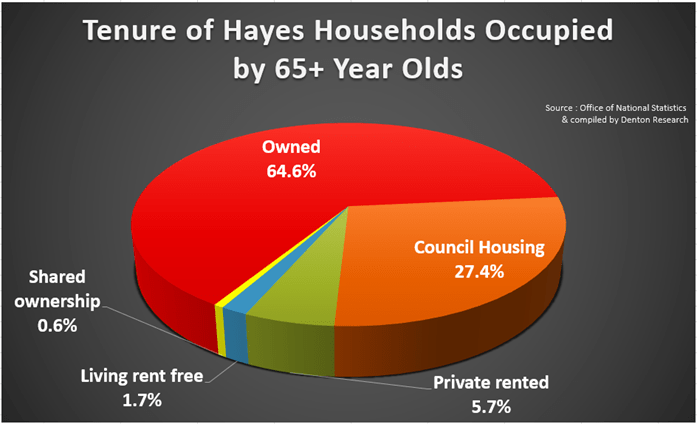
of the 15,923 homes in Hayes/UB3, 2,719 households are 65 years or older, and 64.6% of those households (1,756) are owned (mostly without a mortgage).

A full split as follows …

  • Owned 64.6%
  • Council House 27.4%
  • Privately Rented 5.7%
  • Living Rent Free 1.7%
  • Shared Ownership 0.6%

I talk with many Hayes pensioners who want to move yet are unable to. There appears to be a shortage of suitable properties in Hayes for members of the older generation to downsize into. Due to their high demand and low supply, Hayes bungalows and suitable ground floor apartments achieve on average a 15% to 25% premium per square foot over two/three storey properties. Yet would it surprise you only 1% of new builds in the UK are single storey bungalows (compared to 7% 25 years ago)?

Hayes pensioner homeowners are now worth £923.7m.

YouGov did a survey a couple of years ago and they found that just over one third of homeowning pensioners in the UK were looking to downsize into a smaller property. As I have stated before, as a nation, we need to rethink how we can encourage older homeowners to sell their larger homes to release them to the younger families that desperately need them.

The Government over the last 11 years have appeared to target all their attention on first-time buyers with a strategy such as the Help to Buy Scheme. However, this doesn’t address the long-established under-supply of appropriate retirement housing vital to the needs of Hayes’s quickly ageing population. Unfortunately, Hayes’s housing stock is sadly ill-equipped for this demographic shift to the ageing homeowners.

Also, to add insult to injury, those more mature Hayes pensioners in their 80’s and 90’s who do live in the restricted number of Hayes bungalows and suitable ground floor apartments are finding it difficult to live on their own, as they are unable to leave their bungalow/apartment because of a shortage of sheltered housing and ‘inexpensive’ care home places.

This in turn means the younger 60 to 70 year old Hayes retirees (in their bigger two/three storey family houses) can’t buy those Hayes bungalows (occupied by the older retirees), which means those Hayes families in their 30’s and 40’s can’t buy those larger family houses (occupied by the younger 60 to 70 year old retirees) they need for their growing families … it’s like everyone is waiting for everyone because of the logjam at the top of the property ladder.

So, what is the solution? Quite simple – build more homes!

In the last 30 years, the UK population has grown by around 12 million people, yet the number of properties has only grown by around 4.2 million.

With obstructive planning regulations, immigration, people living longer and increased divorce rates (meaning one family becomes two) we have needed 275,000 properties to be built a year since the Millennium to just stand still and meet demand. Twenty years ago, the UK was building on average 185,000 households a year, that figure dropped in the five years after the Global Financial Crisis in 2008 to 140,000 households a year. Thankfully that has increased steadily over the last five years and last year we created 245,000 households in the UK, however we still have all those years since the Millennium to make up for.

The answer is to build on more land for starter homes, bungalows and sheltered accommodation because land prices are holding back the property market, as the larger national building firms are more inclined to focus on traditional two and three storey houses and apartments than bungalows (because they make more money from them). You might say there is no land to build the property on, yet …

only 1.2% of the UK is built on with residential properties.

So how could Hayes people make money on this news? Shrewd Hayes property investors should consider purchasing bungalows, especially ones that need some titivating (possibly after somebody has passed away). Bungalows purchased at the right price and location are a great gamble for flipping. They should also be considered for renting out as demand will only outstrip supply. This would be a start to the solution of rebalancing the Hayes property market so everyone is happier with their lot.

If you would like a chat about the Hayes property market – don’t hesitate to give me a call.

Half of Hayes Homeowners Move Again Within 14 Years and 6 Weeks – Why?

In Britain, there are 27,071,500 households, of which 17,044,450 are owned, which are worth a total of £3,925,865,212,950 (£3.92 trillion). Over the last 5 years, an average of 86,096 properties sell each month, meaning just over a million UK households move home per year. Therefore, the average British homeowner moves every 16 years 5 months.

These statistics refute a common hypothesis that British neighbourhoods are becoming more fleeting and transitory. On the face of it, they appear to show that, once you have succeeded to buy a property you can call home, there isn’t much motivation to move again.

So, aren’t people moving home so much?

Could it be put down to a certain sense of complacency or apathy to moving home? Whereas we might love our home in Hayes, most of you (including myself) still want to ‘better our lives’ with a bigger house, better area etc, which typically requires us to climb up the Hayes property ladder.

Yet with Hayes house prices having risen by 202.4% in the last 20 years, the cost of going up the next rung on the Hayes property ladder is prohibitive.

Everyone harks back to the 1980’s, when we had an upbeat booming property market as a backcloth, Brits moved home every eight years; so now with the average at just over 16 years this equates to each British homeowner moving around three to four times in their adult lifetime. Maybe we should all call our homes ‘Dunroamin’ and be done with it!

Or does it? 

We have all heard the phrase ‘lies, damn lies and statistics’ … well the stats mentioned above hide some amazing features of the British property market. When homeowners get into their 50’s and 60’s, their tendency to move home drops like a stone. The average length of time a homeowner without a mortgage moves home is 24 years and 7 months (and just under 7 out of ten outright homeowners i.e. without a mortgage are 65 years old or older). 

Yet, homeowners with a mortgage move on average every 10 years and 11 weeks.

So, whilst I cannot determine who has a mortgage and who doesn’t, I can look at how quickly people move home in Hayes.  I have looked at the last 50 property sales in Hayes (UB3 to be precise), and I have found some interesting findings.

On average Hayes homeowner only move every 19 years and 29 weeks.

Nothing interesting about that you might say, when compared to the national average … yet the devil is in the detail.

There appears to be a two-speed Hayes property market … look at the top 25% of Hayes home movers … these Hayes people are moving home really quickly, yet the gap for the next three slices widens tremendously.

  • Top 25% quickest Hayes home movers move every 8 years & 8 weeks
  • The next 25% quickest Hayes home movers move every 19 years & 32 weeks
  • The next 25% quickest Hayes home movers move every 24 years & 20 weeks
  • Whilst top 25% slowest Hayes home movers only move every 26 years & 47 weeks

When looking at the properties that fall into the later bands (i.e. the ones that don’t move/sell so often), they tend to be the larger properties where the homeowners have lived for 25/30 years plus.

The lesson we all should learn is that once people get into their 50’s and 60’s, their propensity to move home drops considerably. This means the properties on the lower rungs of the Hayes property ladder do appear to sell quickly (as they are occupied by younger homeowners) yet once Hayes people get older, their tendency to move diminishes. This puts a roadblock on the younger generation wanting to buy the larger Hayes properties these mature homeowners live in.

What is holding the older generation back from selling and downsizing to free up homes for families that desperately need them? Some of it will be apathy, some of it will be holding on to the home that they brought their family up in, yet the bottom line is…

46.5% of the homes owned in Britain have two or more spare bedrooms.

As a nation, we need to rethink how we can encourage older homeowners to sell their large homes to release them to the younger families that desperately need them. Some suggest tax breaks, yet the Government won’t be in the mood to give huge tax breaks as the measures to protect the economy over the last 12 months will ultimately need to be paid back.

One thing I do know, we as a Country have seen (and will continue to see) a lot of demographic change together with an increasing elderly population, so it’s not just about how many homes we build, but whether we are building the right kind of homes the older generation will want to move into.

Interesting times ahead for the Hayes property market!

If you have a Hayes property to sell or let in the coming weeks, months or years and would like to know how this and other factors will affect you and your property… without obligation, don’t hesitate to give me a call or drop me line.

My 10 year interest only mortgage is coming to an end and the bank want their money back… HELP

Q Ten years ago, we built a detached bungalow in the grounds of our house in  Hayes. We took out a 10 year interest-only mortgage with one of the High Street mortgage providers to pay for it.

Now the 10 years is up and mortgage company wants us to pay it back. I know we agreed to pay into an ISA at the time, but thought as property prices were rising in Hayes, we would let the property market increases pay for the mortgage and sell everything in 2020.

The mortgage company have been given us an extension until the end of 2021 to find the money, yet we have changed our minds and do not want to do that by selling our main home yet.

A mortgage provider recommended we get a buy-to-let mortgage on the bungalow. Yet, we never got round to splitting the title deeds and the buy-to-let mortgage provider needs this before we can apply for a buy -to let mortgage. What are the likely consequences of doing this?

A If you are ever planning to re-mortgage or sell your property, it is vital that you meet with your solicitor. They can outline the exact nature of the title on both properties, get the paperwork in order for you and communicate with the Land Registry to sort it out.

If you select the option of a buy-to-let mortgage, it is imperative to appreciate what rent the bungalow could realise and whether that will cover the mortgage payments.

Also, is there independent access to the bungalow, or do tenants have to go through your own garden in order to access it?  Not many Hayes tenants want to live in a property that is in the gardens of someone else’s home, especially their landlord’s, thus effecting the level of rent that could be achieved

It is really significant that you are conscious that a buy-to-let mortgage means the property has to be rented out. The lender has the right to see proof of the tenancy agreement and the rental payments coming into your bank account.

I would suggest you might also like to talk other mortgage providers, as many other banks and building societies are offering interest only mortgages (as they make up around 7% of all mortgages in the UK). I know of some decent mortgage brokers in Hayes that might be able to help and give you a second opinion.