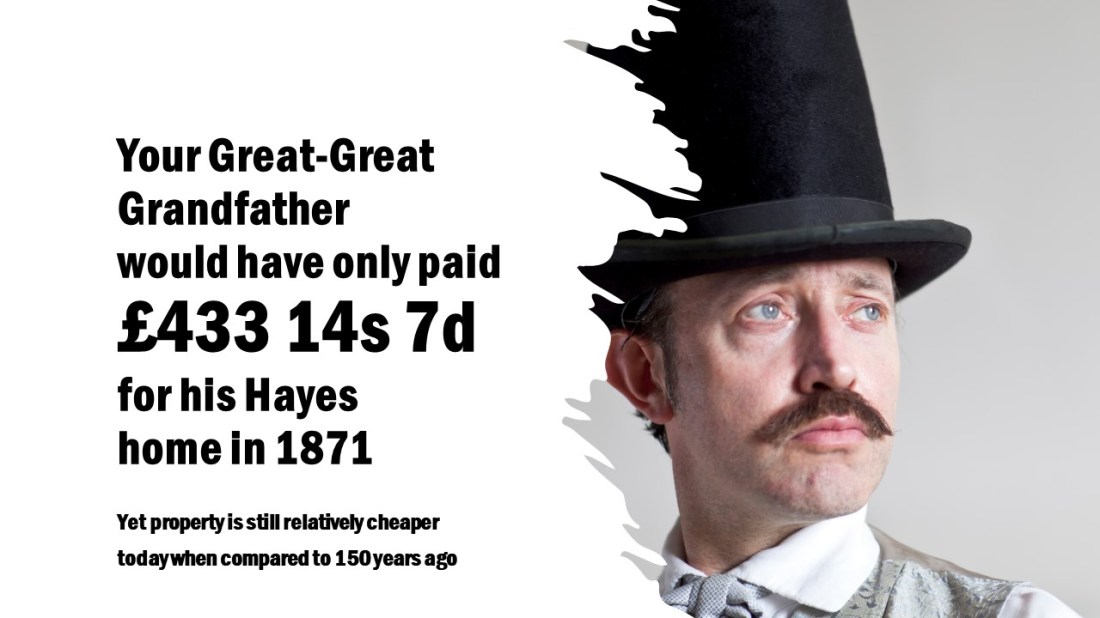
Your Great-Great Hayes Grandfather Would Have Only Paid £433 14s 7d for His Hayes Home in 1871

Would it surprise you even more when I said the ratio of house prices to wages are still lower today when compared to 1871? Yes, you read that correctly, as a proportion of average wages British house prices are 17.6% proportionally cheaper today than they were in 1871.

I wish to talk about the last 150 years of the British property market and later in the article, the Hayes property market. I will also touch on why, before the 1900s, buying a home in Hayes was considerably more expensive than today and why that changed.

So, let’s look at some interesting stats to get us started:

  • In 1871, each house was occupied by an average of 5.33 people (i.e. for every 100 houses, 533 people lived in them), whilst today that stands at 2.39 people per house
  • In 1871, there were 4.5 million properties in the UK, whilst today that stands at 27.9 million.
  • In 1871, the weekly average wage was 13s 8½d (68p), whilst today it’s £585.50
  • In 1871, only 20% of people owned their own home, whilst today its stands at 65%

I stated in the first part of the article it was more expensive to buy in the latter parts of the 19th Century than today. It may only be of historical interest, but back in 1871, the ratio of average house prices to average wages was 10.5 to 1 (i.e. the average house was worth ten and half times the average person’s wage), whilst today it stands at 8.8 to 1.

Interestingly, for the next 45 years, that ratio went on a downward trend relative to wages and only stopped falling after WW1, where the average house was worth only 2.2 times the average wage. This made houses more affordable and set the foundations for the homeowning passion we Brits have today.

So why did this happen, what can we learn from it and what does it mean for Hayes homeowners and Hayes landlords?

There are three significant drivers that made property a lot more affordable between 1871 and 1911: the Victorians built more property, made them smaller and people’s wages rose significantly.

  • In the 40 years between 1871 and 1911, the number of properties in the UK rose from 4.5 million to 8.9 million. To give you some perspective, there were 18 million properties in the UK in 1981. If the UK had grown by the same rate between 1981 and today that was experienced between 1871 and 1911, there would be 35.6 million households in the UK (and not the 27.9 million mentioned above).
  • In 1871, the average plot size of a property was 0.23 acres, yet by 1911, that was down to 0.06 acres (or a plot of 72ft by 40ft). This came about from building smaller types of property (i.e. a change away from larger Georgian detached houses towards the infamous rows of Victorian terraces), and a downshift in the average size of houses within each category.
  • The average value of property dropped by 26% between 1871 and 1911, whilst wages rose by 85% over the same time frame.

So, by 1911, the average Hayes property had dropped in value from £434 in 1871 to £322.

N.B. – you might have noticed I wrote £434 in a slightly different way in the title of the article. Up to 1971, a pound was split not into 100 pence but 240 pence. There were 12 pence in a shilling and 20 shillings (or 240 pence) in a pound. It was expressed in the form £sd and spoken as “pounds, shillings and pence”. I dropped that into the title as it’s the 50th anniversary this year of when the UK decimalised its currency (younger readers – do google the story – it’s a fascinating topic).

So back to the property market and at the end of WW1, four in five people still rented, virtually all from private landlords. Politicians were concerned about the poor living standards of people’s homes, and this led to the ‘homes fit for heroes’ 1919 Housing Act which delivered subsidies for local councils to build council houses. The average value of a Hayes property in 1922 was £506.

The 1930s – By 1930, the average value of a Hayes property stood at £640. With the country building a third of a million houses per annum, interest rates fixed at 2% and hardly any planning regulations, supply of property was outstripping demand, so the average Hayes home dropped ever so slightly in value to £591 by 1938.

The 1940s – With the bombing of many towns and cities and housebuilding being stopped because of the war, this created a perfect storm to increase house prices after the war. By 1947, the average Hayes home had risen in value to £1,977 because just as food was rationed during and after the war, so were building materials. Builders could spend no more than £350 on building materials for a new home (and that lasted until 1954).

The 1950s – The ’50s were all about building council houses – a quarter of a million of them each year. By 1959, the average Hayes home had risen steadily to £2,743.

The 1960s – This decade saw even more houses being built in the UK, with an average of a third of a million houses a year being built. Hayes is full of 1960’s council houses and now even more owner-occupied housing, meaning by the end of the decade Britain had as many homeowners as renters. The average Hayes house had risen in value to £5,031 by 1969.

The 1970s – We experienced the first boom and bust housing bubble in the early 1970s with house prices rising by over 30% a year in the early years of the decade (so the current 10% a year is child’s play!) but prices dropped in 1974. They recovered quickly in the following years, not because of increased demand but due to hyperinflation, making the average Hayes house price rise to £25,586 by 1980.

The 1980s – This was the decade of council tenants being able to buy their own homes, although not many people know it was an idea from Labour. They decided against the idea, but it was seized upon by the Tories, who made it the cornerstone of their 1979 election manifesto. The property market helped improve the economy, and by 1988, Hayes property values increased to £53,517 (only to drop by 32% a couple of years later).

The 1990s – The housing market crash of the early 1990s was painful for all, exacerbated by mortgage interest rates being raised to 15% on Black Wednesday (16 September 1992) and left there for 12 months. Unemployment went from 1.5m to 3m for the second time in ten years, and many of those homeowners who had taken out large mortgages in the late 1980’s housing boom could no longer afford the repayments because of the high interest rates, meaning repossessions went through the roof. The crash also made builders nervous, and they only built 150,000 houses on average a year in this decade. Yet, by the mid-1990s, things started to improve. So much so, the average Hayes home was worth £100,323 by the turn of the millennium.

The 2000s – The decade of cheap mortgages and the rise of Buy to Let, together with a severe drop in the number of new homes being built, contributed to the UK’s third big housing bubble since WW2. The average Hayes house price more than doubled to £268,658 by 2008, before the Credit Crunch brought the boom to an end, and a year later (2009), the average Hayes property had dropped to £238,621.

The 2010s – The property market started to come back to life in the early 2010s with property values steadily rising throughout the decade, yet builders were only building around 135,000 new homes a year. It also might surprise you that by 2015/6, the number of homeowners was starting to rise quite significantly, meaning today, as we enter the 2020’s decade, the average value of a Hayes property now stands at £382,587.

So, now we are back to 2021.

Yes, your Great-Great-Grandfather might have been able to buy their Hayes house for a shade under £434 in 1871. Taking inflation into account since 1871, that same Hayes house today would be £52,245.90, yet if his wages had increased by inflation at the same rate, the average wage today would be £81.91 per week, not the current £585.50 per week.

I appreciate there are plenty of other factors involved with this topic, such as the cost of renting, raising a deposit, changing lifestyles and the biggest point, the cost of borrowing money on a mortgage.

All this begs the question, what does the future hold for the Hayes property market?

It’s obvious since the mid-1980s, house prices have sustained a period of impressive growth (even withstanding a couple of property crashes). The Bank of England has gone on record to say that much of the rise in average house values, comparative to wages, between 1985 and now can be seen because of a sustained, dramatic and consistently unexpected decline in real interest rates and additionally concludes that: ‘An unexpected and persistent increase in the medium-term real interest rates will generate a fall in real house prices.’

Cheap mortgages and a lack of building have created this situation. So as long as interest rates don’t go back to their long-term average of the 5% to 7% range or the Government decides to increase building new homes to half a million a year (from the current 240,000 per year) … things will carry on as they are in the medium to long term.

These are my thoughts … I would love to hear any stories of your family buying property in the late 19th Century or early 20th Century and what they paid for it, together with the affordability of Hayes property and the future of it.

36.1% of Hayes Landlords Could Be Fined £5,000 Each with New Energy Regs

… whilst possible new mortgage rules for Hayes homeowners would make it harder to sell their draughty old properties

As the UK has committed to a legally binding target to be carbon neutral by 2050, one of the biggest producers of greenhouse gasses are residential properties. To hit that target, every UK property will need to achieve a minimum grade of C on their Energy Performance Certificate (EPC) by 2035. The issue is that two thirds of UK’s homes (around 19 million households) are rated D or below.

To help the country hit its targets, in 2018 and again in 2020, the EPC requirements altered for buy-to-let landlords, meaning they couldn’t rent their property unless it had a minimum energy rating of ‘E’ or above.

And now for homeowners, the Government are considering forcing banks and building societies to publish the average EPC rating for all the homes they lend money on and if the banks and building societies don’t hit the Government EPC targets, they will be fined (meaning those homeowners with low energy efficient properties will have to pay much more for their mortgages).

So, let’s look at these two issues, first regarding Hayes landlords and their EPC’s, so you know what your lawful responsibilities are and what else Hayes landlords can expect in the future.

Since October 2008, all UK rental properties have required an EPC, yet from April 2018, the Minimum Energy Efficiency Standards (MEES) regulations regarding EPCs have also required all rental properties’ new tenancies and renewals to have a minimum EPC rating of ‘E’ or above. However, since April 2020, the MEES regulations have applied to all existing tenancies as well, meaning if your Hayes rental property doesn’t have a valid EPC rating of ‘E’ (or above), it is illegal to let out.

485 rental properties in Hillingdon are currently let out with a ‘F’ or ‘G’ EPC rating, making them illegal to rent out and each landlord liable for a £5,000 fine – they just don’t know it

The EPC lasts for 10 years and gives an energy rating of between A – very energy efficient to G – very energy inefficient. So, if you find yourself, as a Hayes landlord, with a rental property that has an EPC rating of below ‘E’, what are your options?

To start with, you have a responsibility by law to carry out the changes suggested in your EPC report to improve the energy rating of your property. The law states that landlords should spend up to a maximum of £3,500 on the energy efficiency improvements set out in the EPC. Yet, if by spending £3,500, that improves your EPC rating but doesn’t mean you reach the ‘E’ rating, whilst you will still be expected to improve the rental property and spend the money, you will be able to apply for a high-cost exemption via the PRS Exemptions Register and still let the property (even though you will have an EPC rating of F or G).

It must be noted that some properties are exempt from the MEES legislation. If your property is listed or protected and the improvements would unacceptably alter it, it is exempt from EPC requirements.

Once your EPC has been registered, it is then valid for ten years. Because the EPC regulations came into force in 2008, there will be some rental properties that had their initial EPC but not had it renewed on its 10th birthday. Now as a Hayes landlord, you do not need to get a new EPC if your EPC reaches its 10th birthday, unless that is, you are starting a new tenancy with new tenants. The issue is …

of 18,141 rental properties in Hillingdon, 6,548 of them have an EPC that is 10 years or older which has not been renewed.

If you are a Hayes landlord, your EPC is 10 years old (or older) and your tenant leaves, you will require a new EPC, because if you don’t, you will be fined £5,000. If all those buy-to-let landlords in our local authority area ignored that law, accumulatively they could be fined £32.7m.

Secondly, what about Hayes homeowners and the mortgage companies?

Under new legislation being considered, homeowners living in poorly insulated and draughty homes (meaning they would have a low EPC rating) could pay more for their mortgages and lose value from their Hayes homes under Government plans to prioritise mortgages on properties with high energy-efficiency ratings.

There are 17,352 properties in Hillingdon with a rating of ‘E’ or below

The Department of Business (DoB) wants to force mortgage providers to classify the energy ratings of their borrowers’ homes and put the average into a Government league table, which will be presented on the DoB’s website. Mortgage providers will then get time sensitive targets to improve their average EPC scores, punishable by fines, meaning this would increase the mortgage costs for those with low energy efficient homes.

Maybe it’s time you looked at your EPC certificate and find out how you can improve your rating? If you are a Hayes landlord or Hayes homeowner, and would like to chat about your legal position or would like a copy of your EPC emailing to you, don’t hesitate to drop me a line and I will be more than happy to discuss your personal circumstances further, without obligation.

So, is it right Hayes landlords should have to fork out to improve the energy performance of their rental property, yet they aren’t the ones benefiting? Also, should Hayes homeowners have to have higher mortgage payments in the future because they have a low energy efficient home?

Let me know your thoughts.

Will the Hayes Property Market Continue to Boom?

All the signs are that the Hayes housing market is sat on good foundations, yet one key hazard could still scupper the market.

UK Property Prices Rising at Record Levels’ is the headline of many newspapers. In the last few weeks, the Halifax reported they had grown by 6.5% in the last 12 months, whilst the Nationwide said 7.1% and not to be outdone, the Government’s own Land Registry said 8.6%. Nothing new there then you might think, don’t UK house prices always increase?

Actually, they don’t, as many Hayes homeowners will remember 2009, when they dropped by 19%. Also, some more mature Hayes homeowners will remember the early 1990’s where house prices dropped just over 40% over 4 years (after the 1989 property crash). So, the increase in UK house prices over the last 12 months has mystified all the forecasts made by most economists as …

house prices were forecast to drop during the pandemic because during the previous six UK recessions experienced since WW2, house prices have always fallen sharply in real terms.

Yet 2020 was different with house price growth increasing at its highest rate since 2014 as the substantial Government support programmes (including Bounce Back Loans, grants and furlough) has mollified the hit to household incomes. Add to that the pent-up demand from the Boris Bounce, all the people working from home wanting an extra room for an office and therefore needing to move, plus the stamp duty holiday, with the cherry on the cake of 0.1% Bank of England interest rates keeping borrowing affordable. This has meant …

Hayes property values are 8.0% higher than a year ago.

Yet the affordability of property is a big issue going forward. By the time of the height of the last property boom in 2008, the national ratio of average property values to earnings had risen from 5.1 in 2000 to 8.8 (i.e. the average house price was 8.8 times the size of the UK’s average person’s annual earnings). We then had the property crash in the proceeding years, and the ratio dropped to around late six’s/early seven’s. However, over the last few years, the ratio has been steadily rising and now with the recent growth in demand for property (the five reasons mentioned in the previous paragraph), the ratio has now smashed past nine. Looking locally …

the ratio of average property values to earnings in Hayes

as a comparison was 4.8 in 2000, rising to 7.9 in 2008, dropping to 6.9 the year later when the Credit Crunch hit, and now

currently stands at 11.3. 

So, are we heading for another house price crash? Maybe, maybe not – because the House Price to Earnings ratio only tells us part of the story. Another indicator of the property market is mortgage affordability, which measures the proportion of mortgage payments to average incomes. For all mortgage holders, in 2015, this stood at 24.13% and today it is only just above the national long-term average of 25%, demonstrating that property is still affordable.

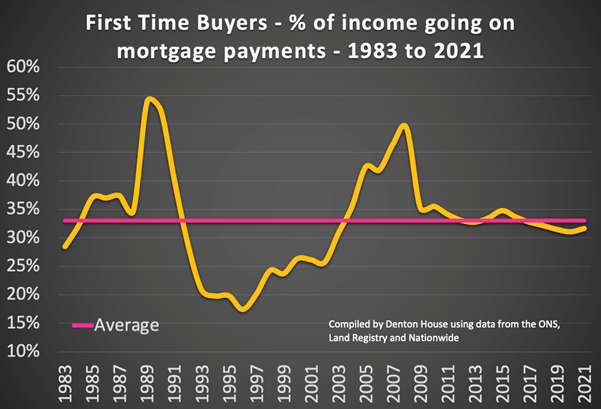
Yet, the life blood of the property market are first-time buyers. The long-term average percentage of income which goes on mortgage payments for first-time buyers is 33%. Just before the 1989 property market crash, this stood at 54%. Whilst just before the 2008 property crash, it reached 49%. Today, it stands at 31.7% (and the reason it’s so low, even with record high property prices, is low interest rates because when mortgage interest rates are low, this permits people to afford larger mortgages, which enables them to bid up house prices).

So why aren’t more first-time buyers buying more homes? Well in fact they are buying more homes. At the turn of the Millennium, just over half of 25yo to 35yo were homeowners and by 2014, this had dropped to just a third, although since then it has increased to 41%. Now with the reintroduction of the Government backed 95% mortgages in April, this demand will continue further.

Once furlough ends, unemployment will doubtless rise in the following 12 months, yet the economy is more than likely to be in a boom phase, so by the spring/summer of 2021, the unemployment rate should start to fall.

So, does everything look great for the Hayes property market?

Before you get the Champagne out, there is a cloud on the horizon – the possibility of higher interest rates.

Undoubtedly, for the next few years, interest rates will not go up (and if they do – it will only be nominally). However, down the line it may be a different tale. Interest rates are used to control a number of economic factors, one being the currency and secondly inflation.

As many suggest, if we get an economic boom in the next 12 to 18 months, as we come out of lockdown, this will put upward pressure on the price of goods and services. Normally, when prices go up (inflation), to ensure that inflation doesn’t get out of control, interest rates are normally increased to dampen down the inflation.

So, will interest rates rise? Undoubtably they will. Hayes homeowners and buy-to-let landlords should seriously consider protecting themselves with fixed rate mortgages (yet 3 in 10 mortgagees are still on variable rate mortgages!). I believe we will see some inflation in the order of 3% to 5% in the coming 24 to 36 months, yet the interest rates won’t be enabled to bring it down. We had a similar case in the early 2010’s when we had a mis-match of demand and supply of goods, and inflation spiked to 5%, before returning back to its long term 2% average quite quickly thereafter.

The Chancellor will also encourage some inflation to reduce the ‘real’ cost of the Billions he has borrowed because of the pandemic, yet won’t want to see interest rates increase to take the cost of the borrowing upwards.

If you are considering moving home or buying/selling a buy-to-let property in Hayes in the next 12 to 18 months, and want a chat about your options, don’t hesitate to drop me a line.

Finally, these are interesting times ahead – I would love your thoughts on this matter. Please do share them in the comments.

Hayes Buy-to-Let Property Market Going into Crisis?

…as Hayes first-time buyers now only need a 5% deposit for a mortgage.

Hayes landlords, sell your property portfolios, your tenants will soon be leaving in droves as they buy their first home with the new 5% deposit mortgages backed by the Government’s new mortgage-guarantee scheme revealed in March’s budget! These 95% mortgages are to be supported by the Treasury, lessening losses for mortgage lenders should the borrower be incapable of repaying and get repossessed, as the Government want Generation Rent to turn into Generation Buy.

This sounds like the death knell for buy-to-let investment in Hayes as many tenants will soon be buying their first home – or is it?

It’s true that on first impressions it might look like many Hayes first-time buyers will now be leaving their rental properties in their droves with this new low deposit mortgage scheme. However, these potential Hayes first-time buyers are facing four big issues which will inhibit their ability to take advantage of the mortgage scheme, meaning many will continue to rent.

Firstly, the mortgage rate for 95% mortgages has increased. The lowest five-year fixed-rate mortgage with a 5% deposit today (with Barclays) is 3.45%, up from 2019’s best rate of 2.75%. That doesn’t sound a lot, yet it makes a massive difference to the monthly mortgage payments (as you will see below).

Secondly, due to pent-up demand post lockdown and the stamp duty holiday, this has increased demand for Hayes property, placing upward pressure on Hayes property prices which has made it problematic for first-time buyers to get on the Hayes property ladder. This has meant…

the average price of a Hayes first-time buyer property has risen from £382,679 to £390,384 in the last 12 months…

and in turn this means, Hayes first-time buyers have had to save an additional £385.25 for their deposit to keep up with the house price increase. That means…

the monthly payment on a 30-year mortgage for a Hayes first-time buyer has jumped from £1,484.14 per month in 2019 to £1,655.01 a month today, an increase of £170.87 per month.

The third issue is demand for Hayes first-time property from buy-to-let landlords is surpassing supply, adding further fuel to the fire of driving up prices. Finally, the fact that most Hayes first-time buyers are of the younger generation and it’s the younger workers that have been most at risk of unemployment or salary cuts during the economic crisis.

 5 Year Fixed Rate – 20195 Year Fixed Rate – 2021
Purchase Price£382,679£390,384
5% Deposit Required£19,134£19,519
95% Mortgage Borrowed£363,545£370,865
Annual Interest Rate2.75%3.45%
Mortgage Length (in years)3030
Mortgage Payment per Month£1,484.14£1,655.01
Sum of Mortgage Payments over whole mortgage term£534,291£595,805
Total Interest Cost over the whole mortgage term£170,746£224,941

You might say things will change in 2022 but would it surprise you that 95% mortgages have been available to first-time buyers since the summer of 2010 and were only withdrawn during the first lockdown in 2020?

Since 2010, even with ultra-low interest rates, the number of private rented properties in the UK has grown by 580,000 households from 3.8m households to 4.4m households and will continue to grow, let me explain why.

The notion that buy-to-let property is a strong long-term investment has not altered with the pandemic. Since 1930 with the all the crises we have had with WW2, the Oil Crisis, 3-day week and hyper-inflation in the 1970’s, Hayes property has been a hedge against inflation and in addition, delivers a decent income yield of 4% and upwards. Not bad when compared to the 0.5% with a savings account (if you are lucky).

It is a fact that those landlords that see buy-to-let investment in Hayes as a long-term strategy will win.

It is certainly the case that I am starting to see an exodus of the ‘amateur landlord’, leaving more professional landlords who see ‘landlord-ing’ as a business, not a game. Those long-term Hayes landlords can see through the present predicament as they have a long-term buy-to-let investment mindset.

Many Hayes landlords are intensely aware that demand for high quality private rental properties in Hayes is only going to flourish as a consequence of the pandemic; whilst not forgetting that demand presently exceeds supply. Also, those same Hayes landlords know that a responsible approach to their tenants with regard to condition and repairs, is a key to ensuring the rent keeps flowing in together with minimal void periods.

Finally, even though Hayes house prices are, on average, on the up, there are still some bargains even in this market. By doing their homework and working with an agent like myself, these savvy Hayes landlords are paying reasonable prices, thus giving them a sturdier rental yield and the ability for future capital growth.

If you are a Hayes landlord, as my clients all know, I am here to help and guide landlords on their long-term investment strategy. I therefore extend this offer to all Hayes landlords, irrespective of whether you manage your property yourself or use one of my excellent competitor agents in Hayes, I am here to help.  

Will Hayes house prices fall in 2022?

As 1 in 10 Hayes homes are selling within a fortnight of coming to market

One of the most astounding things that has happened in the last 12 months was something that did not happen. Even after the country saw the deepest recession since the Great Freeze of 1709, with GDP dropping 28% in one quarter, one would have expected a large fall in Hayes house prices would follow. Yet …

Hayes house prices are 8.0% higher than 12 months ago.

Even though buying and selling Hayes property was put on ice for the first time in the history of the Hayes property market last spring due to the Covid 19 outbreak, as the Hayes property market wobbled on the edge of deep recession, it stepped back in early summer and it is now rocketing upwards as …

10.1% of Hayes homes are selling within a fortnight of coming to market.

Some commentators have suggested the end of the stamp duty holiday together with the ending of the furlough scheme on the 30th September 2021 could be the catalyst for a drop in house prices. Even the Government’s own regulator of finances expects UK house prices to fall around a couple of percentage points in 2022 whilst some others have predicted around a 5% drop as unemployment levels increase post furlough.

However, other property market forecasters believe that property values in 2022 won’t drop against the background of robust British economic recovery in Q3 and Q4 of 2021.

What do I think will happen to the Hayes property market in the next 12 months?

On the positive side, what I do know is the stamp duty holiday enabled Hayes homebuyers to spend those tax savings on the price paid for their Hayes home and that certainly accounts for some of the uplift in house prices mentioned above.

Also, the historically low interest rates that have supported Hayes homebuyers’ affordability for the last 13 years since the Credit Crunch has continued. Secondly, with people spending many months working from home, this has seemed to have polarised people’s inclination to make lifestyle changes. Finally, the Government has recently introduced 5% deposit mortgages for first-time buyers. All these factors will fuel demand and hence may cause house prices to rise.

On a more cautious note, I do not believe these very sturdy Hayes house value rises of the past year will persist at these levels for the next 12 months. With buyers having to use many thousands of pounds on the stamp duty payment, the price they pay for their Hayes home will be curtailed, meaning property values by definition will ease. 

The simple fact is the British economy has yet to feel the full effect of its largest recession since 1709, and we must remain considerate about the long-term effects of the economy (and unemployment levels) on the property market.

These are interesting times for the Hayes property market. If the price you want to achieve for your Hayes home is the most important thing, now as opposed to 2022 might be a good time to consider placing your property on the market.

Don’t forget, you can still put your Hayes property on the market, find a buyer and then go and see what is available to buy. Many buyers will wait for you to find a property, yet if they can’t/won’t – you won’t be made homeless. English property law means you can still come away from the sale and you won’t be forced to sell. If you would like to know a bit more about that or any aspect of buying or selling property in Hayes, drop me a message or call me.