Hayes Homeowners Profit By £50,120 in last 5 Years

… yet Bitcoin investors would have made £17,037,580 in profit. Is investing in ‘Bricks & Mortar’ dead?

Investing in property has historically been a sound investment, yet alternative investments (like Cryptocurrency) have been gaining traction over the last five years. So, should we all ditch buying our own home and buy Bitcoin?

Cryptocurrency with such names as Bitcoin and Ethereum are being bandied about as the new investment vehicle everyone should be investing in. But is Crypto a sound investment or just an ‘end of the seaside pier one arm bandit’ speculation?

Well to start, I need to discuss the difference between investing and speculation.

I have always seen investing as making a thorough detailed evaluation (and you are realistically sure your principal lump sum is relatively safe), you then have an opportunity to make a profit. Whilst speculating is all about putting your money into an asset that has ambiguous protection of your principal lump sum … and you have an opportunity to make a large profit but also the potential to make a huge loss.

In a nutshell, investment should be as interesting as watching paint dry and speculating should be as exciting as putting all your money on red on the roulette wheel.

So, let’s see what has happened to both Cryptocurrency and Hayes property in the last five years.

The average Hayes home five years ago was worth £342,120, today it’s worth £392,240.

We now ask, what would have been the return if you had invested the same amount in Bitcoin?

If you had invested £342,120 into Bitcoin in 2016, it would be worth £17,379,700 today.

What about the return if you had invested the same amount in Ethereum?

If you had invested £342,120 into Ethereum in 2016, it would be worth £56,494,300 today.

Yet only In June, when China placed stringent controls on how its population can use Cryptocurrency, Bitcoin dropped in value by 30% in one day. Also, this year, we saw another fall in Bitcoin when Elon Musk tweeted that Tesla were banning the acceptance of Bitcoins to buy its cars.

Can you imagine the value of your Hayes home dropping in value by £119,633 in just one day because of one tweet?

So, if Cryptocurrency is speculation and extremely high risk, surely buying your Hayes home is an excellent investment?

It is my opinion that purchasing a home to live in is a massive financial choice that can give you peace of mind and a lovely place to live, yet it is not an investment. I know this is going to sound strange coming from someone in the Hayes property industry, but whilst I know it’s common for people to think of their Hayes home as an investment, I believe nothing could be further from the truth.

I am not suggesting every 20 and 30 something should avoid homeownership, but if you are edging towards buying a Hayes home because you think you are making a savvy investing choice, think again.

The concept that the home you live in can be an investment comes from the statistic that, historically, property values increase. We all know someone, our Mum and Dad or Grandparents for example, who purchased their Hayes home in the 1950’s or 1970’s for the price of an Xbox and it’s now worth more than you make in ten years in salary.

Yet, I believe, it’s not an investment only because it goes up in value.

Between 1989 and today, Hayes property values, after removing inflation, have gone up by 50.37% … sounds great until you realise that is only 1.57% growth per annum (after inflation).

Sounds rubbish, doesn’t it?

But guess what? Does it really matter?

Even though your Hayes home’s value has outperformed inflation, there are other reasons your Hayes home is not an investment.

A real investment needs more than the outlook of an increase in value.

A home has a more important primary purpose.

Possibly the specific biggest reason why your Hayes home is not an investment is because its prime purpose is providing a roof over the heads of you and your family. One of the most rudimentary issues that makes an investment an investment is your capability to decide the timing of your possession of the investment.

A true investment requires you to buy it and sell it at times (and under situations) that are probable to exploit your investment return, yet since your Hayes home is your family’s shelter, you will have hardly any power over the sale and purchase of your Hayes home from an investment perspective.

The absence of ‘real’ control over the timing of buying and selling our Hayes homes (and note I use the word home and not house) has had a significant harmful effect on property as an investment.

In all my years in the property profession, I have seen numerous Hayes people buy houses at the top of the market (1988 and 2008) because that was the time that they required a home for their family, but those same people became stuck when having to sell their homes a few years later because of personal circumstances, albeit for a loss.

Then I have seen other Hayes people buy at the bottom of the market (1993 and 2011) because that was the time that they also required a home for their family, and those same people had to sell their homes a few years later due to personal circumstances, albeit for a huge profit. Are the second set of people more savvy investors? No, it was just good or bad timing, and that is not uncommon when it comes to buying homes, and so has to, in my opinion, exclude a home as an investment.

A Hayes home cannot be an investment if you never plan to sell it … and not buy another home.

While it is fact that Hayes homes usually increase in value, there is only a partial opportunity to tap into that growth. The best way to sell your Hayes home is after it has experienced a massive amount of value increase, sell at the top of the market, move into rented accommodation, then buy at the bottom of the market. Nevertheless, how do you know when it is the top and bottom of the property market (and moving home is considered the third most stressful thing you can do after death and divorce).

That doesn’t sound like an investment to me, does it to you?

Ok, most people sell and buy another home, so when you do sell your Hayes home, you will have to use the profit you have made from the sale of your original Hayes home to purchase the next home as you will be moving from one home to another. This means your profit (equity) is trapped profit.

The only time that doesn’t happen is when you either trade down to a less expensive home, or move into rented accommodation, yet both scenarios are quite rare occurrences.

Using your Hayes home as a bank account?

In the early 2000’s, many banks and building societies were encouraging homeowners to re-mortgage their homes as property values rose by 15%+ a year. By extending the term of the mortgage, you could easily borrow £20k, £30k+ for fancy holidays and new cars and the monthly mortgage payments would be lower – that was like free cash!

Known as equity-stripping, a lot of Hayes homeowners found out the hard way during the Credit Crunch that they had in fact bought themselves negative equity when property values crashed. That left them powerless to re-mortgage to lower the monthly payments when the interest rates dropped in 2009, yet unable to sell to move to a less expensive property because of the negative equity. Finally, to add insult to injury, as the mortgage term had constantly been pushed into the future, they had the prospect of having to pay their mortgages until their late 60’s/early 70’s.

Bitcoin doesn’t need a boiler replacing every ten years.

Every homeowner knows it costs money to maintain their home. Replacement windows, soffits, roof, carpets, kitchens, bathrooms, boilers, flat roofs – the list goes on. Over the 25 years of a mortgage, that can add up to many tens of thousands of pounds, yet one can justify those costs since your home is providing you shelter. But that gets back to the original principle – a home is a shelter, and not really an investment.

But isn’t renting out a property an investment?

The solid fact is that your Hayes home, the home that you live in, basically won’t provide any form of cashflow when you are a homeowner, unless you move out and rent the whole house to someone else. That is called a buy-to-let investment – of course that is an investment and I know many Hayes buy-to-let landlords who make a decent living at renting out their rental properties.

Yet, that wasn’t the point of the question I asked originally – “is buying a home, for you and your family to live in, a good investment?”

Of course, you could take in a lodger or rent rooms out as an Airbnb, and this will help you pay your mortgage, Council Tax and other costs associated with homeownership, so it can be worth it for many. However, an “Englishman’s home is his castle” is quite apt and most of us aren’t good with sharing it with strangers.

What do we buy homes for then?

To conclude, I believe the principal reason why so many Hayes people consider their home (not house) to be an investment is because we are all obsessed about how much our home is worth.

We are all guilty of checking out Rightmove when a property on our street comes up for sale. Yes, we are nosey by looking at the pictures, yet the most important thing is what price they’re asking and how it compares to our home. Our home is our biggest tax-free asset and especially when it goes up in value, which it certainly has done for the last nine or ten years, it certainly can feel like an investment then.

However, during the five property crashes that we’ve had since World War II, not only did property values not increase, but they fell. Some dropped dramatically. For homeowners in that position, not only was their home not an investment, but it had become a huge liability.

Thank you for taking the time and trouble in reading this article. I must stress that I’m talking about our own homes as an investment and not buy-to-let investment which is a completely different animal and certainly is an investment, if done correctly.

One final thought – for those of you buying and selling Cryptocurrency – enjoy your roller coaster. For me, the thing about property is this; you can touch it, you can feel it, there is something reassuring about a 9-inch red brick and tiled roof. It’s home, it’s where you bring up your family, it’s where memories are made and the best investment you can make in life is with them, your family … and for that – it is a priceless and enduring investment.

These are my thoughts, please tell me what yours are.
£870,682 – ‘Wood’ You Pay That For a Hayes Semi-Detached House?

The value of an average Hayes semi-detached house has increased in value by £108,360 in the last 12 months, an increase in value of 11.9%.

Yet the costs of building a Hayes home have shot up even more in the last 12 months, meaning the price of Hayes new homes and any building works you do to your Hayes home in the coming months and years could be a lot higher.

The British house building profession is experiencing a building materials supply problem. Everything from cement to bricks, timber and roof tiles, plastic guttering, copper wire and pipe to insulation, even kitchen sinks have become scarce – and when people can find them, they are costly.

For example, looking at the timber industry, three-quarters of the UK’s building timber comes from abroad, so lockdowns around Europe put a restraint on the timber processing industries of Sweden, Lithuania and Latvia throughout 2020. In addition, building material supply chains were interrupted due to the application lockdowns imposed by their Governments, resulting in many sawmills in those countries restricting shift work to comply with their country’s social distancing rules. Some mills even stopped all work for eight weeks last year, meaning they were incapable of cutting, milling or treating timber, causing their existing stocks of building wood to run dry.

Yet, whilst we were all in lockdown, everyone started doing DIY projects, so the public demand for building timber in the UK remained high, giving little opportunity for UK sawmills (let alone North-eastern Europe) to catch up and restock to the levels previously held before the pandemic.

Building timber costs 112% more than a year ago, steel RSJ’s are a lot more expensive because iron ore has gone up 120.1% whilst aluminium is up 56.8%, and copper is up 59.7%.

All the blame cannot be laid at the feet of the virus and lockdown. The ‘B’ word caused issues with supply at the start of the year. Building materials are a worldwide supply chain issue; this spring’s Suez boat crisis, when many boats were diverted around Africa (as the length of time the blockage was going to last was unknown), exacerbated the problem. All this has combined to make the cost of sending a 40ft container from China to Tilbury Docks £7,576 today, compared to £1,195 just before the crisis. Also, supplies of sand and cement are particularly low with massive demand from the large £98bn High Speed (HS2) rail project. All this combined is affecting many building projects, big and small, across the UK.

If an average Hayes semi-detached house had risen by the price of building timber in the last 12 months, today it would be worth £870,682, not the current £459,572.

RSJ (steel joists) take twenty weeks to arrive, compared with the typical five weeks, whilst plasterboard is being rationed with weeks of delays for the ‘good stuff’ and MDF wood, usually takes seven days to arrive; now it takes over a month. Roof battens need to be ordered a month in advance, whilst pre-lockdown they were commonly held in stock by every building merchant.

Demand for building materials has increased so quickly because many British homeowners are driving the explosion. Those people in safe jobs with little opportunity to spend money on foreign holidays and fancy restaurants decided to invest in their property and gardens. According to the Bank of England, this craving for home improvement has particularly exploded since the mature generation have started to be double jabbed (their savings accounts having increased by £180bn during the pandemic).

As I have explained in previous articles, these increases in the price of raw materials will fuel inflation, possibly affecting interest rates upward. An increase in interest rates will make a material difference to the value of Hayes property. To what extent? Please read my previous articles on the Hayes property market.

Please do share your stories of issues with builders and building materials over the last 15 months in the comments. I appreciate any stories you can provide to help others in Hayes.

Is Hayes Heading Towards a House Price Crash?

Hayes house prices rose by 1.8% last month, according to the Land Registry.

This means the annual rate of house price growth in Hayes has increased to 7.5%.

Looking at the national figures, many people were concerned the UK property market was overheating as spring saw annual growth of 9.9%, the highest rate of house price growth documented since June 2007 (when national house prices were rising by 10.8% p.a.). It was only a matter of a few months later the Credit Crunch hit, and the average value of a UK home plummeted from £190,032 to £154,452 in 18 months, a drop of 18.7%.

Government economic measures such as the Furlough Scheme and the Stamp Duty Holiday have so far shielded the Hayes property market from the worst economic recession since 1709.

So, the question is, can this growth in Hayes house prices continue, or is this the start of a house price crash?

One thing is for sure, looking at the number of For Sale boards going up and turning to sold just as quick, shows this market is not maintainable for the long term. Most of the Hayes people looking to move home have brought forward their home-moves from 2022/3 to this year because of the Stamp Duty Holiday and the lifestyle choice of wanting a bigger garden/office space at home.

Nonetheless, the doom-mongers in the press say there will be a second wave of house sellers that will flood the Hayes property market in the autumn and winter when furlough ends. They believe many of the 3.4m people still on furlough will be made redundant when furlough finishes at the end of September 2021 forcing them to move home.

This was the catalyst for the house price slump in 2008/9 mentioned above, when many Hayes homeowners dumped their homes onto the Hayes housing market.

After all, many Hayes homeowners lost their jobs and had mortgages paying 6% to 7% in interest payments.

However, the devil is always in the detail. The industry groups with the highest take-up rates of furlough are the hospitality (public houses) sector, where 70% of staff are furloughed. 65% of hotel staff are furloughed, and 44% people in the creative arts and entertainment industry are furloughed. Most employees in these sectors are in their 20’s and early 30’s and are tenants, not homeowners. This is going to be more of an issue for landlords than homeowners.

And of those furloughed homeowners who do unfortunately get made redundant later in the year, looking at the last four most recent house price crashes, buyers were wrestling with significant declines in mortgage affordability. For example, back in 1988, average mortgage rates were 13.9% before that crash and in 2007 (the Credit Crunch crash) 6.5%. Whilst today, they are under 2%, meaning the mortgages are a lot more affordable, and most Hayes homeowners who get made redundant will be able to ride out the storm better.

But surely, if Hayes house prices are rising, won’t Hayes homes become unaffordable?

Well, with low-interest rates, this means Hayes homes are still relatively affordable. In 1989, the house price to earnings ratio was 5.4 to 1 (i.e. the average house was 5.4 times the average UK salary), whilst today that stands at 8.8 to 1. It’s no wonder some people are concerned there will be a house price crash (as there was in 2008 when that ratio hit 7.5 to 1).

However, it doesn’t matter what the house price to earnings ratio is …. it is what percentage of your income is required to pay your mortgage.

In 1989, 74.6% of your income was required to service an 80% loan to value mortgage on an average UK home (i.e. you borrowed 80% of the value of your house on a mortgage). In the 1990s that percentage dropped yet rose steadily over the next decade and a half, so by the time we got to 2008, that was an equally eye-watering figure of 61.6% of your income to service an 80% mortgage.

Today, it’s only 35.9% of your income to service an 80% mortgage because of low interest rates.

So, if the issue is not the affordability of houses, what is the problem for Hayes homeowners?

Interest rates!

Bank of England interest rates will affect what people pay on their mortgage (higher interest rates normally mean higher mortgage payments). Interest rates are used to reduce inflation, so if inflation rises, interest rates also rise to bring inflation back under control.

UK inflation has just gone through the 2% barrier, and I believe by the end of this year or early next, it will touch 4% or 5%. In normal circumstances, this would trigger the Government (or now the Bank of England) to raise interest rates. Yet, we had a similar scenario in the late 1980s/early 1990s with a spike in inflation to 8.5% due to a shortage of raw materials and labour, but this was soon sorted out, and inflation dropped quite quickly thereafter.

In the coming year, a shortage of raw materials might be an issue. If there is a shortage of raw materials (supply problems are being found in key items such as timber, concrete, aggregates and steel), this will fuel construction and manufacturing costs upwards.

Next, will there be a shortage of labour? Some say it won’t be an issue (as unemployment will be higher), yet there are certain sectors of the economy that have an imbalance of trained staff of specialised jobs or people not wanting work in that type of job in the first place.

For example, many hospitality and dining establishments are reporting a shortage of staff because they were often filled with hard-working European migrants. I have read reports of London restaurants advertising for chefs and waiting staff, who would have received 1000+ enquiries for such jobs pre-pandemic to only be receiving applications that could be counted on two hands this summer. The hospitality and dining sector was hit harder than most, having to stop trading during the three lockdowns and working under firm restrictions. This led to the majority of staff being placed on furlough (as mentioned above, 7 in 10 are still on furlough), which has prompted some to ride out the pandemic in their own country.  

The question is – will they return? If not, to entice them back restaurants will have to increase the wages they pay to attract the staff, which in turn will mean they will have to put their prices up (i.e. inflation). If businesses have to put their wages up and the cost of raw materials continues to rise, prices for everything will rise, and at this point, higher interest rates will kick in.

But how will increased interest rates affect the Hayes property market?

Thankfully, 91% of all new mortgages being written are fixed interest rate mortgages and 78% of all existing UK mortgages are fixed-rate (compared to 32.8% in the credit crunch) … meaning we won’t have so many houses being dumped on the housing market like we did in the Credit Crunch, because on a fixed rate mortgage if interest rates rise – mortgages don’t follow suit.

And that’s the key … unemployment combined with high-interest rates caused many Hayes homeowners to put their property on to the market in 2008/9. Tied in with curtailed demand for property, because it was really difficult to get a mortgage (that’s why it was called the Credit Crunch) … we had an oversupply and subdued demand of Hayes homes – causing house prices to drop by 16% to 19% depending on what type of property you owned.

So, a good bellwether and indicator on what will (or will not) happen to Hayes property prices is the number of properties for sale at any one time.

There are 324 properties available to buy in Hayes today, slightly higher when compared to the 14-year average of 298 properties for sale in the town, whilst at the height of the Credit Crunch, there were 567 properties for sale at one point in Hayes.

As we look to the future, if you want a crystal ball of what will happen to the Hayes property market … you won’t go that far wrong by getting yourself on the property portals and seeing how many properties are for sale.

These are my thoughts … what are yours?

Hayes Buy-to-Let Landlords Owed £1,012,796 in Unpaid Rent. Rogues or Saviours?

There is no getting away from the fact that the rise in the number of buy-to-let properties in Hayes has been nothing short of astonishing over the last twenty years. As a result, many in the press have said Britain is a broken nation, with many twenty and thirty-somethings unable to buy their first home. The press has named this group ‘Generation Rent.’

Hayes landlords have been accused of scooping up all the smaller Hayes properties for their buy-to-let property empires. Others blamed the Government (of both persuasions) for pouring petrol on the buy-to-let fire for giving landlords an unfair advantage with the way buy-to-let has been taxed in the past. Many have said these landlords have priced out Hayes’s ‘Generation Rent’. Many say they are rogues, and you can see why there is little sympathy for landlords, especially as…

Hayes (UB3) landlords receive £54,993,456 a year in rent – easy money or what?

So, as we come out of lockdown, I want to make a stand for Hayes landlords and talk about the great work they have been doing during the pandemic.

Since lockdown, it has been (almost) illegal to evict a tenant from private rented property. Yet, in the last few weeks, this ‘ban on evictions’ has begun to be eased, making some commentators forecast a ‘tsunami of homelessness’ as landlords ready themselves to kick out the tenants who cannot pay their rent.

You might say they can afford it, yet I need to highlight an often-untold story in the massive numbers of Hayes landlords who have co-operated with their Hayes tenants to evade eviction.

The personal finances of some Hayes landlords and tenants have been ruthlessly strained during the last 16 months — something that is going to have ramifications on the back pockets of both landlords and tenants, as well as the attraction of being a buy-to-let landlord (more of that later).

331 Hayes tenants are in arrears with their rent

to the tune of £1,012,796.

That’s money these landlords need to pay their mortgages with and even to live off themselves.

The eviction ban was imposed in March 2020 and the Government has expected private landlords to stand the cost of their tenant’s rent if they could no longer pay. It was estimated over 1 in 5 landlords with mortgages had requested a mortgage payment holiday in 2020. Thankfully, that now stands at 1 in 100 as most Hayes landlords with shortfalls in rent have been using their own personal savings to cover the mortgage payments.

I have seen so many landlords giving their Hayes tenants rent breaks and discounts to help them through these times. However, most landlords I talk to acknowledge that it is better to have a tenant paying something rather than a tenant paying nothing, hoping that total rent will start flowing as the economy recovers.

Going into the pandemic, 1 in 25 Hayes tenants were in arrears, yet that now stands at 1 in 11.

So, are we going to see lots of evictions? I would go as far as to rebuff the idea that we will see a rush to the courts of landlords to obtain possession orders now the eviction ban has been lifted. I have always viewed evictions as a last resort.  

Before the pandemic, it took about 12 months for courts to hear rental repossession cases, so this backlog will be nearer two years (if not more). Nonetheless, the threat of a County Court Judgement (CCJ) often makes tenants pay up as it will demolish their credit rating, making it very challenging for them to rent another home.

I feel for those Hayes tenants under furlough or reduced hours as they have the quandary of wanting to reduce their outgoings by moving to a cheaper rental property, yet whose rental deposits will be sacrificed to cover their rent arrears. However, some have said that because house prices have exploded during the last 16 months, Hayes landlords should write off their tenants’ arrears as a goodwill gesture.

The issue is, 590 Hayes landlords only have a single property for rent, so the arrears would have to be funded by their personal savings.

For them, the pandemic experience could be the incentive to sell up for good.

A National Residential Landlords Association survey found around a third of all landlords were now more likely to sell their buy-to-let properties altogether or sell some of them. This would mean fewer properties for tenants to rent, thus driving up the rent.

According to government and industry data, evidence suggests that a tenant who rents a property directly through a landlord and not through a letting agent is between two and three times more likely to go into arrears of 2 months or more. Is this because tenants know that private landlords who advertise directly for tenants on Gumtree and other platforms don’t carry out the checks letting agents do on them?

Many of those landlords are switching the management of their property to an agent, and for those landlords sticking with self-management of their property, there is circumstantial evidence they are starting to become a lot pickier when starting new tenancies. Even though illegal, spurning tenants on benefits is woefully all too common. I also worry there could be a stigma about renting properties to self-employed people because of the erratic nature of their income.

Looking into the future, I envisage a growth in the use of ‘rent guarantor contracts’, whereby the tenant is called upon to provide a 3rd party person to pay the rent if the tenant doesn’t. These are pretty common for student lets and those on certain benefits, and it wouldn’t surprise me if these are used more often for self-employed tenants and regular professional lets.

That is why I believe Hayes landlords should be celebrated … most of them have been saviours. These are my thoughts – what are yours?

How Eco-friendly are Hayes Homes?

And how new Gov’t rules will mean draughty low-eco Hayes homes will drop in value

‘It’s Not Easy Being Green’, was the song that Kermit sang on Sesame Street.

Yet now being green is a normal way of life for most of us. Walking or cycling places instead of taking the car, recycling and even shunning meat are some of the things most Hayes households are trying to do their ‘bit’ for going green.

Our conduct may have improved but when it comes to our Hayes homes, there is still a long way to go. It is estimated around a fifth of carbon emissions come from home energy usage (nearly three quarters from heating and lighting). The country is releasing 37% less carbon into the atmosphere than in 1990, yet we have legally binding targets to hit 100% by 2050 — and the Committee on Climate Change has stated the UK will need to eradicate greenhouse gas emissions from homes to meet that target.

Landlords were hit first because since April 2018, the Minimum Energy Efficiency Standards (MEES) regulations with regards to eco-friendliness of the rental properties have required all rental properties to have a minimum Energy Performance Certificate (EPC) rating of ‘E’ or above otherwise it is illegal to let out a property, bar a couple of exceptions. This has meant Hayes landlords have had to spend many thousands of pounds to improve their rental property’s EPC rating (an EPC rating ofA’ being the best eco rating through to a ‘G’ for the worst – just like washing machine or fridge ratings).

But new Government plans could hit Hayes

homeowners in the pocket as well.

The Government is planning to force banks and building societies to penalise people wanting a mortgage of draughty low-eco homes with an energy performance certificate (EPC) rating of D or lower. For those properties not hitting the correct level of EPC rating, it is suggested some form of levy will be placed on the mortgage provider, who in turn will pass that on to the home buyers in the form of higher mortgage payments. Some are describing this charge as an ‘eco-mortgage levy’.

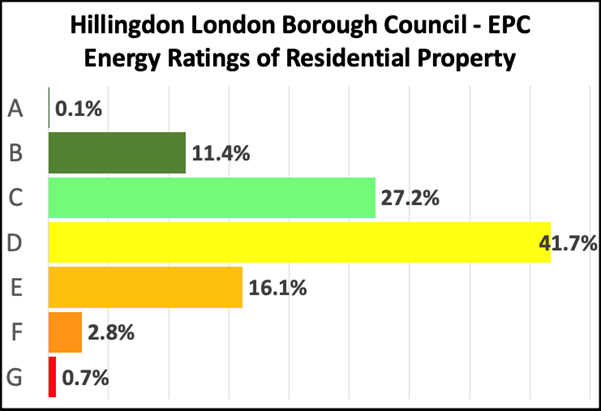
Just over 6 in 10 (61.3%) homes in Hillingdon London Borough Council would be hit by this ‘eco-mortgage levy’, thus potentially reducing the value of those homes

Interesting when you compare this with the national average of 60.6%.

In real numbers, 55,497 homeowners and landlords in our local authority area would either struggle to get a mortgage from a bank or building society or it would cost them more because they were a ‘D’ rating on their EPC or below.

Looking at the stats broken down for Hillingdon London Borough Council

  • 90 properties are classified as A on the EPC register
  • 10,330 properties are classified as B on the EPC register
  • 24,583 properties are classified as C on the EPC register
  • 37,782 properties are classified as D on the EPC register
  • 14,608 properties are classified as E on the EPC register
  • 2,518 properties are classified as F on the EPC register
  • 589 properties are classified as G on the EPC register

So, what can Hayes homeowners and landlords do

to improve their EPC rating?

Well surprisingly, it need not cost a lot to improve the EPC rating of your Hayes home. One of the most inexpensive ways to help improve your Hayes home’s energy efficiency is low energy light bulbs with an estimated cost of just under £40 per UK property. Other efficiencies can be gained by insulating your hot water cylinder, draught proofing any single glazed windows, increasing your loft insulation, and upgrading your central heating controls, all of which can be done for a total of around £750 to £850 per property.

If you want to know the EPC rating of your home, either google the phrase ‘EPC register’ or send me a message and I will find out for you.

Finally, as Kermit famously also said, “Life’s like a movie. Write your own ending”. If you are a Hayes homeowner or Hayes landlord, why not look at your property’s EPC rating and look at the recommendations. You are going to have to spend the money sometime, so why not do it now and enjoy lower energy bills and when you come to sell, you won’t be penalised .. a win-win situation for you and the planet?