How Many Days Does It Take to Sell a Hayes Home?

Whether you are a Hayes homeowner, first-time buyer or landlord; the last 15 months has been a roller coaster ride when it comes to the Hayes property market.

With 213,120 UK house buyers and 58,580 UK tenants moving home in June, the summer has been manic for many people. Meaning some Hayes homeowners are asking if they should be staying put? Or should they wait for the best home to come onto the market before putting their home up for sale or find a buyer but be unable to find a property – it’s all rather confusing.

Then we have some Hayes landlords who are asking themselves if they should buy another property investment (and some even wondering if they should sell and cash in on the boom) and then finally, with 95% mortgages back, first-time buyers are asking if they should look to take the plunge and buy their first home or wait.

In this article, I hope I can help you with the decisions you might want to make and to navigate this unusual post lockdown housing market. Let me start with some stats to show you what is happening at the moment in Hayes.

The average time it takes to sell a Hayes property in this housing market is 73 days.

Interesting when compared with nearby Southall at 61 days, Hillingdon at 36 days and Cowley at 42 days.

Look back five years, it took 62 days on average to sell a Hayes home!

The property market has certainly solidified a little over the last few weeks. The Stamp Duty holiday rush has seen its run and the pent-up post-Brexit and more importantly post-lockdown demand has receded and although I am still observing competing offers on most Hayes properties, I can certainly get a feeling of a small shift in the balance-of-power between the seller and buyer.

Many people have put their house hunting on hold as they go on their first holiday since 2019, be that glamping in Cornwall or having days out on a ‘staycation’. That means between now and mid-September, depending on what type of property you are looking for, many buyers could well discover that there are fewer competitors for their next home than there might be.

Also, July and August are notoriously barren months for estate agents putting new properties up for sale. Yet since the typical ‘seasonal property market’ is so out of kilter as a result of the pandemic, many agents are taking on a decent number of very good properties now, which is not something that characteristically would have happened in the summer months.

The important thing is not to wait for the property to hit the portals (i.e. Rightmove etc). Yet research shows, nearly 5 out of 6 people who bought their home were not on the agents mailing list before they viewed the home they eventually bought. That’s OK in a normal property market as you can wait until it hits Rightmove or Zoopla, yet these are unprecedented times and if you are not on an agent’s mailing list – you will miss out on properties.

If you don’t put yourself on the agent’s mailing lists, you will end up losing out on the property of your dreams.

So, the question is should you put your Hayes home on the market first or wait for the right property to come along?

Roll the clock back a few years and it was standard practice for people to wait for their dream home to come onto the market, then put theirs on and hope that it would sell in time. This housing market is different and only those who are in a position to proceed (cash buyers or those sold subject to contract) will be considered as serious buyers.

Yet, nobody wants to be homeless if they do sell.

Estate agents are returning back to their old skills from the 1980s and 1990s by chain building. By starting at the bottom of the chain of the smaller house and building up a chain, waiting for everybody to find their next homes, nobody need be made homeless.

This is not an issue because most house sales are taking on average between 20 and 25 weeks and as long as everybody communicates with each other and everyone knows where they are, then normally things go through, albeit slower. Can you believe it – estate agents really are earning their money with this!

So what Hayes homes are selling the fastest?

Hayes Terraced and Town Houses are selling in 70 days

Hayes Semi-Det Houses are selling in 39 days

Hayes Apartments are selling in 145 days

Hayes landlords, maybe there are some bargains to be had on some apartments with that length of time on the market? Again, do your homework or even consider picking up the phone to me for a chat.

So, there you have it. The lessons I hope you have now learnt from this are to put yourself on agent’s mailing lists, talk to agents about your requirements so you get the heads up first when a property is coming on to the market (don’t just do everything over a computer screen) and once you have found a property be a little bit more patient with how long it takes to build a chain and then get the property through to an exchange and completion so you get the keys to your forever home.

Whether you are a Hayes homeowner, Hayes landlord or first-time buyer and would like some advice and opinion on your circumstances in the current Hayes property market, please don’t hesitate to either pick up the phone or drop me a message.

To everyone else, what are your thoughts on the Hayes property market?
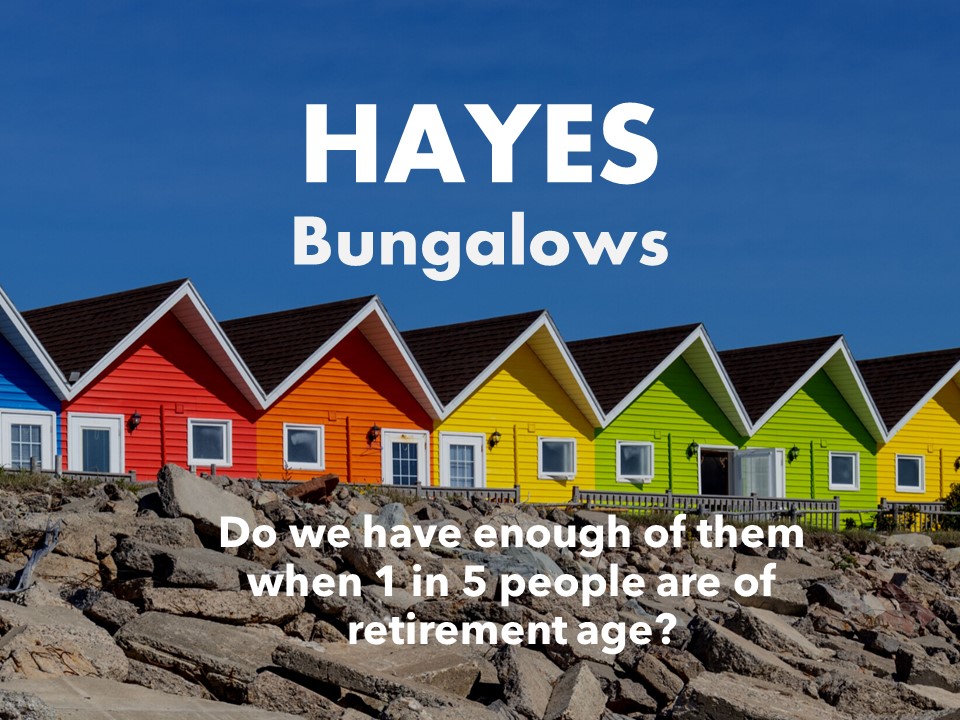
Only 1 in 53 Hayes Properties are Bungalows, Despite an Ageing Population. Why?

The bungalow is a building that has represented a more leisurely, gentler way of life since the early 1900’s. Bungalows have been sold as an aspiration for those about to retire, saving them the annoyance of having to climb stairs. With an ageing population, one would think they would be building more bungalows, yet nothing could be further from the truth. In fact, this could be one of the main issues that is holding back many mature homeowners moving home, thus creating a bottleneck in the Hayes property market for the younger families who are being held back and unable to move into the larger homes they so need to grow their families.

So, before I answer that question, let me share this fascinating fact about bungalows. The word ‘bungalow’ originated in India, not the UK. The name is derived from the Hindi word ‘baṅglā’ or the Gujarati word ‘baṅglo’, both of which seem to refer to a home occupied by a Bengali person. The colonial English started to use it for themselves in the late 1600s to describe the same sort of basic lodgings that sailors and staff of the invading East India Company used.

Anyway, back to the here and now in Hayes.

There are 303 Bungalows in Hayes (UB3).

When you consider there are 15,923 properties in Hayes, that means only 1.9% of property in Hayes are bungalows.

To give you an idea of the age demographic of Hayes homeowners, there are 2,980 Hayes homeowners aged 65 years old (and over) and 4,508 Hayes homeowners aged between 50 and 64 years of age.

You can see demand for bungalows is only expected to grow.  Yet new homes builders are having to deal with soaring land prices meaning to get a profit from the site, they are under pressure to build more vertically than horizontally as with bungalows (as bungalows take up so much more land).

The last available data is from 2018 and only 1.6% new builds in the UK were bungalows, interesting when it was just over 7% in the middle of the 1990s. As British people are living longer, those existing Hayes bungalow homeowners will be living in them longer, thus creating even more of a bottleneck in the Hayes property market.

So, what is the answer?

Well with building land in Hayes at a shortage, maybe new homes builders should be forced under planning rules to reserve ground floor apartments to be set aside for older people to encourage them to move out of larger houses. I would challenge the long-held point of view that building more bungalows in Hayes is the pre-eminent way to urge growing numbers of mature ‘last-time buyers’ to move out of their under-occupied Hayes homes and free up their large homes (where their children have flown the nest) for younger Hayes families to grow.

With the new Planning Regulations due to be in place in a couple of years, local authorities could require builders to set aside a share of homes for mature residents, as they are already obligated to subsidise local community facilities or low-cost social housing in return for obtaining their planning permission to build in the first place.

Another option would be to convert all those empty shops in our town and city centres up and down the country into residential use. There is no need for planning permission to change offices to residential property and the Government are considering the same for shops (although I have heard of some horror stories of those office to residential developments making rabbit hutches look spacious) – so again, it comes down to the planning laws and making them fit for purpose.

There are no doubt consequences of not designing our housing stock for the 21st Century and beyond for older people.

The population of Hayes is set to grow

by 9,082 to 56,882 by 2040.

As the UK population gets older in the coming decades, as life expectancy is set to grow from 81 years 2 months to 83 years 3 months by 2040, I fully appreciate the need for more Hayes homes to be built for families, yet one must ask if the planning authorities are focusing too much on new housing for the younger generation, when they in fact should be encouraging new homes builders to develop larger, ground floor two-bedroom homes and decent accessible transport links.

These are my thoughts, what are yours the good people of Hayes?

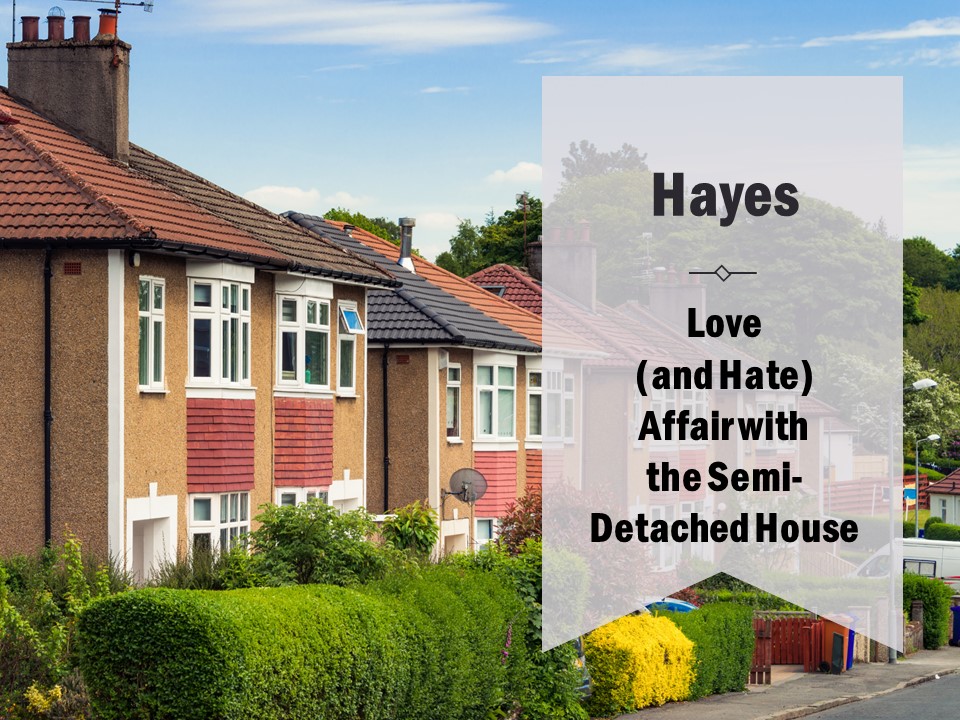
Hayes’s Love (and Hate) Affair with the Semi-Detached House

The semi-detached house – the icon of middle-class aspiration, the pinnacle of liberalism yet at the same time compromised individuality, the ‘semi’ as it is colloquially termed is, for many Hayes homeowners, the highpoint of modern domestic bliss.

Britain’s gift to architecture is the humble ‘Semi-Detached House’. This type of property has been exported around the world with – the ‘Doppel Haus’ in Germany, the ‘Duplex’ in the USA, Canada and Australia. 

For those young, hip and trendy people living in your converted warehouses with strobe lighting and exposed brickwork, it might surprise you the semi is the dream home of an immense number of Hayes people. In fact, it is the most common dwelling type in the British Isles, with 8,060,657 semi-detached homes occupied by Brits alone (representing 31.68% of all occupied property) compared to 23.81% detached, 25.49% terraced and 19.02% flats.

In Hayes (UB3) alone, there are 6,786 semi-detached houses meaning…

43.3% of properties in Hayes are semi-detached.

So, when did the semi-detached house first come into play? Many people think the semi-detached boom started with mass swathes of the suburban mock Tudor bay-fronted semis being built between the first and second world wars. The fact is actually that rich landowners in the post Great Plague (1665+) years wished to house their farm labourers as inexpensively as possible, yet making their grand estates look as imposing as possible.

And that’s the point of a semi-detached house. Only half the property is yours, yet you ‘feel’ like you own it all.

The next phase of the semi-detached story, and a phase that really pushed home the point, were many of the late Georgian houses built around the Kensington Gardens area in West London. Many upper-middle class Georgians were wanting something more than the classic Georgian terraced house yet couldn’t afford a large detached home. Therefore, architects took the humble semi-detached house to the next stage of its evolution by masquerading the building itself as one home by slipping its two front doors down opposite sides of the building, making it look like one home from the front, to complete the impression of total ownership.

By Victorian times, semi-detached houses fell out fashion as the railways were building many of them for their railway workers and they became associated with the lower working classes, but speculative builders continued building semi-detached homes for the new lower middle class, that is the reason why ultimately the country is full of semi-detached homes today.

The semi-detached house was saved from the annals of history by the Bedford Park development in Ealing (London). Referred to as the world’s first ‘garden suburb’ and started in the 1870’s, the architect of Bedford Park used influences of the Aesthetic Movement, the precursor to the Arts and Craft Movement to make the buildings look more pleasing on the eye. The architect also took reference from the style of properties from British history such as Queen Ann to be seen in such features as a sweep of steps leading to a carved stone door, rows of painted sash windows in boxes set flush with the brickwork and bright coloured brickwork with limestone stone quoins emphasising the building’s corner.

As the car enabled people to commute to work from further away, people wanted to get out of the big cities, thus giving rise to the interwar semi, with its mock Tudor fronted, rosemary tiled roof, oak beamed, herringbone brickwork and the leaded and stained glass windowpanes that we all recognise. It was Bedford Park that gave the green light for architects up and down the country to use old styles of building design to make their semi-detached houses look the part.

And now, in more modern times, the semi-detached house has gone from strength to strength.

3,942 of Hayes (UB3) semi-detached houses have changed hands since 1995, many upwards of 5 times (and a handful even more).

The semi continues to appeal, both to big national builders and smaller Hayes developers, and most importantly to home buyers. The advantage of semi-detached houses over town houses/terraced houses or apartments is they afford access to their (typically bigger) gardens without having to pass through the house, and they have natural sunlight on three sides of the property, are easily extendable and quite often have a driveway.

And that’s at the heart of what a semi-detached house is all about, the schism or divide of the semi reveals the tension at the heart of owning your home, which on one side of the coin is a commodity/way to make money and on the other side, a vision to have your own castle, a piece of ground to call your own. It articulates both the craving for personal freedom and the inevitability of socio-economic life. What do I mean by that?

We may dream of owning a castle in many acres, with a drawbridge and moat, yet in real life we can only afford half a building plot sliced out by a volume national builder next to the A437.

I just love a semi-detached house! Style and substance combined.

What are your thoughts? Share your stories and opinions on the humble semi-detached house.

Hayes Home Moves Hit Record High In June

as 401.2% more people sell in June compared to the Hayes area 10-year average

June 2021 was the busiest month ever for UK estate agents, home removal companies and conveyancers since monthly records began as HMRC logged 213,120 residential transactions in June, a jump of more than 216% nationally on the same month last year (when the housing market had just reopened after the initial lockdown). 

The cause of this was all the homebuyers trying to complete their property purchases before the approaching Stamp Duty Holiday deadline finished at the end of June. This was important as house buyers had until 30th June to complete their sale to save up to £15,000 in Stamp Duty Tax.

Many property market commentators believed the property market would slump after the Stamp Duty Holiday finished. Yet, I haven’t observed many property sales falling through or renegotiations because the buyer had to pay the extra Stamp Duty, and talking to other property professionals around the UK, neither have they.

Let’s not forget that the Stamp Duty Holiday isn’t totally over as it is tapering off until 30th September. This means homes and apartments sold under £250,000 will still profit from the Stamp Duty Holiday.

So, what sort of property transaction numbers are we talking about here in Hayes?

An average of 12 properties a month in the Hayes area (UB3) have sold in the last 12 months, compared to the 10-year rolling average of 31 properties sold per month.

The best month ever before this June was March 2016, when there was a rush by Hayes buy-to-let landlords to secure a property before the introduction of a 3% Stamp Duty surcharge for second homes. In March 2016, 123 Hayes properties changed hands.

My calculations show 153 Hayes households sold in June 2021, 401.2% more than the long-term average.

So, what has driven this? The Stamp Duty changes caused some Hayes people to bring their home moves forward from 2022/3 to take advantage of the tax savings. Yet the most significant thing, talking to many Hayes homebuyers and sellers, is the pandemic has changed the way people live. Working from home and needing additional office space has meant many Hayes families (and others from out of the area) are seeking larger properties with more extensive gardens and better access to the countryside. I really can’t see this social trend changing for a long time. I believe this means Hayes property prices in the medium term will not be markedly different over the next couple of years yet …

don’t be alarmed to see volatile short-term changes in the run-up to Christmas (both up and down) with Hayes house prices.

I have always been a believer in the medium-term (i.e. over a couple of years) house price trends instead of the monthly trends, which can sometimes be like a yo-yo. I have always said the best bellwether to the health of the Hayes property market is the number of property transactions rather than the house prices.

Finally, I can only see this continuing as banks scrabble to give money away in the form of cheap mortgages. A few weeks ago HSBC and TSB launched a 0.94% two-year fixed rate deal for those wishing to borrow 60% or less. More recently, the Nationwide Building Society launched a 0.99% five-year fixed-rate mortgage deal (again on a maximum of 60% loan to value basis).

If you would like a chat about the Hayes property market, your options and where you stand in the Hayes property market – please do not hesitate to give me a call.

In the meantime, I would love your thoughts on this.

Has the pandemic made you move home earlier?

What do you think will happen in the coming years to property in Hayes? Do share your views.

Why Savvy Hayes Buy-to-Let Landlords Don’t use 10 Years Mortgages

And the reason you shouldn’t either

I know of many Hayes buy-to-let landlords who fell into property investing by accident. Many didn’t want to sell their family home when the Hayes housing market crashed in the Credit Crunch of 2009/10, yet still needed to move (often for work). They thought they would keep their Hayes family home in case they ever moved back to Hayes. Yet by keeping it, it couldn’t remain empty (there was still a mortgage to pay on it), so they ended up renting their home out.

And that was the start of many Hayes buy-to-let landlord’s journeys!

Many of you Hayes landlords reading this have had your fair share of problems, from tenants doing a midnight flit, rent arrears and troublesome tenants, yet also had your rewards.

The average Hayes landlord in the last ten years has seen their investment rise by an average of £154,300 and has earned in rent (before costs) £142,352.

Many of you reading this have started to learn about investing and creating a property portfolio by buying additional Hayes homes to rent. The average Hayes buy-to-let landlord now owns 3.38 properties that generate an impressive passive monthly income with the bonus of growing their household net-worth through growth in the value of their buy-to-let portfolio.

With the average Hayes buy-to-let landlord in the 56-to-58-year age range, one thing I learned about savvy buy-to-let investing, the shrewd Hayes landlords tend to want longer-term mortgages.

Taking longer-term mortgages reduces the risk to the landlord.

It sounds counterintuitive, yet it comes down to leverage. Let me explain that whilst leverage is formidable in buy-to-let, it is also quite risky.

Before I explain why some readers might not know what leverage is and how it relates to mortgages and buy-to-let, two-thirds of landlords are debt-free, yet those landlords who have come into the property investment game in the last 10 or 20 years have had to use borrowed money (mortgages) to finance their deals. Therefore, by putting down a small amount of say 20% and borrowing the other 80%, if you calculated your return on an investment base only the money that you put into the deal, then that is what is called leverage (i.e. using borrowed money as a funding source when investing in property and generate greater returns on borrowed money).

You would think, as, say a typical 55-year-old Hayes landlord, you would want to be only taking a mortgage out for however long you intend to work (say ten years at most) – meaning your portfolio would be all bought and paid for by the time you retire. Yet the clever buy-to-let Hayes landlords I talk to don’t see their portfolio as having to be paid off (and mortgage-free) by the time they retire. They have understood how to utilise and administer their mortgage debt rationally to enhance their returns without taking on unwarranted risk.

By taking a short-term mortgage of say ten years, compared to a 25-year mortgage, during those ten years, your monthly mortgage payments will be particularly high (because the longer the mortgage term, the smaller the monthly payments will be).

Also, you can pay off a 25-year mortgage in 10 years, but you cannot pay off a 10-year mortgage in 25 years.

Longer mortgage terms mean lower monthly mortgage payments, which in turn means greater cash flow and more elasticity within your rental portfolio. Now to some Hayes landlords, possessing their rental properties debt-free is very important. Yet, I would still seriously consider taking the 25-year buy-to-let mortgage and make additional payments every month to help you to pay the mortgage off early.

Therefore, as an example, if you have a bad couple of months without any rent coming in or unexpected bills, you can return to making the mandatory lower monthly mortgage payments without getting your property repossessed.

So, by taking on the longer-term mortgage, you decrease your risk because it has the lower required payments.

Let me give you an example – if our Hayes landlord wanted to buy a Hayes terraced house property for say £401,800 and put down a 25% deposit of £100,450, the best buy-to-let deal I found online on the day of writing this article was a 1.79% Santander 5-year fixed-rate buy-to-let mortgage.

Looking at the mortgage payments per month when comparing the mortgage terms; on the 10-year mortgage, the mortgage payment would be £2,768.78 per month. Therefore, our landlord would have to top up from personal savings to make up the monthly mortgage payments. Whilst if they choose the 25-year mortgage, the mortgage payment would be £1,272.89 per month. This would mean our landlord would be in profit from day one.

Some might say though the longer term means more interest payments, as it’s 25 years and not 10 years. Yet, at today’s low interest rates, that would only mean an additional £49,613 in interest payments spread over 15 years – not much in the grand scheme of things.

 10-year Mortgage25-year Mortgage
25% Deposit Required£100,450£100,450
75% Mortgage Borrowed£301,350£301,350
Annual Interest Rate1.97%1.97%
Mortgage Length (in years)1025
Mortgage Payment per Month£2,768.78£1,272.89
Sum of Mortgage Payments£332,253£381,867
Interest Cost£30,903£80,517

Therefore, by taking the longer-term mortgage, as a savvy Hayes landlord, you are ‘cash flow positive’, meaning you can build a reserve fund for every one of your rental properties to enable you to deal with any unforeseen voids and repairs.

The best way to deal with a buy-to-let property is to see it as a small mini-business, and as with all businesses, you need to grow your income and reduce your expenses whilst in the background provide a decent rate of return for your investment.

The greater the amount of mortgage debt you carry, the greater your monthly mortgage payments, and the simple fact is, the shorter the mortgage term, the higher the monthly mortgage payments. So, if you take on a sensible level of mortgage debt and be ‘cash flow positive’, you can profit from much better returns without taking on excessive risk.

These are my thoughts – please share yours.

P.S. Before I go, I have to say this to cover my proverbial. My comments are only a very brief commentary on the issues raised and should not be relied on as financial advice and that no liability is accepted for such reliance, and that anyone needing such advice should consult a qualified financial adviser or other authorised person.