Hayes People’s Addiction to their Spare Bedrooms?

The Housing Minister, Chris Pincher, has suggested older homeowners are “rattling around” in their homes as they are too big for them. He implied they are selfish and should sell up and move to a retirement home when he spoke to a committee in the House of Lords. He stated that many British homes are “under-occupied” and could be better used by younger families with children.

He went on to say that the Government will aim to persuade UK housebuilders to build more developments suitable for OAPs, freeing up space in their existing homes, which in turn would open up more homes for first and second-time buyers.

So why is this an issue?

The fundamental problem of the Hayes housing ‘crisis’, is the point that the supply of Hayes homes has not historically met demand, thus increasing property values (and in turn rents), consequently ensuring home ownership becomes an unattainable ambition for the twenty something’s of Hayes.

Call me a pragmatist, but it’s understandable that either demand needs to drop or supply needs to rise to stop this trend getting worse for the generations to come.

Don’t get me wrong, I admire Westminster’s plans to help first-time buyers with their ‘First Homes’ initiative to increase the supply of new homes being built just for first-time buyers. Yet it’s targeted to deliver only 1,500 homes in around 100 locations in the next two years.

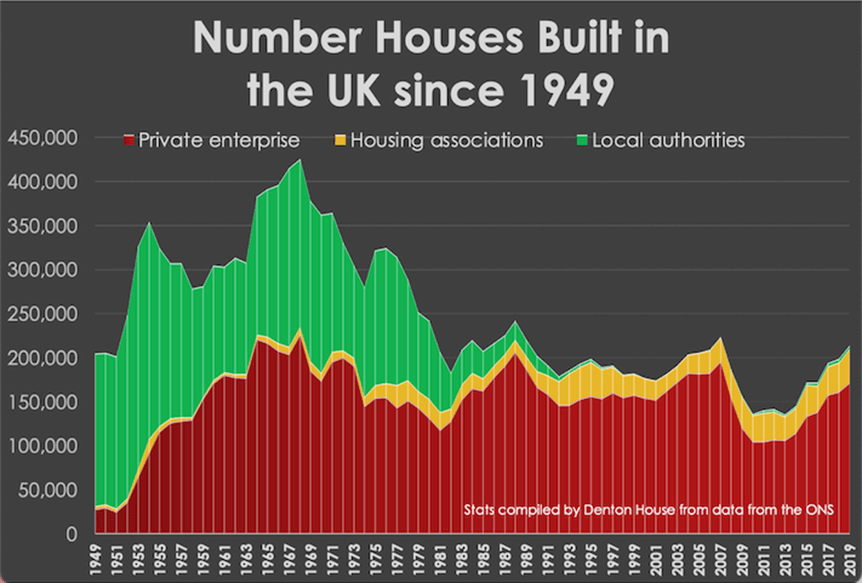
To give you an idea of how this a drop in the ocean, the Government sponsored the independent Barker Review of Housing Supply Report in 2004 which was tasked at looking at what could be done to level the playing field regarding the housing needs for the UK. The report found that the UK needed 240,000 homes to be built each year just to meet the demand of a growing and aging population. Since 2000, the average number of properties built in the UK each year has only been 177,975 per year. This means we have been around 62,000 homes short per year. Therefore, after 20 years of this annual shortfall we, as a country, have 1,240,500 too few homes – hence the massive uplift in house prices over the last two decades.
Therefore, one option that could resolve the housing crisis is if the Government literally looked closer to home, concentrating on matching households with the appropriately sized home … and this is what the government have shone a light on … people with too many spare bedrooms.

Is having a spare bedroom something that in this day and age is particularly wasteful? Well, let’s look at the numbers for Hayes.

4,108 Hayes homes have one spare bedroom.

Well, everyone in my opinion needs a spare bedroom, especially in the light of lockdown where many of us needed to work from home.

Ok, let’s see who has two or more spare bedrooms.

Of the 15,923 households in Hayes 2,617

have two or more spare bedrooms!

Of all the homes in Hayes, be they owned, privately rented or council house, 16.4% of Hayes homes have two or more spare bedrooms, compared to the national average 45.2%.

Breaking it down by ownership/tenure –

Of the 8,385 owned houses in Hayes, 2,054 have two or more spare bedrooms or as expressed as a percentage,

24.5% of Hayes owned homes have 2 or more spare bedrooms (compared to the national average of 53.9%).

Of the 3,682 council houses in Hayes, 285 have two or more spare bedrooms, or as expressed as a percentage,

7.7% of Hayes council homes have 2 or more spare bedrooms (compared to the national average of 11.6%).

Of the 3,856 private rented houses in Hayes, 278 have two or more spare bedrooms or as expressed as a percentage,

7.2% of Hayes private rented homes have 2 or more spare bedrooms (compared to the national average of 19.4%).

You can see there is the spare capacity in the Hayes housing market.

The Government hit the social housing sector with their ‘Bedroom tax’ in 2012, (also known as under occupancy charge or spare room subsidy) which meant that in council homes you would receive less in Housing Benefit or Housing Costs Element in a Universal Credit claim if you lived in a housing association or council property and were deemed to have one or more spare bedrooms.

Now it seems the Government have concentrated on the group that makes up the bulk of homeowners with spare bedrooms, the older owner occupiers of large properties, in their 60’s and 70’s, where the kids have flown the nest.

However, there are many explanations why these mature homeowners do not downsize. These people have lived in the same house for 30, 40 even 50 years, and as one matures in life, many people do not want to depart from what they see as the family home. Much time has been invested in making friends in their neighbourhood and it’s nice to have all those rooms in case every grandchild decided to visit, at the same time, and they brought their friends!  

But is that a selfish point of view? Are we addicted to our spare bedrooms?

Or should the Government keep its nose out of where people live?

I would ask if the ‘Minister of Superfluously Sizeable Houses’ should be kicking you out of the Hayes home you worked for and have spent much of your life in? And why is it assumed that retired homeowners want to downsize to small little bungalows and apartments? Many love their spacious living rooms and kitchens (which are typically found in bigger houses).

This Government is in a muddle about housing policy.

On one side of the coin, the Government announced an increase in the tax burden on the British public with a rise to its highest level since the early 1950’s to pay for care and the NHS, yet on the other side of the coin, recently cancelling vote losing policies, so that mature people going into care do not need to sell their homes (which if you think about it, they won’t live in anyway because they are going to long-term care). Whilst at the same time, to muddy the waters, they are suggesting to mature homeowners they have to move out of those same large homes to free it up for younger families?  If the Government don’t know what the answer is, who does?

The subject of downsizing is a delicate one to unravel.

We all know that mature homeowners, if they moved to a smaller Hayes home, would lose all the space they take for granted and would be unable to have the grandchildren over. Remaining in your large Hayes home is not greedy, it’s just the accepted human longing to enjoy a life after 50 plus years of working and paying your dues and taxes. You could say move to a managed retirement home? Yet many are very small and quite expensive.

I have spoken in previous articles in my blog on the Hayes property market that there aren’t enough bungalows being built either. And anyway, why should you have to relocate and wave goodbye to all your neighbours who have become friends and provide a support network?

There is a case made by some that mature downsizers could be given stamp duty tax breaks to get them to downsize, yet I am not sure how this could be policed, and it doesn’t solve the problem of increasing the overall supply of property in the UK.

The real issue isn’t spare bedrooms, it’s the need to change the planning rules to increase the number and type of new homes being built that will satisfy these mature homeowners with excess spare bedrooms to move into.

Big national builders have exploited ham-fisted planning rules since the 1980s, but no political party seems to have the answer. Housing Minister Chris Pincher might say he wants to persuade builders to build more suitable homes for mature people, yet his Government’s actions don’t seem to match his words.

In the Queen’s Speech this spring, the Government announced a proposed new planning system, which would create “simpler, faster procedures for producing local development plans, approving major schemes, assessing environmental impacts and negotiating affordable housing and infrastructure contributions”, or in layman’s terms, allowing more building to take place.

However, word coming out of Government is those plans could be cancelled following the Conservatives’ surprise defeat in the Chesham & Amersham by-election to the Liberal Democrats in the summer, which was blamed by some Conservative MPs on the new proposed planning laws.

So, whilst the Government decide what to do, what can mature Hayes homeowners do if they feel they do want to downsize?

The biggest fear many mature Hayes homeowners have is they will sell their large Hayes home but be unable to find anything to buy – thus making themselves homeless.

In this current Hayes housing market, the issue isn’t selling your Hayes home, but ensuring you find the right home to move into. Feel free to drop me a line to discuss how we can potentially sell your own Hayes property, tell the buyer to wait, then we will go and find a home for you to move into in your chosen area of Hayes.

Of course, all this takes time and patience, yet this is what old school estate agents did before the internet and the property portals. There is no extra charge for this and even if we find you a buyer, and for whatever reason the move doesn’t go ahead, there will be no charge. 

If you are a Hayes homeowner or landlord and think this may affect you – feel free to drop me a line.

In the meantime, what are your thoughts about excess ‘spare bedrooms’? Let me know in the comments.
Should Hayes Landlords Be Worried About These New Rental Regulations?

Everyone should be doing their bit to help reduce the UK’s carbon footprint on the globe – yet the question is, is that burden being put too much on the shoulders of Hayes landlords with potential bills of £7,600+ in the next four years?

The background – the UK has obligated itself to a legally binding target to be carbon neutral by 2050. One of the biggest producers of greenhouse gasses is residential homes.

To hit that carbon-neutral target (as one-fifth of the UK’s carbon output comes from residential property), every UK home will need to achieve a minimum grade of ‘C’ on their Energy Performance Certificate (EPC) by 2035. Each EPC has a rating between ‘A’ and ‘G’ – ‘A’ being the best energy rating and ‘G’ the worst – like an energy rating on a fridge or washing machine.

All UK rental properties have required an EPC. Yet, from April 2020, the Minimum Energy Efficiency Standards (MEES) regulations have required all private rental properties (including rental renewals) to have a minimum EPC rating of ‘E’ or above.

Yet new legislation being discussed by the Government’s Climate Change Committee has suggested that landlords should play their part and increase the energy efficiency of their private rented homes. Sounds fair until you dive into the details.

The Government is muting the idea that all new tenancies (i.e. when a new tenant moves in) in private rented properties should be at an EPC rating of ‘C’ or above by 2025 (and all existing tenancies by 2028). The issue is…

64.61% of all private rented properties in the Hillingdon Borough have an EPC rating of ‘D’ or below.

The problem is some Hayes landlords will find it very expensive, neigh impossible, to improve the energy efficiency of their Hayes rented properties, especially those Hayes landlords who hold older housing stock such as terraced properties built in the 1800s. These Victorian terraced houses never perform well on EPC ratings as they have solid walls.

Now, of course, you can improve the EPC rating of a terraced house by improving roof insulation, boiler replacement, solar heating, and high-grade uPVC windows. Yet, with some terraced houses, there will come the point where you will be unable to get to the haloed ‘C’ rating without installing external or internal wall insulation, sometimes even floor insulation.

With wall insulation costing between £5k and £15k and floor insulation around £5k…

the bill to improve all the Hillingdon Borough private rented

properties will be a minimum of £87,180,040.

But before I talk about what the options are for Hayes landlords, here’s the weird part of EPC’s. An EPC rating is calculated on the cost of running a property and not the carbon output or energy efficiency, despite its name.

My advice to Hayes landlords – although it’s correct to create a future strategy, all I can say at this point is ‘more haste less speed’. These rule changes are only a discussion paper, and it remains open for consultation by any member of the British public until 30th December 2021. That means the Government’s strategies and tactics may change.

Given that 57% of private rented properties are below a ‘C’ EPC grade, it is hard to believe the Government could achieve this without making big cash grants available.

For example, there is presently a cap of £3,500 for energy improvements that Hayes landlords have to spend to get it to the existing EPC ‘E’ target grade on private rented homes (i.e. if you have a privately rented home at an ‘F’ or ‘G’ EPC rating, you only need to spend a maximum of £3,500 as a landlord on improving your EPC rating and still being legal even if those £3,500 don’t get you to the current ‘E’ rating minimum). So, if the current rules allow an exemption to the EPC renting rules, if a Hayes landlord can’t improve their Hayes property enough, conceivably, could this be extended?

So, what are Hayes landlord’s options?

One thing you could do is put your head in the sand and hope it all goes away!

Another thing some savvy Hayes landlords do (be they my client, clients of other letting agents in Hayes or even self-managing landlords) is to sit down and plan a strategy for their Hayes rental portfolio. I print off all the EPCs of their rental portfolio, look at the recommendations, then discuss a plan to ensure they are covered whatever the Government decides to make the new EPC rules. Like all things in life, plan for the worse and hope for the best.

If your agent isn’t offering that service, please drop me a line because I would hate for you to miss out on the advice and opinion that so many Hayes landlords have already had from me. The choice is yours.

Hayes House Prices – The Effect of Rising Inflation

House prices tend to rise with inflation, so with UK annual inflation hitting 4.2% last week, that’s good news, isn’t it? Yes and no – let me explain what it means for Hayes homeowners.

The year-on-year cost of living rose by 4.2% in October, its highest rate in almost a decade. This jump in prices (inflation), pushed mainly by increasing fuel and energy costs, placing further pressure on Hayes household budgets.

So, what will this rise in inflation mean to Hayes house prices?

Let me look at the downsides first. The first is the effect inflation has on the true spending power or value of your hard-earned money.

The mid-1970s to mid-1980s was a time of high inflation in the UK, so I think that is an excellent place to start.

The average house in Hayes in 1974 was worth £17,472,

and by 1984 it had risen to £54,128

So, Hayes property prices had risen by 209.8% in the decade 1974 to 1984.

Good news for everyone, then?  Well, as always, the devil is in the detail.

Inflation over the same decade rose by 224.2%, meaning your Hayes house was worthless in real terms (i.e., spending power terms).

If that same Hayes home had gone up by the inflation rate seen between 1974 and 1984, the house would have been worth £56,651

in 1984

That doesn’t sound a lot (the difference between £54,128 and £56,651), until you apply that difference to today’s prices; that’s a loss of £18,188 in today’s money.

The second is the effect of interest rates.

When inflation rises, the usual weapon of choice to reduce inflation is to increase interest rates. Homebuyers tend not to borrow as much on their mortgage when borrowing money becomes more expensive due to higher interest rates.

When interest rates get high (they were over 15% in 1992) Hayes homebuyers may not even want to borrow any money at all (staying put in their existing home). This would mean fewer Hayes home buyers wanting to buy (decreased demand). However, at the same time, more Hayes houses would be coming onto the market (because existing Hayes homeowners would want to sell and downsize because they have high mortgage payments), meaning higher supply … low demand and high supply does drive house prices in a downward direction.

So, does that mean you should hold off buying a Hayes home?

Although Hayes house prices did not keep up fully with inflation in the late 1970s and early 1980s, they did a pretty good job (and much better than keeping money in a savings account). You must remember your house is not a pure investment, it’s a place you and your family live in. It’s a place you call home. So don’t worry if it doesn’t keep up with inflation in the medium term as your four walls offer a lot more than just a simple investment.

Ok, so let’s look at what does happen when inflation effects property.

When your Hayes house price rises because of inflation, it increases the value of your house, not by the cost/value of your deposit. So, if inflation increases the value of your Hayes home by, say half (50%), it may triple, quadruple, or even quintuple the value of your deposit/equity.

For example, if you buy a Hayes property for £500,000 with a £50,000 deposit and inflation increases the price/value by 50% to £750,000, that means your equity in the property quintuples from £50,000 to £300,000. It also means you go from (in this scenario) owning 10% equity (£50k of £500k) in your home to 40% after inflation (£300k of £750k).

Even better if you take out a fixed-rate mortgage because you would be making a fixed monthly mortgage payment that dropped in real spending power ‘inflation adjusted’ pounds over the time of the fixed rate. You might ask why? Well, you are paying less for the mortgage than you did when you took it out (i.e. inflation erodes the actual value of money, meaning your mortgage debt diminishes in real value terms in line with inflation).

So, holding off moving home could cost you a lot of money.

What does this all mean for existing Hayes homeowners?

It’s challenging to forecast with any certainty what will happen with UK inflation and interest rates. I believe we will see inflation hover between 3% and 5% in 2022, with it returning to more normal levels of around 2% in 2023 (although I am no economist!).

We know the Bank of England base rate is just 0.1%, meaning it’s unlikely to get any lower.  I have spoken about this in previous articles on the Hayes property market and said the money markets have already priced in an interest rate rise to 0.75% to 1% by the summer of 2022.

So, if you haven’t already, you need to seriously consider taking advantage of these low mortgage rates (can you believe 21% of Hayes homeowners aren’t on a fixed-rate mortgage). The bottom line is, irrespective of what is happening to inflation and Hayes house prices, being able to afford the monthly payments on your Hayes home is what counts for everyone.

Next, if you are worried about the spending power of the equity tied up in your Hayes home, you will have built up a decent buffer if you have been in your house, for example …

The average value of a Hayes house has risen by 13.3% in the last five years, yet inflation has only been 11.3%

This means the equity in ‘real spending power’ terms has increased by 2.0% in the last five years.

One final thought for any Hayes homeowners thinking of selling and not buying another home, inflation could eat into the real spending power terms of the equity of your Hayes home – so now might be the best time to sell to get maximum bang for your bucks. Then invest the money in other pure investments that consistently tend to beat inflation, such as gold, commodities, or Real Estate Investment Trusts? Again, I am giving you my opinion here, not financial advice. You must take independent advice from someone qualified in these matters and make your own decisions.

If you would like a chat about anything in this article, do drop me a line.

With Hayes Tenants Deposits Totalling £6,445,695, how will ‘Lifetime Deposits’ Change the Hayes Rental Market?

The Government’s scheduled publication of their White Paper for the Renter’s Reform Bill, which incorporates proposals to forbid Section 21 evictions and introduce ‘Lifetime Deposits’, has been suspended until 2022.

The additional time is required to give a chance to create a level playing field to reforms for both landlords and tenants in the private rented sector in England.

In this article, I want to look at these lifetime deposits. How could the Lifetime Deposit Scheme work, and how could they benefit both Hayes landlords and Hayes tenants?

When a tenant moves between rented homes, they need the deposit for their new home before being released from their old home.

The average deposit for a Hayes rented

home stands at £1,753.

This means finding that amount of money at the time of moving home can be difficult for many tenants; thus, they become stuck in their existing rental.

Therefore, Westminster wants to propose in this White Paper a new deposit choice for tenants. A deposit is transferred from the old landlord (letting agent) to the new landlord (letting agent), thus making life simpler as the tenant doesn’t need to save for an additional new deposit every time they move home.

Now, of course, it’s vital that any new ‘deposit scheme’ does not dissuade Hayes landlords from making valid claims for damage to properties. Landlords cannot be expected to give up their right of recourse to a security deposit until such time that they are satisfied there will be no need to claim it.  

So how would Lifetime Deposits work?

There would need to be some form of system safeguarding that the new Hayes landlord is protected by a whole deposit, even if the deposit on the old Hayes home comes into dispute.

This will be critical and central to Hayes landlords having conviction in the Lifetime Deposit Scheme. That could be something like an interest-free loan for the tenant on the crossover between the properties.

Another advantage to the scheme is that ‘lifetime deposits’ could be used for tenants to build a deposit for a house for the future.

What about the existing system of deposits?

The rules regarding the amount of deposit held by a Hayes landlord were changed a couple of years ago, where only five weeks’ worth of rent can be held as a deposit.

The deposits Hayes tenants have had to save for certainly raises the cost of renting a Hayes home.

Some say this extra burden puts another nail in the coffin of the dream of homeownership for many Hayes renters. To give you an idea of the level of deposits held for Hayes rental properties…

The total of all the tenants’

deposits in Hayes is £6,445,695.

Yet the other side of the argument contends that if the Hayes tenant misses more than one month’s worth of rent, the landlord is immediately out of pocket, even before they’ve got the costs of solicitor and any improvement works from the tenant trashing the place.

Does a deposit of just over one month provide Hayes landlords with a decent level of protection against unpaid rent or damage to the property? When you consider…

The total value of all the privately rented properties

in Hayes is £1,408,537,914.

Before I conclude my thoughts to the initial question of ‘lifetime deposits’, the need for decent landlord insurance to ensure you are adequately covered as a Hayes landlord is vital.

So, what are my thoughts on ‘Lifetime Deposits’?

It is my opinion the common need for Hayes tenants to stump up a ‘two-fold deposit’ is not helping many Hayes renters when it comes to moving home. It’s clear the standard cash down deposit is not fit for purpose for the 21st Century.

One might suggest the Government’s quest for the ‘lifetime deposit’ could open the door to other deposit alternatives that have come onto the market for tenants in the last few years.

Some landlords don’t require a deposit yet are compensated by asking the tenant to pay a higher rent to cover the risk. Also, there are companies that offer insurance backed deposits where the tenant pays one week’s rent to an insurance firm, and the insurance firm pays out if a loss is incurred by the landlord.

Interestingly, other countries are already offering deposit loans and guarantee schemes. Could this be something for the British Government to contemplate?

We must wait until at least the spring of 2022 for the Renter’s Reform White Paper to be published. Then every stakeholder involved (tenants, landlords and agents, et cetera) can look at it in the cold light of day and decide how this will affect the way they view the landlord/tenant/agent relationship.

Many will say the bigger issue isn’t ‘Lifetime Deposits’ in the White Paper, but the removal of no-fault Section 21 evictions. The removal of Section 21 is something the current Government have pledged to bring in during this parliamentary cycle (i.e. before Q4 2024). 

I am not concerned about removing no-fault Section 21 evictions, but what will replace it to ensure there is suitable redress for landlords if the tenant doesn’t pay the rent?

Of course, a handful of Hayes landlords will decide to sell their rental portfolio because of the White Paper. The same happened in 2016 when the increase in landlord taxes were announced. 

However, this will reduce the supply and availability of Hayes rental properties, meaning rents will rise (classic textbook supply and demand), thus, landlords return and yields will rise.

Yet, because tenants still can’t afford to save the deposit for a home and we are all living longer, the demand for rental properties across Hayes will continue to grow in the next twenty to thirty years. The reason being we are still not building enough homes to accommodate our growing and ageing population. This means we will turn to more European ways where the norm is to rent rather than buy in their 20s and 30’s.

This means new buy-to-let landlords will be attracted into the market, buy properties for the rental market in Hayes and enjoy those higher yields and returns. Isn’t it interesting that things mostly always go full circle?

Is the Hayes Property Market Running Out of Steam?

In recent articles on the Hayes property market, I have been talking a lot about house prices over the last 12 months and 5 years in Hayes.  

When it comes to newspapers talking about the property market, the headline most people look at is what is happening to house prices.

However, as 2 in 3 (65.1%) of Hayes home sellers are also home buyers, the price is almost irrelevant. Let me explain.

If your property has gone down in value – the one you want to buy has also gone down in value – so you are no better or worse off (and if you are moving up market – which most people do when they move home – in a suppressed property market the gap between what yours is worth and what you will buy gets lower … meaning you will be better off).

Many property commentators (including myself) consider a better measure of the health of the property market is the transaction numbers (i.e. the number of people selling and buying).

Let’s take a look at the numbers for Hillingdon Borough as a whole (including Hayes).

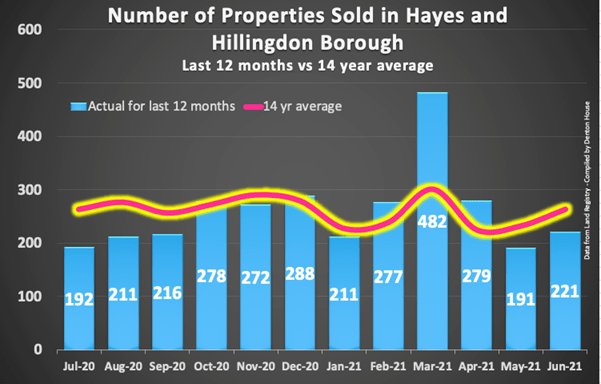
The average number of properties sold in Q1 (Jan/Feb/March) between 2008 and 2020 was 251 properties per month, whilst Q1 in 2021 saw 323 properties sell on average per month (boosted by the March stats where an eye watering 482 homes sold). This meant …

29.1% more houses sold in the Hayes area in Q1 2021

than the 14-year average

The average number of properties in Q2 (April/May/June) between 2008 and 2020 was 241 properties per month, whilst Q2 in 2021 saw 230 properties sell on average per month, meaning …

4.4% less houses sold in the Hayes area in Q2 2021

than the 14-year average

Finally, whilst the exact stats for Q3 2021 for our local authority won’t be published by the Land Registry for a couple of months, I can make certain calculated assumptions from the national data published by HMRC. The number of property sales for our local authority area in Q3 (July/August/September) between 2008 and 2020 was on average 286 properties per month. However, using the HMRC data, I calculate there will only be 212 properties sold on average per month in Q3 2021. This means …

25.9% less houses sold in the Hayes area in Q3 2021

than the 14-year average

I wanted to then look at the month-by-month statistics for our local authority for the last 12 months (up to June 2021). As you can see, there have been some interesting months in terms of housing transactions 

One of the two main drivers of activity in the housing market in the latter half of 2020 (meaning Q1 figures were better than the long-term average) was the battle for space, with many Hayes buyers seeking larger properties to work from home. The second was the short-lived tax relief measures such as the cut to Stamp Duty Tax meaning property prices were at an all-time high.

But what also might surprise you is the number of people buying for the first time.

1 in 4 mortgages since lockdown have been

for first-time buyers (25.12%)

Hayes first-time buyers, buoyed by parental help with their deposits, the Government’s 5% deposit mortgage and ultra-low borrowing costs, have also helped to push house price growth since the start of 2021. In fact, if you split down house price growth between second time (third time etc) buyers and first-time buyers, the national annual house price inflation for first-time buyers is 9.2% compared to 8.1% for the second or third etc buyers. 

Yet, the Q3 2021 Hayes property market was worse than the long-term Hayes average (in terms of property transactions)

The question is – should we be worried?

The UK economy continues to deliver a benevolent framework to the British housing market. 

The labour market has outstripped expectations with the millions expected to join the dole queue at the end of furlough failing to materialise and with the number of job vacancies on the rise.

Of course (and I mentioned a lot in my recent posts), the Bank of England is projected to increase interest rates to dampen inflation in the coming months, with further small rises predicted over 2022, so I do expect the demand for property to cool off as mortgage borrowing costs increase. 

Normally such rises in mortgage costs would mean less property would sell, yet nothing over the last couple of years has been normal.

Many Hayes property homeowners have held back putting their property on the market in the last 6 months because they were afraid, they would sell their own home but not find another to buy – thus making them homeless (nothing could be further from the truth – yet that is what a lot of people incorrectly believe).

If the Hayes property market slows and interest rates rise, mortgage costs will still be very low by historical standards.

Also, if the obstacle of raising the 5% deposit can be overcome by first-time buyers plus a confidence that existing homeowners won’t be made homeless because of a cooling property market, many more people could be tempted to enter the property market by placing their property for sale first …

… thus opening up the market to more buyers – which in turn will drive up transaction numbers back to their normal 14-year average. However, raising a deposit is likely to remain the primary obstacle for many.

If you are a Hayes homeowner or first-time buyer and want my thoughts on the future, then please do drop me a line.

2022 is going to be an interesting year ahead for the Hayes property market – only time will tell if this will be a brief respite or is it running out of steam?

Please tell me your thoughts on what you think will happen.