Is your Hayes home bigger than 936 sq ft?

Hayes homeowners – do you know how big your Hayes home is?

What is the square footage of your Hayes home?

Don’t worry, most of us don’t – yet it could be fundamental as Hayes home buyers search for new homes.

Us Brits are obsessed with our homes, yet most Hayes homeowners need to learn the square footage (those born after the mid-1970s) or square metre(age) of their homes.

As an agent, I find homebuyers usually assess the size of their intended house purchase chiefly by the number of bedrooms the property offers. However, could we all make more effort to calculate how much actual space we require in the home outside the number of bedrooms?

Let me see how the properties locally are split down regarding bedrooms.

The split of bedrooms in Hillingdon is as follows:

  • 14.9% of properties have one bedroom compared to the national average of 10.7%
  • 28.2% of properties have two bedrooms compared to the national average of 26.7%
  • 37.8% of properties have three bedrooms compared to the national average of 40.6%
  • 19.1% of properties have four or more bedrooms compared to the national average of 22.0%

As one would expect for our location in the UK, we have a higher number of 2 and 3-bedroom homes in our locality.

So, are more bedrooms better? Not necessarily.

Unless you are buying a Hayes property to develop and then sell on straightaway, I believe it is imperative to enjoy your property for what it was designed to be – your home.

Though room for growth and resale ability potential of the house purchase is vital, the manner of the way you and your family live and how you use your home must be the primary consideration for improving your quality of life. And because of this …

I have noticed a slight change in how Hayes buyers (and tenants) have been asking and enquiring about property in the last 18 months.

The first is asking for a property’s energy efficiency rating. This can be seen on the property’s Energy Performance Certificate (EPC). That was expected, with the rise in gas and electric bills.

Yet the second is that more and more Hayes tenants and buyers are asking about the size of the property, which can be found in the EPC mentioned above.

Talk in the property industry suggests a move towards home movers wanting homes with minimum square footage instead of a property with a particular number of bedrooms.

I am noticing mature Hayes homeowners who are downsizing are asking for the size of a property, as they require fewer yet large rooms.

Should we all consider how we use our space in our Hayes homes before we decide to move? Before we do, let me look at the average sizes of the properties locally.

These are the averages for the Hillingdon area:

  • The average size of a house is 1,044 sq. ft. compared to the national average of 1,103 sq. ft.
  • The average size of a bungalow is 872 sq. ft. compared to the national average of 862 sq. ft.
  • The average size of a flat/apartment is 430 sq. ft. compared to the national average of 464 sq. ft.
  • The average size of a maisonette is 581 sq. ft. compared to the national average of 657 sq. ft.
  • The overall average is 936 sq. ft. compared to the national average of 994 sq. ft.

Again, as I would expect due to our location, the average home is slightly smaller than the national average.

In the last few years, with lockdowns, as a nation, we have started to use our homes differently.

Rooms in our homes have become interchangeable – having more bedrooms isn’t automatically the status symbol it once probably was.

Spare bedrooms have become offices, dining rooms have become gyms, and so on.

Are you willing to sacrifice living room space for an extra bedroom, even if it makes the living room feel cramped and uncomfortable?

Before selecting a home based solely on the number of bedrooms it offers, there are several factors to consider.

Evaluate your current living space and how you use it.

Determine if you utilise all the rooms to the best of the space available, if you have enough storage, and if the layout works for you. If you value space and openness, prioritise square footage instead of bedrooms.

Consider your current life stage and living space needs. If you have a family, bedrooms may be a priority, but assessing how many are needed is essential. It would help if you also considered whether you need a separate space for work or a top-of-the-range ensuite.

If you plan to rent out your Hayes property, the number of bedrooms is crucial.

However, it is essential to consider the type of Hayes tenant you want to attract and what type of space would be most marketable.

Instead of moving to a new Hayes home, renovating your current space might be a better option?

By reconfiguring the space or extending it, you could improve your quality of life or increase the value of your Hayes property. A home makeover could give you the open space or environment you desire?

By answering these questions, you can determine whether the number of bedrooms, other rooms, or square footage is the most crucial factor when selecting a new home.

What do you think?

Before I go, if you are a Hayes homeowner or property buyer and you want to pick my brains on your best options, please don’t hesitate to pick up the phone or drop me a line and we can start a discussion without any obligation or cost.

50% of Hayes house sellers in 2022 had only been in their home on average 11 years and 37 weeks

The share of Brits moving each year has been declining since the late 1980s (when at one stage, people moved every eight years), yet since the pandemic’s beginning, something has appeared to upset that trend.

Newspaper stories and social media posts painted a picture of homeowners moving from the city centres to its suburbs, from the suburbs to the towns and countryside around the UK. Areas like the Cotswolds and coastal towns around the country got swamped by the ‘race for space’, significantly affecting housing markets (including Hayes).

But how many Brits moved? And how long had they been in their homes before they moved?

In Great Britain, there are 28.3 million households, of which 19.3 million are owner-occupied and 4.43m owned by private buy-to-let landlords.

There is £7,035 trillion of residential property in private hands.

Eight years before the initial lockdown in 2020, an average of 79,646 properties were sold each month in the UK, meaning just under a million UK households move home annually.

Therefore, in those 8 years, the average British homeowner

moved every 20 years and 4 months.

So, what uplift was there in people moving home after the first lockdown in 2020?

In 2021 and early 2022, an average of 102,021 people moved home monthly, taking the average move time to once every 16 years. So even though there was an uplift in people moving home, it was nothing like the 1980s.

It shows that in the 21st Century, once you have succeeded in buying a property you can call home, there isn’t much enthusiasm to move again.

What is happening in the Hayes property market now?

We love our homes in Hayes, but most of you (including myself) still want to ‘better our lives’ with a larger house, better area etc., which typically requires us to climb up the Hayes property ladder.

Yet, with Hayes house prices having risen by 421.5% in the last 25 years, the cost of going up the next rung on the Hayes property ladder has become prohibitive.

Everyone remembers back to the 1980s, when we had an upbeat booming property market as a backdrop, and British homeowners moved home every eight years; so now, with the average move time in the mid to late teens (in years), this equates to each homeowner only moving around three to four times in their adult lifetime.

Or could it be something else?

We all know the phrase, “lies, damn lies and statistics”.

The home moving statistics above hide some great details about the British property market.

When British homeowners get into their 50s, 60s and beyond, their inclination to move home drops like the proverbial stone.

The average time a homeowner without a mortgage moves home is 24 years and 27 weeks (and just over 7 out of 10 outright homeowners, i.e. without a mortgage, are 65 or older). 

Homeowners with a mortgage tend to be younger to middle-aged.

Homeowners with a mortgage move on average

every 10 years and 11 weeks.

So, whilst I cannot determine which house seller has a mortgage and which doesn’t, I can look at how quickly people move home in Hayes. 

Therefore, I have taken a look at the last 50 property sales in Hayes and found some interesting results.

The average Hayes homeowner had only been in

their home on average 18 years and 34 weeks before they sold.

Yet the devil is in the detail.

There appears to be a two-speed Hayes property market …

50% of Hayes house sellers in 2022 had

only been in their old home on average 11 years and 37 weeks.

Then, let’s split the findings into quarters.

  • Top 25% fastest Hayes homeowners in 2022 moved on average after 7 years & 0 weeks
  • The following 25% of fastest Hayes homeowners in 2022 moved on average after 16 years & 3 weeks
  • The next 25% of Hayes homeowners in 2022 moved on average after 23 years & 17 weeks
  • Whilst the 25% slowest Hayes homeowners in 2022 moved on average after 27 years & 36 weeks

When looking at the properties that fall into the slower time bands (i.e. the ones that don’t move/sell so often), they tend to be the larger properties where the homeowners have lived often for 30 or 40 years.

Maybe, the one lesson from these statistics is that once homeowners get into their 60’s and 70’s, their tendency and inclination to move home declines significantly.

This means the homes on the lower rungs of the Hayes property ladder are selling quickly (as younger aged homeowners occupy them) … yet once Hayes people tend to get older, their tendency to move diminishes.

This obstructs the younger generation of Hayes homeowners from wanting to buy the bigger Hayes properties these mature Hayes homeowners live in.

What is holding the older generation back from selling and downsizing to free up family homes for families that desperately need them? Some will be apathy, and some will be wanting to hold on to the homes they brought their families up in, yet the bottom line is …

as a country, we must reconsider how we can encourage (not force) older homeowners to sell their large homes to release them to the younger families that desperately need them.

Some recent articles I have written suggested tax breaks, yet the government doesn’t have the money to give massive tax breaks.

One thing I do know we, as a country, have seen (and will continue to see) a lot of demographic change together with an increasingly ageing population, so it’s not just about how many households we build but whether we are constructing the right kind of homes for the older generation?

Thought-provoking times are ahead for the Hayes property market!

If you have a Hayes property to sell in the coming months or years and want to know how this and other factors will affect you and your property … without obligation, don’t hesitate to call me.

Is Buy-to-Let in Hayes Still Worth the Risk?

Over the last five years, life has become a little trickier for Hayes landlords, with changes to their taxation status, mortgage interest relief and an additional 3% stamp duty for a buy-to-let property and has made lots of Hayes landlords ask themselves:

‘Is buy-to-let in Hayes still worth the risk?’

Regarding taxation, in 2016, the Government added a 3% supplement in stamp duty on all buy-to-let properties. Then, in 2017, the Government started to reduce mortgage interest by stopping landlords from deducting the interest they paid on their mortgage before paying tax on the rental profits and replacing it with a flat rate tax credit based on 20% of the interest they spent on their mortgage.

There would be no effect if a Hayes landlord were a basic rate 20% taxpayer. Yet Hayes landlords who were higher-rate (40%) or top-rate taxpayers (45%) saw an effect as their tax relief was cut in half.

So, is buy-to-let in Hayes still an advisable investment?

The response to this question is much more significant than the issue of taxation.

To a large degree, as with all investments, it depends on why you are investing and what your final objective is. Let me expand.

The rewards of Hayes buy-to-let.

You can earn money two ways with buy-to-let.

The first is the rental income from the property.

The average rent achieved in Hayes is £1,507 pcm,

a rise of 14.4% in the last 12 months.

This rent is expressed as a yield and is described as a percentage figure that’s calculated using the annual rental income and dividing it by the value of the buy-to-let property.

Landlords and buy-to-let investors use rental yield to judge and measure the value of their rental investments and portfolios. E.g., rent is £1,000 per calendar month (pcm), which means the annual rent is 12 x £1,000 = £12,000. If the property is worth £180,000, the rental yield is £12,000 divided by £180,000, which, when expressed as a yield percentage, is 6.67%.

The average yield in Hayes is 4.3%.

Some areas in Hayes can easily achieve a 5.8% to 7.3% yield, sometimes even more, depending on your choice of property and type of tenancy you wish to have.

If yield is your number one focus, the highest average yield in the UK can be found in Bradford City Centre, where it is 12%, Hyson Green and Radford in Nottingham at 9.6% and Pontypridd at 8.7%, while other areas in the UK can be as low as 2.2%.

So indeed, is the best strategy to go for high-yielding properties?

The problem with pursuing high-yielding Hayes buy-to-let properties is that you usually must compromise on the property’s capital growth to attain that high yield.

The second way to earn money with buy-to-let is capital growth as your Hayes property increases in value.

UB3 property values are 15% higher than 3 years ago.

A reasonable return in anyone’s books.

Of course, this all depends on the rent coming in, yet you can buy landlord insurance to cover against loss of rental income, tenant damage and legal costs.

Interestingly, using Government data and Industry data, Denton House Research has found that in the first lockdown landlords who managed their rental properties themselves were 272.5% more likely to be in arrears of 2 months or more (compared to those who utilised the services of a letting agent to manage their property).

The drawbacks of Hayes buy-to-let.

Your tax bill is higher today than a few years ago, but isn’t everyone’s?

If Hayes property prices fall, the capital you invested will reduce, yet if it sat in the bank, it would decline in value anyway.

Being a landlord is a big responsibility, with over 170 pieces of legislation and orders to comply with. That’s where a suitable letting agent can help you with your rental property to ensure you remain compliant.

I recommend Hayes landlords consider all options to maximise their rental income whilst reducing their outgoings concerning their rental property.

Rents are rising in Hayes (as mentioned above), and many Hayes landlords appreciate the demand-led increases in their rent. And let me ask you, why shouldn’t they, as they have been exposed to many legislative and taxation changes over the last five years?

Ok, last point and the elephant in the room.

Will there be a house price crash, and should Hayes landlords wait for it?

A house price crash conjures up a big event that makes house prices go down, and it certainly happened like that in 1988 with the removal of dual-MIRAS tax relief on mortgages and the Credit Crunch in 2008. Yet this time, it’s different.

As there is more normality and balance in the Hayes property market at the moment (compared to 2021/early 2022), the price that is being paid today on most houses in Hayes is not as extreme or as extravagant as what was being paid in 2021/early2022 (when people were outbidding each other).

Therefore, if you were to look at the house price indexes going into the spring and summer of 2023, then there will be a reduction. The doom-mongers and newspaper editors will call that a house price crash, yet I see it as the market easing back to normality.

A massive driver behind landlords and home buyers ‘waiting for a house price crash’ is that they fear they have ‘missed the boat’ when it comes to buying/investing.

There is always newspaper (and now social media) attention when house prices explode. This means people quickly feel pressure to enter the ‘property market’, as everyone is making money, yet they aren’t.

The problem is that during the previous boom phases (the late 1980s and early/mid-2000s), house prices increased quicker than some people could save money for their deposit (for a house purchase). They saw their friends and acquaintances snapping up buy-to-let deals and they were missing out on the spoils of house price growth. As a result, many of these excluded house buyers judged that a house price correction was foreseeable, inevitable, and sometimes even needed. Not with any rational economic argument, but classic FOMO (Fear of Missing Out).

Yet a ‘house price crash’ isn’t the silver bullet

that many think it will be.

‘House price crashes’ virtually never drop house prices to reasonable levels, and in fact, they have a lot of additional effects that make house buying even harder.

Investing in buy-to-let is a long-term investment. Remember what I said at the start. It would help if you decided why you’re getting into buy-to-let investment and when you will get out (and what you want to get out of it). Buy-to-let has advantages and disadvantages, but it is something tangible and something that investors can understand.

The UK needs to build more houses, so the demand for rental properties will only continue to grow.

The heady days of the early 2000s, when anybody could make money from any property, though, have gone. With increased legislation and taxation, you need the advice of a great agent to guide you on what to buy (and not to buy) for an excellent yield, incredible capital growth or a balance of the two. That agent should be able to find you a great tenant who will pay the rent on time and look after the property to ensure that when they leave, your investment is returned to you in the best condition possible.

If you would like to pick my brain, whether you are considering becoming a landlord in Hayes, an existing landlord (irrespective of which agent you use) or even a self-managed landlord, do not hesitate to pick up the phone to me.

I will tell you what you need to hear, not necessarily what you want to hear.

Thatcher’s Dream Smashed as Home ownership in Hayes Drops

In her first conference speech as the Tory’s new leader in 1975, the grocer’s daughter from Grantham, Margaret Thatcher, asserted her conviction in a ‘property-owning democracy’.

Although Thatcher didn’t conceive the saying – (that credit belonged to Conservative MP Noel Skelton in 1923), it encapsulated what she thought Britain should be.

Through prudence, saving and hard work, she believed that everyday British families should be able to purchase their own homes. Thus giving them security, self-esteem and independence and freeing them from the nanny state of local authority landlords.

Although that idea was a Labour idea initially in the mid-1970s, Margaret Thatcher introduced legislation (Right-To-Buy) in 1980 to allow local authority tenants to buy their own council homes at significant discounts. In the 1980s, homeownership boomed (although it had been on the increase for the previous two decades), and she led the country in economy with which house buying became a national passion.

Between 1981 and 1990, home ownership went up

from 11.88m to 15.47m.

The other lesser-known fact of the Right-to-Buy legislation in 1980 was it stopped local authorities from building new council houses.

Fundamental to her idea was that government (central or local), which had built between 30% and 45% of all homes in the 1950s, 60s and 70s, should stop providing homes and let the market provide them.

The proportion of homes owned rose from 55.4% in 1980

to 65.7% during Thatcher’s reign as PM.

A few days ago, the housing element of the 2021 Census was released, and it has shown the proportion of home ownership had fallen to its lowest level since 1985. 

The proportion of households owned in the country fell from 64.1% to 62.5% between 2011 and 2021, the lowest level for the past 37 years, when the figure was 61.6%.

In the meantime, the proportion of privately rented households has surged to its highest since the late 1960s, with 20.4% of households renting from a private buy-to-let landlord.

This means the proportion of British households in private rented accommodation has more than doubled in the past two decades, from the 9.5% recorded in the 2001 census.

So, let’s look at the local stats for the Hillingdon council area.

The percentage of households owned in Hillingdon has

dropped from 62.9% in 2011 to 57.8% in 2021.

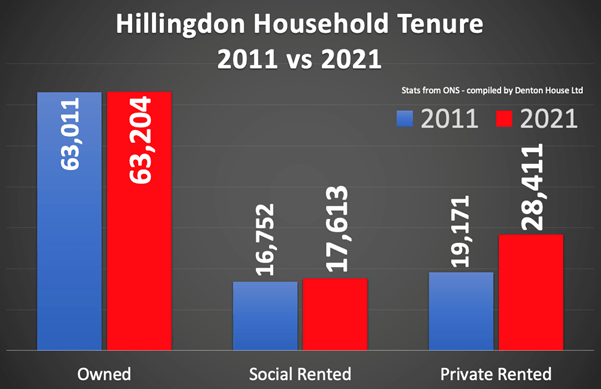
But would it surprise you to know that even though the percentage/proportion of homeownership has dropped, the actual number of households owned has increased!

The number of owned households in Hillingdon has grown slightly from 63,011 in 2011 to 63,204 in 2021, a rise of 0.3%.

So, what explains the contradiction of reducing homeownership, yet the number of households owned has increased?

One simple reason – the number of privately rented accommodation has grown even more!

The number of privately rented households in Hillingdon has grown from 19,171 in 2011 to 28,411 in 2021, a rise of 48.2%.

Over the coming weeks and months, I intend to drill down further into these stats nationally and locally.

Even though homeownership has increased in terms of pure numbers, the proportion of homeowners with a mortgage has dropped.

Just some headlines to whet your appetite.

As I said above, 64.1% of householders in Britain owned their own home in 2021 (of which 30.8% owned their home outright and 33.3% with a mortgage).

In 2021, of the 62.5% of homeowner households, those without a mortgage has increased to 32.8%, and those with a mortgage has dropped to 29.7%.

So, has Thatcher’s dream been smashed?

Of course, nationally, home ownership is at the lowest level in many decades due to several factors, including the late 1980s and 2008 housing crash, negative equity, the credit crunch and increased mortgage regulation. 

Yet, at the same time, as every single local authority in Britain has seen an increase in the number and proportion of private renters over the past 20 years, the entrepreneurial property-owning spirit has moved into the ownership of private buy-to-let property. The market has undoubtedly filled the housing gap that the councils and local authorities left in the 1980s.

These are interesting times, and I shall share more insights in the coming weeks and months.

Let me know your thoughts on the information above.

Hayes Property Market Holding Up Despite Doom and Gloom in the Newspapers

The Hayes housing market over the last three months is now becoming more ‘normal’ after the last couple of years of insane demand when the lockdowns started a race for space!

Even with the blackening economic doom-mongers forecasting a harsh slowdown in the British property market, the number of people buying and selling their homes is still very good for the time of year.

Whilst many homeowners are reducing their asking prices, it is not the 20% (some even said 30%) drop some property commentators and newspaper journalists had predicted.

Looking at the stats for Hayes for the last three months since the disastrous Truss mini budget – they make good reading.

Of the 117 Hayes (UB3) properties that have sold (stc) since late September, the average length of time it took to achieve a sale was 69 days.

Interesting when you split it down by price, in Hayes:

  • Under £100k – 780 days
  • £100k to £200k – 45 days
  • £200k to £300k – 80 days
  • £300k to £400k – 42 days
  • £400k to £500k – 70 days
  • £500k to £1m – 70 days
  • £1m and above – 22 days

And by type:

  • Hayes Apartment/Flat – 69 days
  • Hayes Terraced/Townhouse – 94 days
  • Hayes Semi-Detached – 71 days
  • Hayes Detached – 21 days

The latest sold price data from the Land Registry shows that Hayes house prices currently remain 10.4% higher than they were 12 months ago.

With interest rates at 3.5% and further increases likely in 2023, that will undoubtedly spur ongoing cooling in Hayes property values yet it’s doubtful we will see the Hayes property market go into the deep freeze that many doom-mongers were predicting.

As I said in recent articles on the Hayes property market, we will see a 5% to 10% reduction in Hayes house prices over the next 12 to 18 months.

That will only take us back to the prices achieved in mid/late 2021 or early 2022 (depending on the property type).

Landlords have experienced double-digit rent growth in the last 12/18 months with a shortage of rental properties coming onto the market. I cannot see this changing in the short term, so I expect rents to be a further 10% higher by Christmas 2023.

Last week I stated it is not always wise to only focus on house prices but also take reference from the number of property transactions completed that feed the fire of the British property market.

For example, in March 2021, 135,670 properties sold, yet a month later, it dropped to 87,600. A couple of months later, it rose again in June 2021 to 165,290 homes sold (for it to drop to 64,000 in July).

Whilst this is good news for estate agents and removals companies, it can skew the property market and put undue pressure on the property market (pressure which could cause a housing crash if not put under check).

Like most things – slow, steady and consistent is the preferred option for the property market.    Throughout 2022, the number of properties selling in the UK has been a steady average of 68,832 per month, ranging from a low of 61,800 in January 2022 to 72,200 in July 2022.

This consistency will continue into 2023 and a return to a more ‘normal’ housing market.

One final thing I have noticed about the Hayes property market in the last six months is the number of larger properties coming onto the market that last sold over 25 years ago.

Homeowners in their 20s, 30s and early 40s tend to move every five or six years, yet when they reach their late 40s and 50s, they tend to stay put for longer. These properties only tend to come on the market when people pass away or must be sold for nursing home fees.

These mature homeowners are downsizing for several reasons. Their children have flown the nest and they’re rattling around in homes with accommodation they don’t need. Many are being driven to sell their large homes in light of mounting energy bills, high inflation and never-ending maintenance costs that larger properties demand.

The second reason is that the recent rises in Hayes house prices has meant the money released to downsize has grown, meaning if these mature homeowners sell up and cash in to more manageable properties, the amount of money released is quite impressive.

In conclusion, 2023 is going to be a more ‘normal’ year, akin to the 2016 to 2019 years. Hayes homeowners need to be realistic with their pricing, yet as over eight out of ten sellers buy another home, the one you buy will be lower.

If you are considering selling your Hayes home in 2023 and would like a chat about your options, feel free to drop me a line or call the office.